Culture
Entertainment Prediction Markets 2026: How They Work
How entertainment prediction markets work in 2026: how Oscars, Emmys, box office and Netflix contracts are priced, resolved, and where odds mislead you.
Keyword
entertainment prediction markets
US volume
0
Difficulty
0

ScreenOdds editorial image generated with Kie.ai / ChatGPT Image 2.
Key takeaways
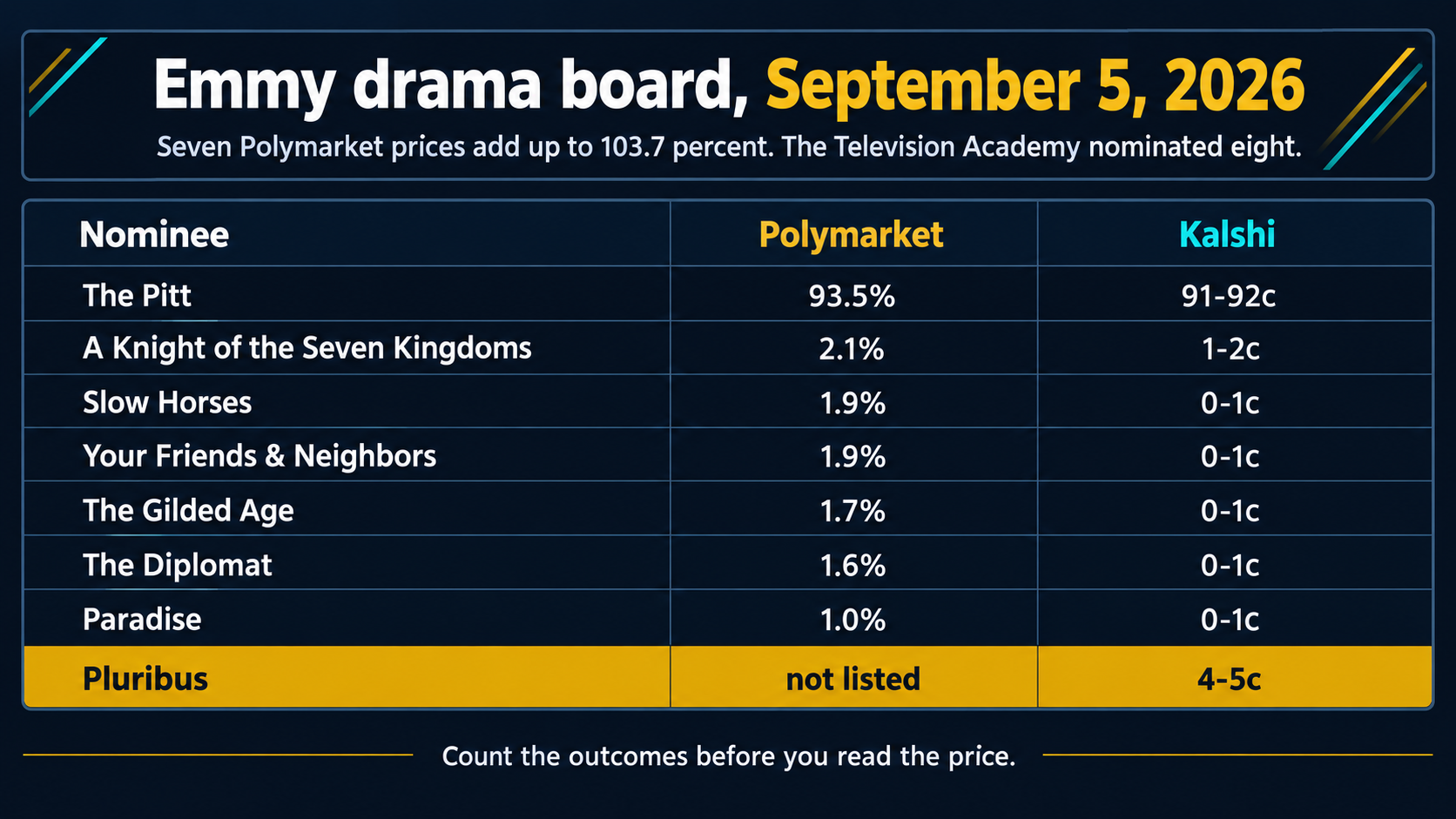
Polymarket's Outstanding Drama Series board prices seven contenders. The Television Academy nominated eight. Pluribus is missing from Polymarket entirely, while Kalshi quotes it at 4 to 5 cents.
Those seven Polymarket prices add up to 103.7 percent. Roughly 3.7 points of that board is spread and fee drag, not probability, and it is sitting on top of an incomplete outcome set.
The two venues agree more than they disagree on the favorites: The Pitt is 93.5 percent on Polymarket against a 91 to 92 cent quote on Kalshi, and Widow's Bay is 66.0 percent against 67 to 69 cents.
Box office contracts do not resolve on narrative. The current By Any Means market settles on The Numbers' final three-day figures, and a result landing exactly on a bracket boundary resolves to the higher bracket.
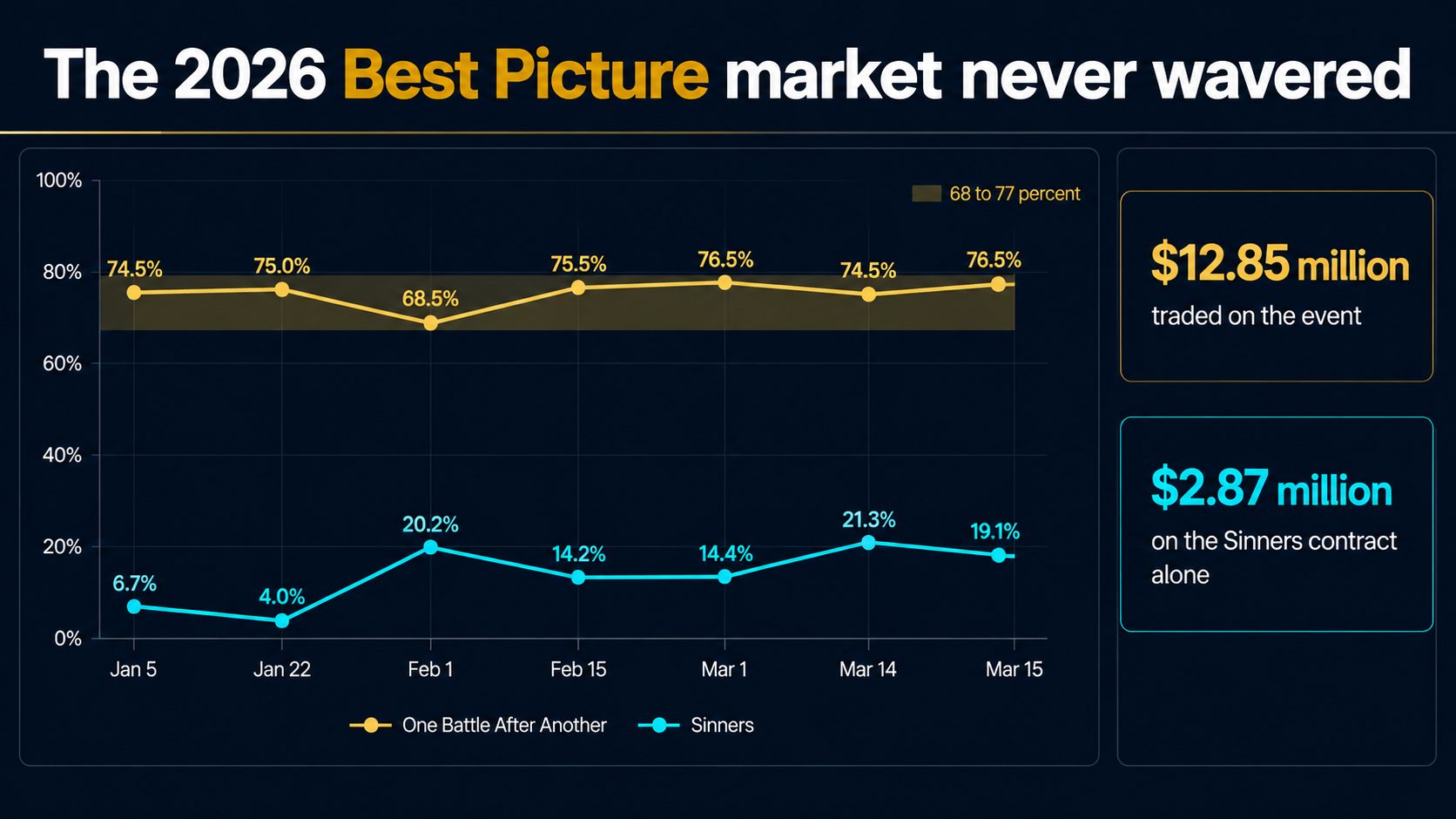
The 2026 Best Picture market barely moved all season. One Battle After Another traded between 68 and 77 percent from early January to the ceremony and won, while Sinners peaked near 22 percent despite a record 16 nominations. That single event turned over 12.85 million dollars.
Every number in this guide was pulled on September 5, 2026 from the Polymarket Gamma and CLOB endpoints and Kalshi's public market API, then checked against the Television Academy nominee list.
What an entertainment prediction market actually is
Most entertainment odds coverage tells you a show is the favorite without telling you what the number means, who set it, or what has to happen for it to pay. That vagueness costs you money and time: this week the same Emmy category is quoted at 93.5 percent on one venue and 91 cents on another, and one of those two boards is missing a nominee the Television Academy actually nominated. Entertainment prediction markets are readable once you know which three things to check, and this guide walks through all three using the live Emmys, box office and Netflix boards as worked examples. We pulled every figure here ourselves rather than repeating a press release.
A prediction market contract is a claim on a specific, verifiable outcome. You buy a share in Yes or No at some price between zero and one dollar, and when the event resolves the winning side pays one dollar per share. If The Pitt trades at 93.5 cents, the market is saying it thinks The Pitt wins Outstanding Drama Series about 93.5 percent of the time, and you are risking 93.5 cents to make 6.5.
That is the whole mechanic. Everything else that makes these markets interesting comes from the details around it: who is allowed to trade, what document decides the winner, how much money is actually sitting in the order book, and whether the list of outcomes on the screen matches the list of outcomes in the real world.
Entertainment is a good category for this format because the resolution events are scheduled and public. An awards ceremony has a date. A box office weekend has a closing figure. A streaming chart updates on a fixed day. Compare that with a market on a vague corporate rumor, where nobody can agree on what counts as the event happening, and you can see why Oscars, Emmys, box office and Netflix charts have become the busiest entertainment boards on both venues.
Why the Emmy drama board adds up to 103.7 percent
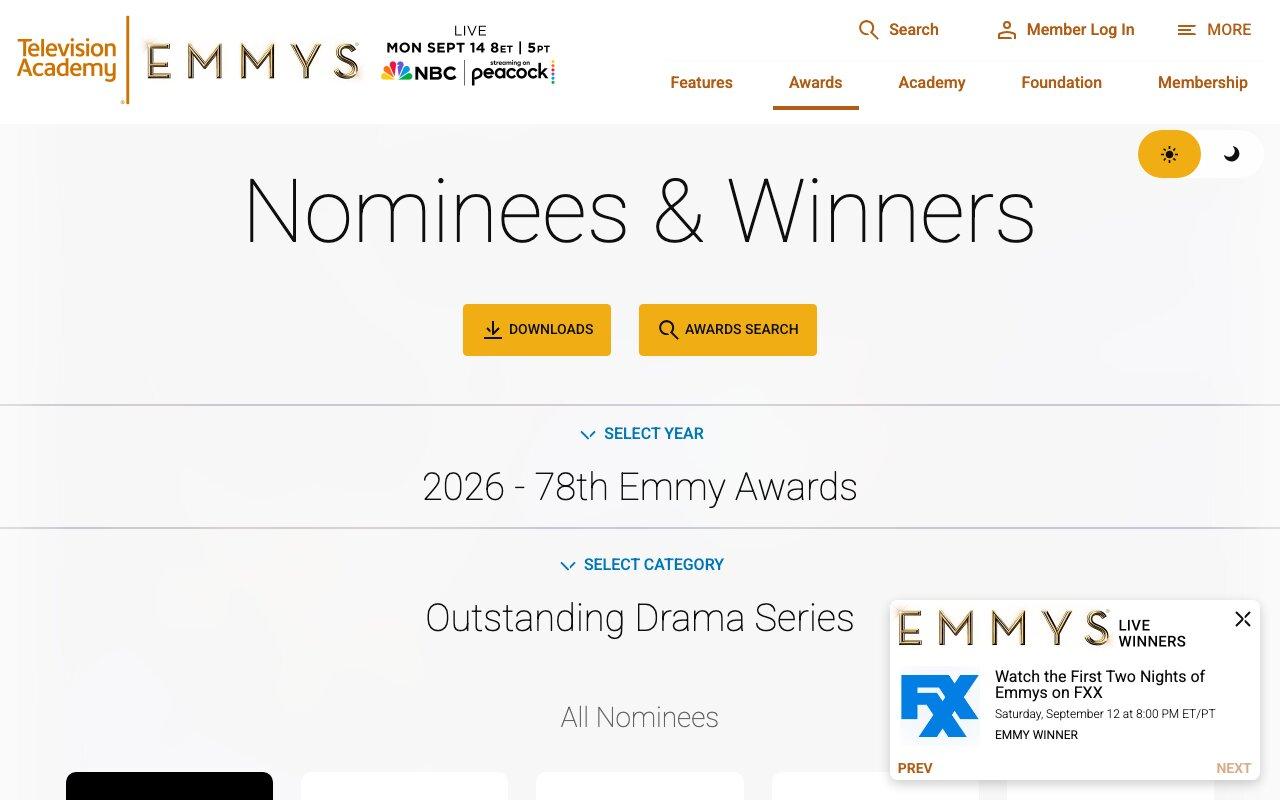
The 78th Primetime Emmy Awards are scheduled for September 14, 2026, and both major venues have had drama and comedy boards open for months. Here is the Polymarket Outstanding Drama Series board as it stood on September 5, 2026, with the Kalshi quote for the same nominee alongside it.
Nominee | Polymarket price | Kalshi bid-ask | Polymarket outcome volume
The Pitt | 93.5% | 91-92c | $19,046
A Knight of the Seven Kingdoms | 2.1% | 1-2c | $861
Slow Horses | 1.9% | 0-1c | $2,275
Your Friends & Neighbors | 1.9% | 0-1c | $1,247
The Gilded Age | 1.7% | 0-1c | $931
The Diplomat | 1.6% | 0-1c | $856
Paradise | 1.0% | 0-1c | $851
Pluribus | not listed | 4-5c | n/a
Add the seven Polymarket prices and you get 103.7 percent. That is not a bug, and it is not free money. In a multi-outcome market each contract has its own bid-ask spread, and the displayed price is the last trade or the mid, so the column will normally sum to slightly more than 100. Treat anything in the two-to-five point range as ordinary friction on a market this size.
The missing row is the part worth caring about. The Television Academy lists eight Outstanding Drama Series nominees, including Pluribus, which Kalshi prices at 4 to 5 cents. Polymarket's event covers seven of them. If you read that board as a complete probability distribution you are implicitly assuming a nominee with a mid-single-digit chance cannot win, and the 103.7 percent total is masking the gap rather than revealing it.
This is the single most useful habit to build: before you read any percentage, count the outcomes on the board and compare them with the official list. It takes twenty seconds and it catches the errors that no amount of staring at a price chart will.
Polymarket and Kalshi disagree, and the gap is the point
The comedy board is the cleaner of the two. Both venues cover all eight Outstanding Comedy Series nominees, and Kalshi adds a Tie contract that Polymarket does not offer.
Nominee | Polymarket price | Kalshi bid-ask | Polymarket outcome volume
Widow's Bay | 66.0% | 67-69c | $31,137
Hacks | 34.1% | 33-34c | $16,676
Abbott Elementary | 0.7% | 0-1c | $5,368
Margo's Got Money Troubles | 0.4% | 0-3c | $5,468
Shrinking | 0.4% | 1-2c | $5,620
The Bear | 0.2% | 0-1c | $6,649
Nobody Wants This | 0.2% | 0-1c | $6,896
Only Murders in the Building | 0.2% | 0-1c | $5,409
Two venues, two independent trader populations, two clearing arrangements, and the top of the board lands within about two points. That agreement is the strongest evidence you will get that the number is a real consensus rather than one enthusiastic trader moving a thin market.
The disagreements are informative in a different way. Kalshi's Tie contract exists because Emmy categories can produce ties, and a Polymarket reader has nowhere to express that view. Kalshi's wider quotes on the longshots, such as Margo's Got Money Troubles at 0 bid and 3 ask, tell you the market maker will not commit to a price down there. A 3 cent ask against a 0 cent bid is not a 1.5 percent probability estimate; it is an absence of opinion.
So when you see two venues quoting the same event differently, work out which of three things is happening: they are pricing different outcome sets, one of them is thinly quoted, or the two crowds genuinely disagree. Only the third case is a signal, and it is the rarest of the three.
Box office markets resolve on a spreadsheet, not a narrative
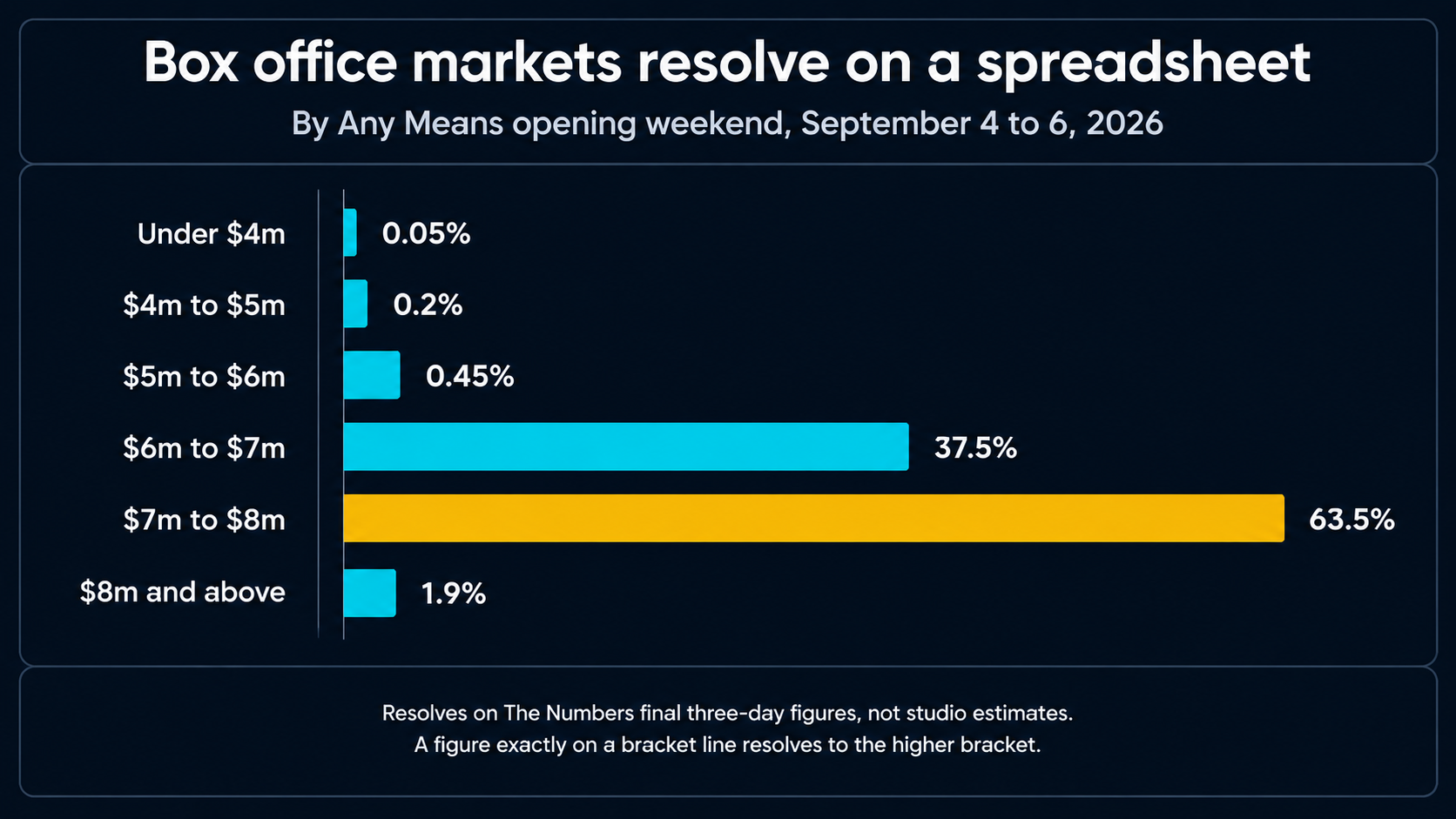
Box office is where new readers most often misread the contract. The market is not asking whether a film is a hit. It is asking which numeric bracket a specific reported figure lands in, on a specific date, according to a named source. Here is the live By Any Means opening weekend board for the September 4 to 6, 2026 frame, which had turned over 42,218 dollars against 26,223 dollars of liquidity when we pulled it.
Opening weekend bracket | Market price | Outcome volume
Under $4m | 0.05% | $1,005
$4m to $5m | 0.2% | $5,045
$5m to $6m | 0.45% | $9,040
$6m to $7m | 37.5% | $12,961
$7m to $8m | 63.5% | $5,579
$8m and above | 1.9% | $8,588
Read the resolution text before the price. This market resolves on the daily box office figures published on The Numbers for the three-day opening weekend, and only once those values are final rather than studio estimates. Two rules do a lot of work: a figure that lands exactly between two brackets resolves to the higher bracket, and the source figures are used regardless of whether domestic means the United States alone or the United States and Canada.
That matters because studio Sunday estimates and final Monday actuals routinely differ by a few hundred thousand dollars, which is more than enough to move a result across a one million dollar bracket line. A trader reading Sunday headlines and a contract settling on Monday finals are not looking at the same number.
The practical consequence is that box office markets reward people who know the reporting calendar rather than people who know the film. If you want the ScreenOdds view of how these weekend markets behave, the weekend box office guide and the Box Office hub cover the same ground with the seeded market pages attached.
TV and streaming: renewal markets barely trade, Netflix charts do
The most common question we get about TV markets is where to trade renewals and cancellations. The honest answer for September 2026 is that you mostly cannot. We searched the live Polymarket event set for renewal and cancellation contracts and found none with meaningful volume. Renewals are announced on no fixed schedule, sometimes leak through trade reporting weeks before an official confirmation, and often arrive bundled with vague language about episode counts. That is a resolution nightmare, and market operators avoid it.
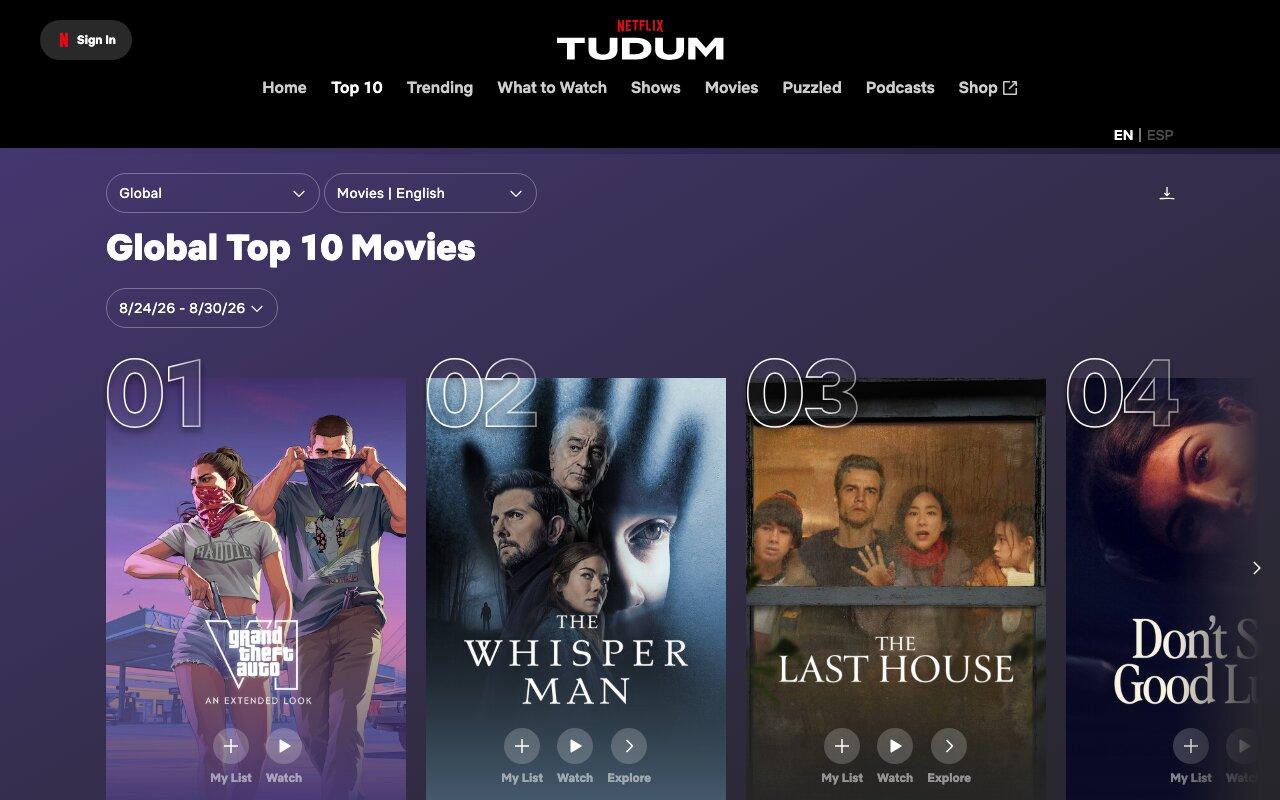
What does exist is a weekly Netflix chart complex. There are separate markets for the top United States show, the number two United States show, the top global show, and the equivalent movie charts, all resolving on the Netflix Top 10 update.
Market | What decides it | Update timing | Volume
Top US Netflix show this week | top10.netflix.com US Top 10 TV, English, by total views | Tuesday 3:00 PM ET update | $6,260
Number two global Netflix show | same source, number two rank | Tuesday 3:00 PM ET update | $18,827
Number two US Netflix show | same source, number two rank | Tuesday 3:00 PM ET update | $10,863
These contracts carry two rules that catch people out. Ties resolve to whichever title comes first alphabetically, and if the chart update does not happen by the stated deadline the market resolves to Other. Both rules are about protecting the settlement process from a source that is entirely outside the exchange's control.
The current United States show board is a good illustration of what a decided market looks like: Death of the Pastor's Wife sits at 98.4 percent with the rest of the field under one percent. There is no trade there. The interesting Netflix markets are the number two slots, where the ranking is genuinely contested, and that is exactly where the volume has gone.
What the 2026 Oscars actually proved
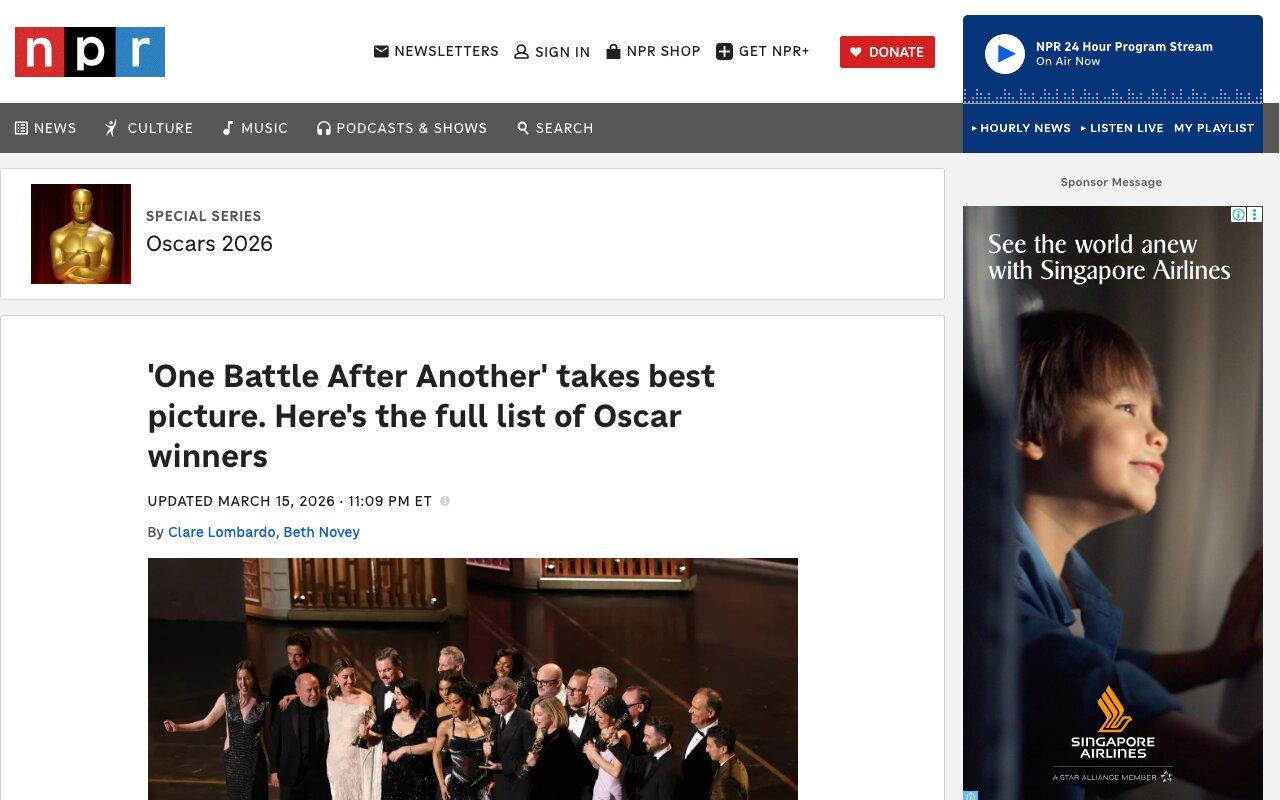
The 98th Academy Awards on March 15, 2026 were the biggest entertainment prediction-market event to date, and they are worth studying because the result cuts against the story people tell about these markets. One Battle After Another won Best Picture, along with Best Director for Paul Thomas Anderson and five other awards. Here is what the Polymarket Best Picture winner market thought on the way there, taken from the CLOB daily price history.
Date | One Battle After Another | Sinners | Sentimental Value
January 5, 2026 | 74.5% | 6.7% | 1.4%
January 22, 2026 (nominations) | 75.0% | 4.0% | 0.9%
February 1, 2026 | 68.5% | 20.2% | 0.6%
February 15, 2026 | 75.5% | 14.2% | 0.9%
March 1, 2026 | 76.5% | 14.4% | 0.6%
March 14, 2026 (eve of ceremony) | 74.5% | 21.3% | 0.4%
March 15, 2026 (ceremony) | 76.5% | 19.1% | 0.3%
The market never wavered. From the first week of January to the ceremony itself, the eventual winner sat in a band between 68 and 77 percent, and the nominations announcement that gave Sinners a record 16 nominations moved the Best Picture winner market by almost nothing. Sinners rallied into the low twenties twice and faded both times.
That is a market doing its job well and a useful correction to two opposing myths. It was not a coin flip resolved by a late swing, and it was not clairvoyant either: a 76 percent favorite loses about one time in four, and the same board would have looked equally confident in a season where the favorite lost.
The money involved was real. That single Best Picture winner event turned over 12.85 million dollars, and the Sinners contract alone accounted for 2.87 million of it. The most-traded contender was not the winner, which is normal: volume follows disagreement, not correctness. Our Polymarket Oscars guide goes deeper on how awards-season signals sequence, and the Oscars hub tracks the current cycle.
Liquidity is the number to check before the percentage
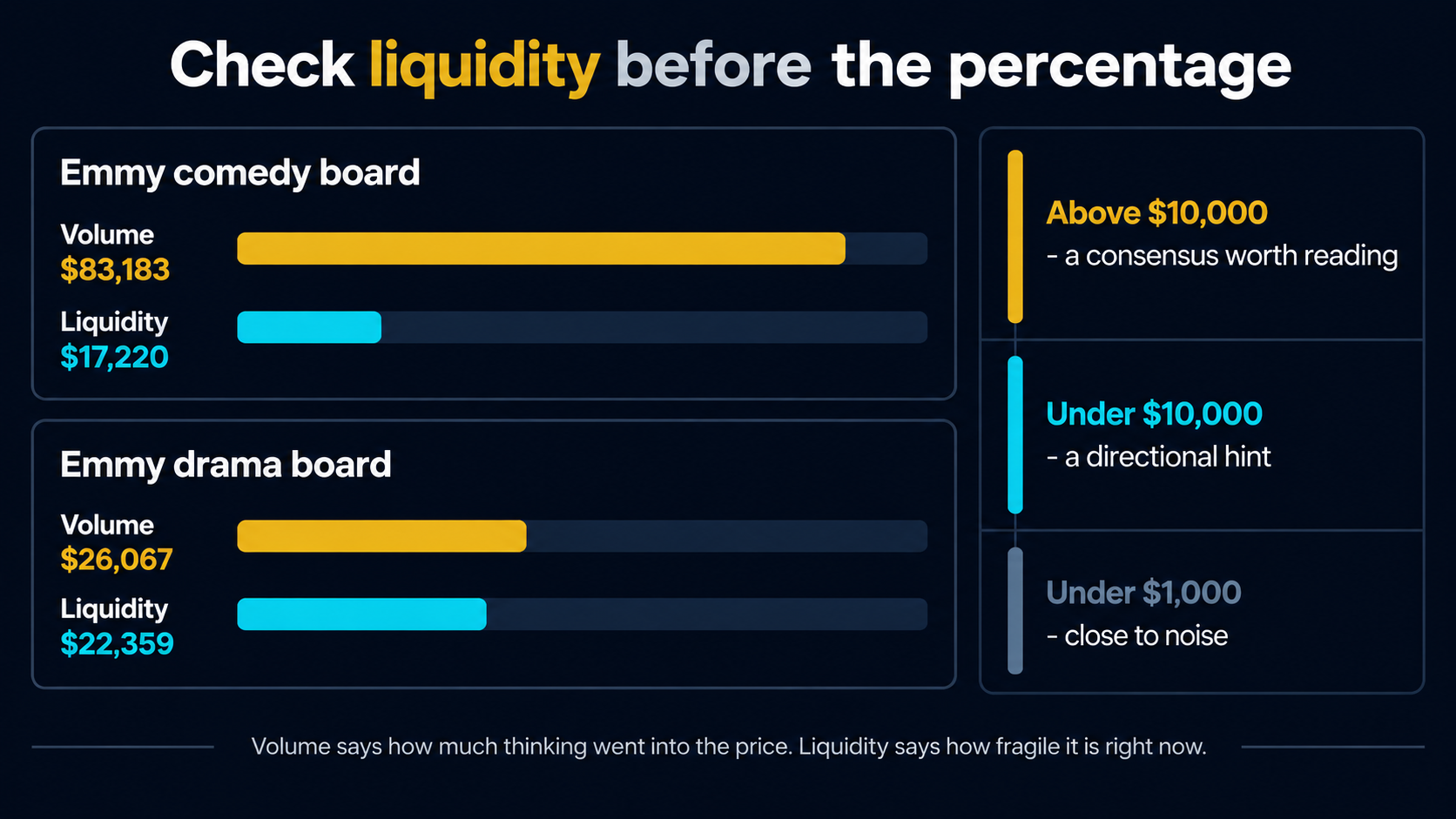
A clean percentage on a screen implies a crowd behind it. Often there is not one. The Emmy comedy board has 83,183 dollars of cumulative volume behind it and 17,220 dollars of resting liquidity. The drama board has 26,067 dollars of volume against 22,359 dollars of liquidity. Neither of those is a deep market by financial standards, and a single five-figure order would move either one several points.
Volume and liquidity answer different questions. Volume tells you how much interest the market has attracted over its life, which is a measure of how much thinking has gone into the price. Liquidity tells you how much is resting in the book right now, which is a measure of how fragile the displayed price is. A market can have high volume and thin current liquidity if the argument was settled months ago, which is exactly the state the Netflix top United States show market is in today.
The rule of thumb we use on ScreenOdds is to read any contract with under about 10,000 dollars of outcome volume as a directional hint rather than a consensus. Under 1,000 dollars, as with most of the Emmy drama longshots in the table above, the price is close to noise. Those contracts are not lying to you, but they are not the aggregated judgment of an informed crowd either.
This is also why the cross-venue check in the comedy table matters so much. Two thin markets that independently arrive at the same number are more convincing than one thin market on its own. The Polymarket volume guide covers how we read these figures across the site.
Where entertainment contracts sit legally in 2026
Event contracts in the United States are regulated by the Commodity Futures Trading Commission rather than by state gaming regulators, and both major venues operate under that framework. Polymarket returned to United States traders in late 2025 through a licensed exchange acquisition, and Kalshi has operated as a federally designated contract market for years.
The friction is at state level, and it is concentrated almost entirely on sports contracts, which several states argue are sports betting under another name. Entertainment contracts such as awards, box office and streaming charts have attracted far less of that attention, but the legal position is still moving and state-by-state availability changes. Check your own jurisdiction rather than trusting a general statement in an article, including this one.
There is a second, more practical distinction worth holding onto. A sportsbook sets a line and takes the other side of your bet. A prediction market matches you against another trader and takes a fee. That is why prediction-market prices are described as market-implied probabilities and sportsbook prices are not: nobody at the exchange has an opinion on who wins Outstanding Drama Series.
ScreenOdds publishes these numbers as research. We do not accept wagers, and nothing here is financial advice. Where we link to a market venue, that link may be a referral link, and the market pages carry that disclosure next to the link.
How to read a ScreenOdds market page in five minutes
Every market page on this site follows the same five-step reading order, and it is the order we would use on any venue.
Step one, read the exact market title and resolution rule. A nomination market and a winner market for the same category are different contracts, and a bracket market is different again. Step two, count the outcomes and compare them with the official list, which is what surfaced the missing Pluribus row above.
Step three, check volume and liquidity before you look at the percentage, using the rough floors in the previous section. Step four, look for a second venue quoting the same event and note whether the two agree. Step five, only then read the price, and read it as a range rather than a point: a 66 percent contract quoted 67 to 69 on another venue is a high-sixties view, not a 66.0 view.
From here, the Awards hub carries the live Emmys and Oscars boards, the Box Office hub carries the weekend bracket markets, and the TV and Streaming hub carries the Netflix chart markets. The Related Articles block below points at the deeper guides for each vertical.
If you only remember one thing from this guide, make it the outcome count. Prices are easy to read and easy to fix in your head. An incomplete board looks exactly like a complete one until you count it.
Sources
78th Emmy Awards Outstanding Drama Series nominees
Television Academy | Accessed 2026-09-05
Polymarket Gamma API event and market data
Polymarket | Accessed 2026-09-05
Kalshi public markets API
Kalshi | Accessed 2026-09-05
The Numbers box office figures
Nash Information Services | Accessed 2026-09-05
Netflix Top 10 weekly charts
Netflix | Accessed 2026-09-05
Oscars 2026 winners list, 98th Academy Awards
NPR | Accessed 2026-09-05
FAQ
What are entertainment prediction markets?
They are exchanges where traders buy and sell contracts on verifiable entertainment outcomes such as Oscar and Emmy winners, opening weekend box office brackets, and weekly streaming chart positions. A contract pays one dollar if the outcome happens and nothing if it does not, so the price acts as a market-implied probability.
Are prediction market odds more accurate than critics?
Sometimes, and not automatically. In the 2026 Best Picture race the Polymarket favorite held between 68 and 77 percent from January to the ceremony and won. But a 76 percent favorite is still expected to lose roughly one time in four, and a thin market with a few hundred dollars of volume is not a crowd forecast at all.
Why do the percentages add up to more than 100?
Each outcome in a multi-outcome market has its own bid-ask spread, and the displayed figure is usually the last trade or the mid-price rather than a normalized probability. The Emmy drama board summed to 103.7 percent when we checked it on September 5, 2026. Two to five points of overround is normal on markets this size.
How do box office prediction markets resolve?
They resolve on a named third-party source rather than on studio press releases. The current opening weekend markets settle on The Numbers' three-day weekend figures once those are final rather than estimates, and a result that lands exactly on a bracket boundary resolves to the higher bracket.
Can you trade TV renewals and cancellations?
Not in any meaningful volume as of September 2026. Renewal announcements have no fixed schedule and often leak before official confirmation, which makes them hard to settle cleanly. The live television markets are weekly Netflix Top 10 chart contracts, which resolve on a scheduled published update.
Why do Polymarket and Kalshi show different odds for the same award?
Usually because they are pricing different outcome sets or because one side is thinly quoted. Kalshi lists a Tie contract for Emmy categories and Polymarket does not, and Polymarket's Outstanding Drama Series board omits Pluribus, which Kalshi prices at 4 to 5 cents. Genuine disagreement between the two crowds is the least common explanation.
Is trading entertainment prediction markets legal in the US?
Event contracts are regulated federally by the Commodity Futures Trading Commission, and both major venues operate under that framework. State-level challenges have focused overwhelmingly on sports contracts rather than awards, box office, or streaming markets, but availability varies by state and continues to change, so check your own jurisdiction.
What volume counts as a liquid entertainment market?
As a working floor, we treat an individual contract with under about 10,000 dollars of outcome volume as a directional hint rather than a consensus, and anything under 1,000 dollars as close to noise. Also check resting liquidity separately: it tells you how far a single order could move the displayed price.