Culture
Polymarket Volume: Liquidity Guide
Polymarket volume explained through liquidity, depth, spreads, market age, false moves, and ScreenOdds prediction-market signal checks.
Keyword
polymarket volume
US volume
210
Difficulty
16

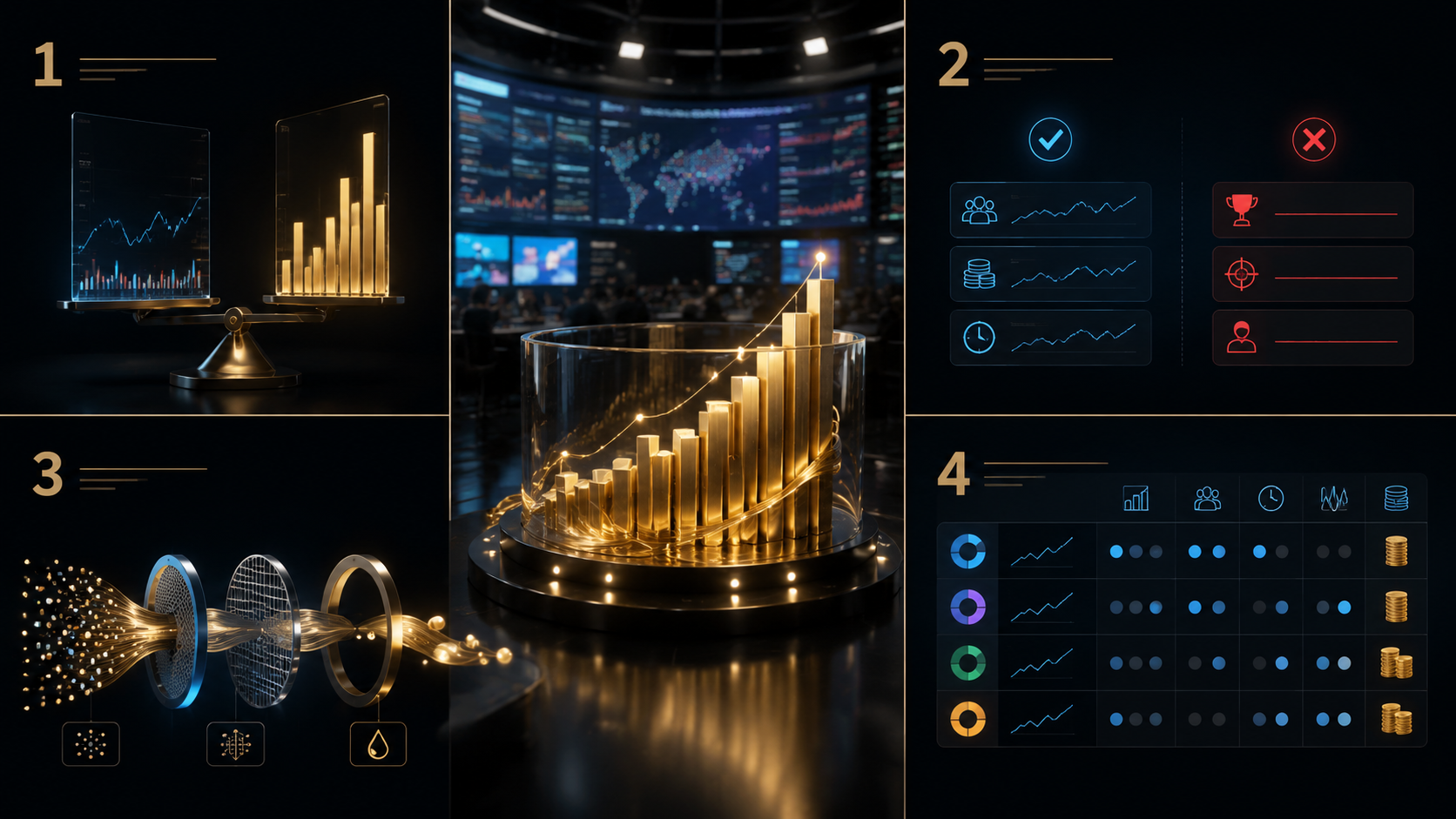
Kie.ai image generated for ScreenOdds.
Why volume is a separate ranking angle
DataForSEO shows `polymarket volume` at 210 US monthly searches with keyword difficulty of 16 and a CPC near $60. That makes it a smaller but commercially meaningful page inside the ScreenOdds prediction-market cluster.
Volume deserves its own guide because it is the fastest way to tell whether a price movement has support. A market can show a dramatic probability change while still being too thin to trust.

What volume can and cannot prove
Volume proves that trading activity happened. It does not prove that the market is correct, that the move is informed, or that the price will hold.
The useful question is whether volume arrived with liquidity, tighter spreads, and an identifiable catalyst. When those line up, the move deserves more attention.
Liquidity matters more than a headline number
Liquidity tells readers how much depth exists around the current price. A market with shallow liquidity can move quickly because there is not much standing between one order and a new displayed probability.
That is why ScreenOdds should pair every volume discussion with a liquidity note. Volume without depth can create false confidence.
How to compare volume across markets
Do not compare a mature election market with a niche entertainment market as if they are the same. A small entertainment market can have meaningful movement at lower volume if the question is specific and close to resolution.
The better comparison is category-relative: Oscars market against Oscars market, Netflix market against Netflix market, and reality TV market against reality TV market.
Where this fits in ScreenOdds
Polymarket volume should support market pages and tracker alerts. If a price move appears on a ScreenOdds market page, this guide explains why volume and liquidity are checked before assigning meaning.
It also supports arbitrage content. Cross-market spreads are less useful when one side has weak depth or unclear execution quality.
Best use case for readers
Use volume as a quality filter. When volume, liquidity, timing, and source-backed catalysts agree, a market move becomes more interesting.
When they do not agree, ScreenOdds treats the move as a note to monitor rather than a conclusion.
Sources
FAQ
What does Polymarket volume mean?
It refers to trading activity in a market over a period of time, usually used to judge whether a price move has participation behind it.
Is high volume always good?
No. High volume is useful context, but readers should also check liquidity, spreads, timing, and the market's resolution rules.
Why does ScreenOdds separate volume from analytics?
Volume is important enough to deserve its own guide because it affects every tracker alert, market update, and arbitrage check.