Awards
Oscars 2027 Odds: What Prediction Markets Price Now
Oscars 2027 odds read properly: The Odyssey at 53.5% on Polymarket, why Best Picture prices sum to 112.7%, and the placeholder traps on an early board.
Keyword
oscars 2027 odds
US volume
0
Difficulty
0

Illustration generated for ScreenOdds.
Key takeaways from this week's Oscars 2027 odds
The Odyssey is the only film on the board priced like a real favorite. It trades at 53.5 cents on Polymarket, and $123,479 of the Best Picture event's $187,373 lifetime volume sits on that single outcome.
Polymarket's Best Picture mid-prices add up to 112.7 percent, not 100. Every headline probability in that category is inflated by roughly a tenth before you do anything else with it.
Kalshi has 496 open Oscars markets across 28 categories. We checked every one of them on September 15, 2026 and found zero contracts traded, zero open interest, and not a single live bid or ask.
Twenty-four of the 46 outcomes in Polymarket's Best Picture market are unnamed placeholders such as Film Y and Film Z, parked at 50 cents with no volume behind them.
Venice, Telluride and Toronto reshaped the pundit narrative far more than the price. The Odyssey has traded inside a 47.5 to 57.5 band for the entire last 30 days.
Where the 2027 Academy Awards race sits right now
If you search for Oscars 2027 odds in the middle of September, you get a number and almost no instructions. A film is 53 percent, an actress is 64 percent, a longshot is 2 percent, and nobody tells you that two of those three figures are close to meaningless on their own. The 99th Academy Awards are still six months out, on March 14, 2027, with nominations on January 21, and the boards pricing them are young, thin in places, and full of scaffolding that was never meant to be read as a forecast.
That gap matters more than usual this cycle, because the money is real. Polymarket's Best Picture market alone has turned over $187,373 and carries $208,649 of resting liquidity. Its Best Actress market has done $132,122. Those are not toy numbers for an awards market this early, and they are large enough that a reader treating a mid-price as a probability will size a position off a figure that is wrong by a predictable amount.
So we pulled the raw data instead of quoting a screenshot. Every price, volume and spread below came from Polymarket's Gamma API and Kalshi's public markets endpoint on September 15, 2026, and we walked all 28 Kalshi Oscar series and all 46 Polymarket Best Picture outcomes rather than the top ten each platform shows you. The numbers moved our read of the race in three places, and one of them is a straight correction to how these boards are being quoted elsewhere.
What follows is the board as it actually stands, then the four arithmetic problems that sit between a quoted cent and a probability you can use.
What the Oscars 2027 odds say about Best Picture
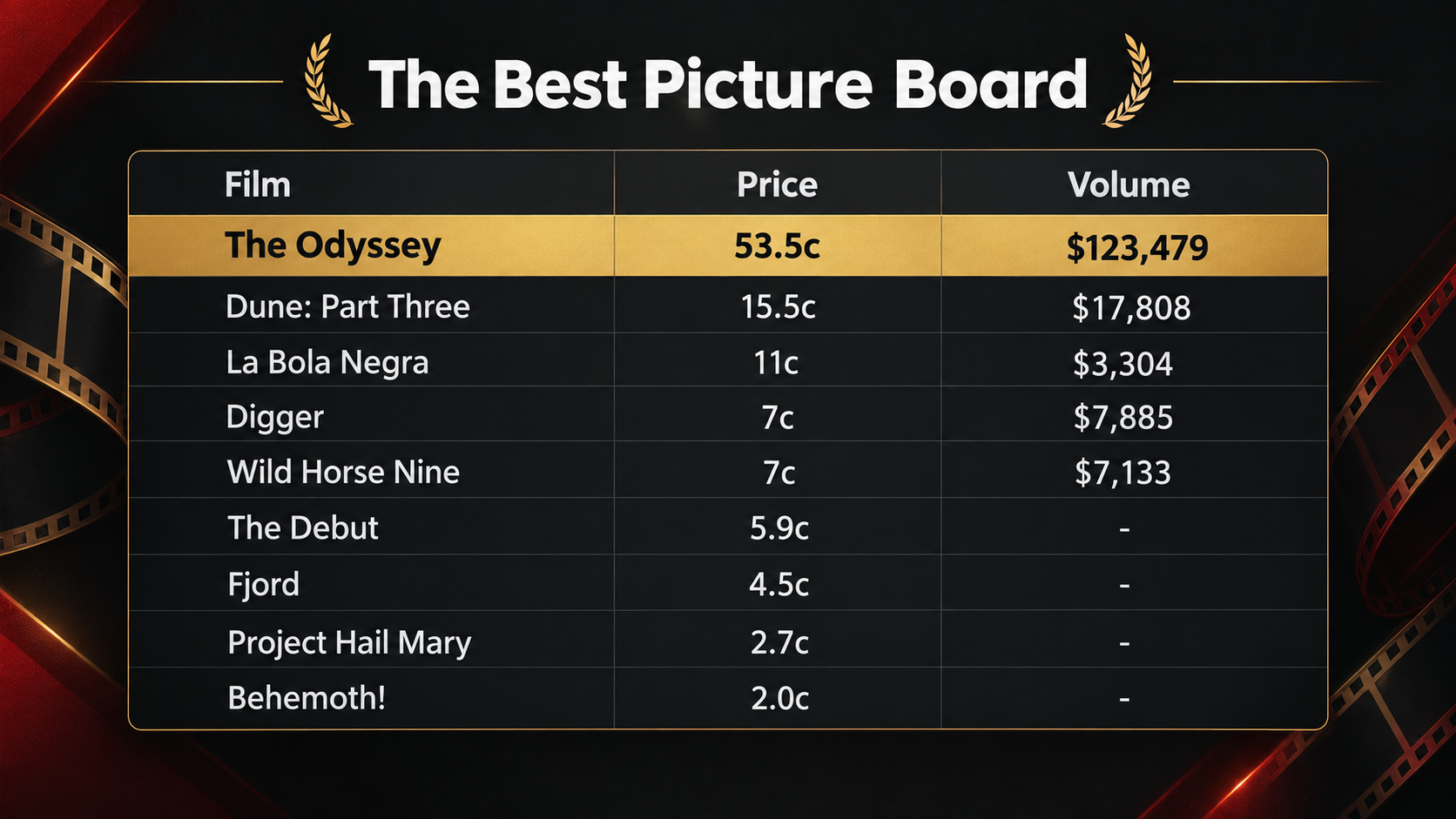
Christopher Nolan's The Odyssey opened its Polymarket contract near 48.5 cents on July 30, 2026 and trades at 53.5 today, with a one-cent spread between the 53 bid and the 54 ask. That tight quote is the tell: this is the only outcome in the category with enough two-sided interest to price cleanly.
Behind it the board thins out fast. Dune: Part Three is 15.5 cents on $17,808 of volume. La Bola Negra, Netflix's Cannes winner, is 11 cents on just $3,304. Martin McDonagh's Wild Horse Nine and Alejandro G. Inarritu's Digger are both around 7 cents, on $7,133 and $7,885 respectively. Jesse Eisenberg's The Debut, the Telluride premiere that launched Julianne Moore's campaign, sits at 5.9 cents.
Then the drop-off gets steep. Fjord is 4.5 cents, Project Hail Mary 2.7, Behemoth! 2.0, and the remaining named contenders are all under a cent and a half. Twenty-two outcomes have traded at all. The other twenty-four have not.
The shape is worth naming plainly, because it is the whole story of this board: one film carries two thirds of the money, a second film carries most of the rest, and everything below fourth place is being priced by a handful of traders moving a few thousand dollars. A 7-cent contender and a 2-cent contender are separated by less conviction than the five-point gap suggests.
That structure is also why the next three sections matter. When almost all of the volume is concentrated in one outcome, the arithmetic of the rest of the board stops behaving the way a casual reader expects.
Why the prices do not add up to 100 percent
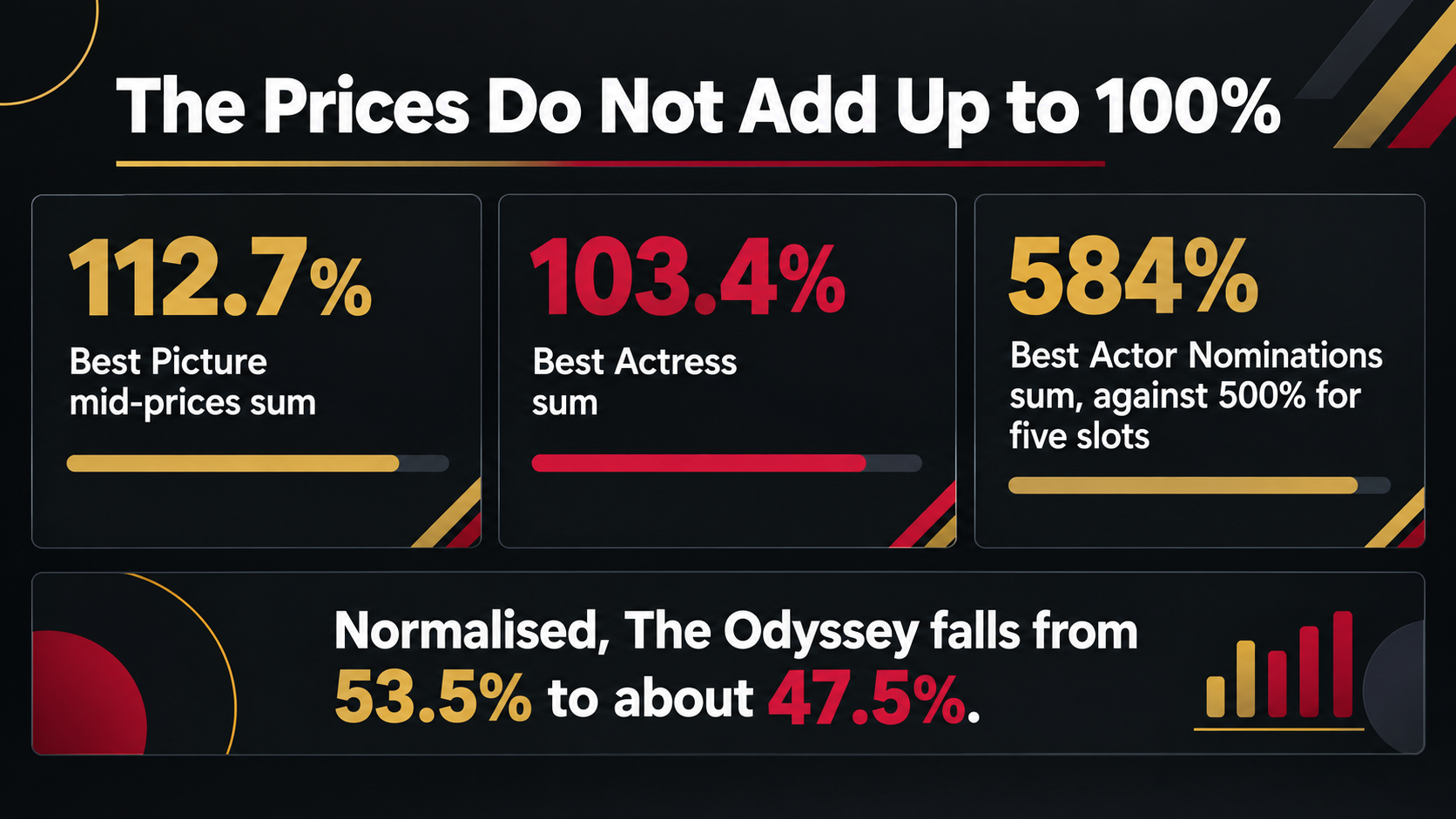
Add up the mid-prices of every traded outcome in Polymarket's Best Picture market and you get 112.7 percent. Exactly one film wins Best Picture, so a coherent probability set has to sum to 100. The extra 12.7 points are overround, the prediction-market cousin of a bookmaker's margin, and they exist because every contract is quoted with a spread and mid-prices sit above the bids you could actually sell into.
The practical fix is normalization: divide each price by the total. The Odyssey's 53.5 cents becomes about 47.5 percent once you do. That is a six-point haircut on the headline number, and it is the difference between a coin-flip favorite and a clear one.
The overround is not uniform across the board either. Best Actress sums to 103.4 percent, which is tight and reflects how much of that category's money is parked in one contract. Best Adapted Screenplay sums to 111.8 percent. Best Documentary Feature sums to 50 percent, which is the opposite failure: only seven of its 34 outcomes have traded, so half the probability mass in that category simply has not been priced yet.
A market that sums to 50 percent is telling you something real, and it is not that the favorite has a 14 percent chance. It is telling you the field is incomplete. We would not take a documentary price seriously until that total climbs somewhere near 100, and the same test is worth running on any early market you are about to trust.
Placeholder outcomes are the biggest trap on an early board
Polymarket's Best Picture event carries 46 outcomes. Twenty-four of them are named Film A through Film Z, plus an Other bucket. They exist so the market can add real titles later without relisting the whole event, and they are a sensible piece of engineering.
They are also sitting at 50 cents with a zero bid and a one-dollar ask, and no volume whatsoever. Anyone reading the raw board, or pulling the API without filtering, sees a 50 percent probability next to a film that does not exist. Two of the five categories we pulled had more placeholder outcomes than traded ones.
This is the single most common way an early awards board gets misreported. The 50-cent figure is not a market view, it is the default midpoint between an empty bid and an empty ask. The filter is simple and we would apply it to any prediction-market data you scrape: discard every outcome with zero volume, then re-check your totals.
It also explains part of the 112.7 percent above. We excluded placeholders from that sum. Had we left them in, the Best Picture category would have totalled well over 1,200 percent, which is the kind of number that tells you the filter was never applied.
Kalshi has listed 496 Oscars markets and traded none of them
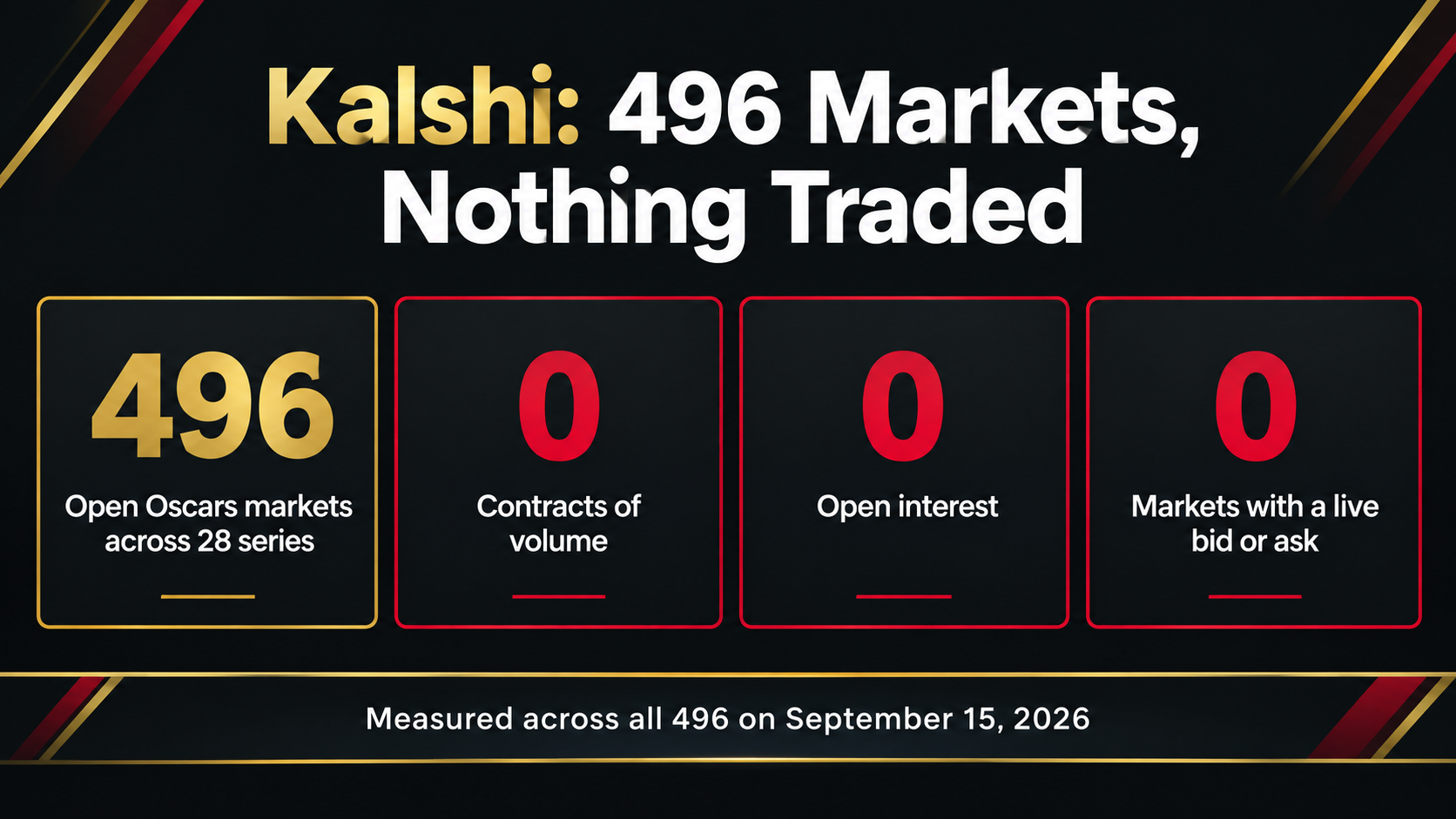
This is the finding that surprised us most. Kalshi, the CFTC-regulated exchange, has a fully built 2027 Oscars board: 28 series covering Best Picture, Director, all four acting categories, both screenplays, score, cinematography, makeup, visual effects, animated feature, international feature, documentary and casting, in both winner and nominee flavours. That is 496 individual open markets.
Across all 496, on September 15, 2026, we measured zero contracts of volume, zero open interest, and zero markets carrying a live bid or ask. The Best Picture series alone lists 41 outcomes, every one of them quoted at nothing on both sides, with a placeholder close date of December 31, 2027 rather than the real ceremony date.
That matters because Kalshi prices for this cycle are already being quoted as though they were forecasts. At least one widely-read odds page lists a full Best Actress table in Kalshi cents and names a frontrunner off it. A cent value attached to a market with no bid, no ask and no trades is a listing artifact, not a price, and it cannot be sold back at anything.
None of this is a knock on the exchange. Listing early is how you build a book, and Kalshi's political and economic markets are deeply traded. It does mean that for the 2027 Oscars specifically, Polymarket currently has the only board with real price discovery on it, and any comparison that treats the two as equivalent sources right now is comparing a market to a menu.
Nomination markets answer a different question than winner markets
Polymarket's Best Actor Nominations market has Matt Damon at 90.6 percent, John Malkovich at 87.5, Andrew Scott at 78.5, Tom Cruise at 61.5 and Ryan Gosling at 43.5. Those eighteen traded outcomes sum to 584 percent, and unlike the Best Picture board that is not an error.
Five actors get nominated, so a correctly priced nominations market sums to roughly 500 percent, one full unit of probability per available slot. The 84 points above that are the overround, proportionally similar to what we found in the winner markets. It resolves on January 21, 2027, the nominations announcement date, not on ceremony night, which is why its contract expiry is nearly two months earlier.
The distinction trips people up constantly. Damon at 90.6 percent is not a claim that he wins Best Actor. It is a claim that he shows up on a five-name list, which for the lead of the year's presumptive Best Picture frontrunner is close to a formality. The Odyssey at 53.5 percent to win and Damon at 90.6 percent to be nominated are entirely consistent statements.
One number in that market is worth flagging for a different reason. Robert Pattinson shows a 56 percent mid, but his bid is 44 and his ask is 68. That is a 24-cent spread, and it means the market has no real opinion at all.
Where the market disagrees with the pundits
The trade consensus coming out of Venice and Telluride was that the race had finally tightened, with Wild Horse Nine emerging as the strongest challenger on the back of strong festival reviews. Gold Derby and Variety both moved it up their boards in early September.
The money did not follow. Wild Horse Nine trades at 7 cents on Polymarket, sixth in the category and a point behind Digger. Dune: Part Three, which has not screened at a festival at all, is priced more than twice as high at 15.5 cents. Traders are weighting scale, release slot and Villeneuve's track record over the thing the festival coverage actually reported on.
Best Actress runs the other way. Julianne Moore's Telluride reception for The Debut translated straight into price: she is 64 percent, on $88,486 of volume, more than the rest of the category combined. When a festival signal is about a single performance rather than a whole film, this board absorbs it fast.
The most useful check, though, is the price record rather than either narrative. Over the last 30 days, through the entire Venice, Telluride and Toronto run, The Odyssey traded between 47.5 and 57.5 cents and finished roughly where it started. Across its whole life since July 30 it has never left a 44.5 to 56.5 band. Whatever the festivals did to the commentary, the favorite's price barely noticed.
How to read Oscars 2027 odds without getting burned
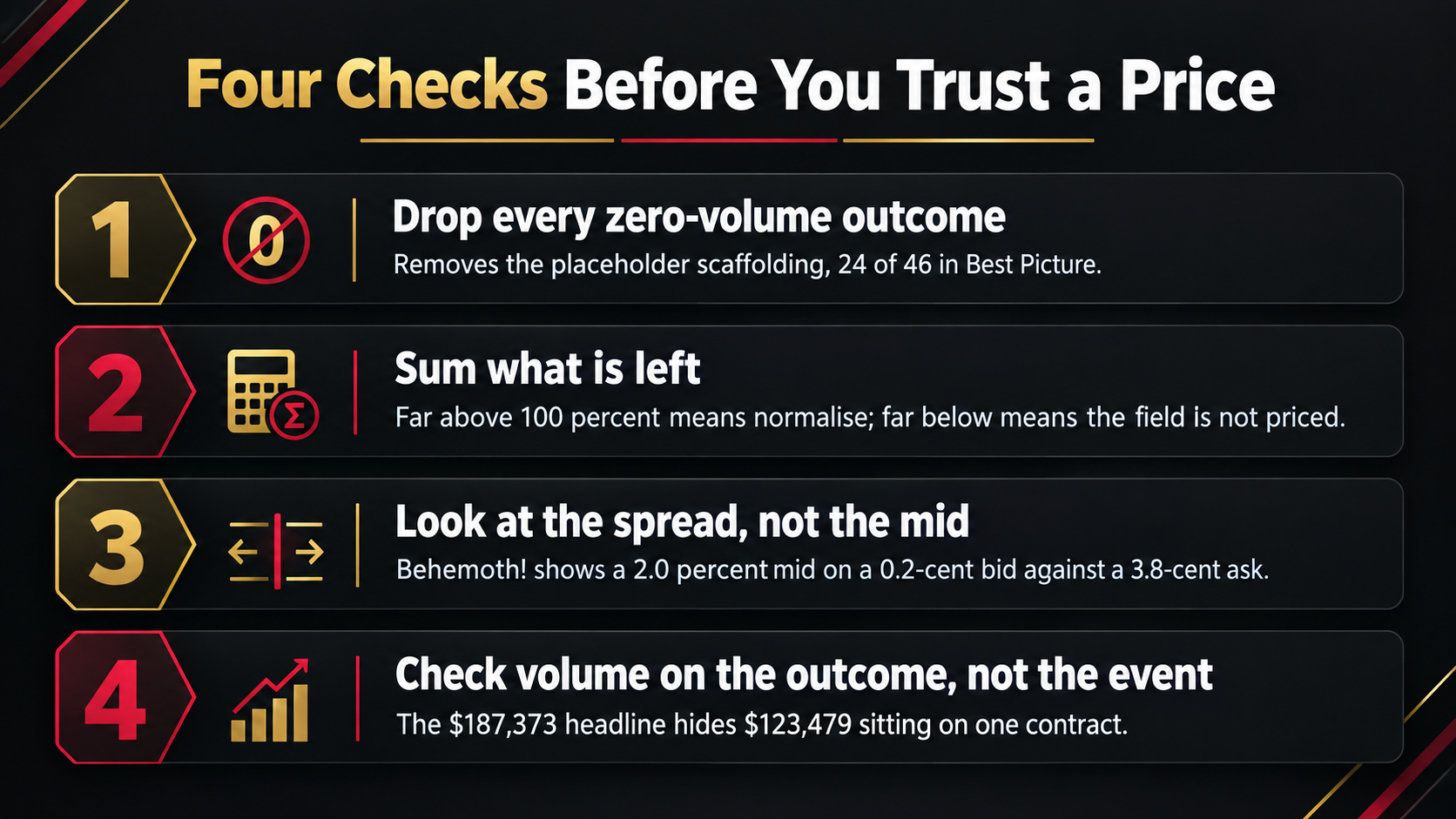
Four checks, in order, and they take about two minutes on any market you are looking at. First, drop every outcome with zero volume, which removes the placeholder scaffolding. Second, sum what is left. If the total is far above 100 percent, normalize; if it is far below, the field is not fully priced and the category is not ready to read.
Third, look at the spread rather than the mid. Behemoth! shows a 2.0 percent mid on a 0.2-cent bid against a 3.8-cent ask, which is a nineteen-fold range dressed up as a point estimate. In Best Adapted Screenplay, Wildwood shows a 9-cent spread on a 6.7-cent mid. Where the spread is wider than the price, there is no price.
Fourth, check the volume behind the specific outcome, not the event. The Best Picture market's $187,373 headline looks deep until you notice that $123,479 of it is one contract, and that La Bola Negra's 11 cents rests on $3,304 total. The event is liquid. Most of the outcomes in it are not.
Run those four and the board reads very differently: one properly priced favorite around 47 percent after normalization, one credible second at roughly 14, and a long tail where the honest answer is that nobody knows yet.
The dates that will actually move these prices
Nomination voting runs January 11 to 15, 2027, with nominations announced Thursday, January 21. That announcement is the hard reset: every nominations contract resolves, and the winner markets reprice against a known five-name field instead of a speculative one.
Before that, the precursor circuit does the real work. The Actor Awards, which SAG-AFTRA renamed from the SAG Awards and moved to Netflix, stream on February 28, 2027, with nominations voting opening December 21 for features. Historically the guild awards are the strongest single predictor of the acting categories, and they land inside the Academy's final voting window of February 25 to March 4.
Then the ceremony itself, Sunday March 14, 2027 at the Dolby Theatre, on ABC and Hulu. Polymarket's winner contracts expire that night, which is worth knowing if you are holding something illiquid: a 2-cent longshot with a 3.6-cent spread is not a position you can quietly exit in March.
Our expectation is that the board stays roughly where it is until December, when the guild and critics nominations start landing, and that the documentary and below-the-line categories do not become readable at all until the field is complete. We will re-pull these numbers as the precursors resolve.
Sources
Oscars 2027: Best Picture Winner market data
Polymarket | Accessed 2026-09-15
Kalshi open Oscars markets (series KXOSCARPIC)
Kalshi | Accessed 2026-09-15
Academy Sets Dates for Oscars 2027 and 2028 Ceremonies
Variety | Accessed 2026-09-15
Oscars Dates For 99th & 100th Ceremonies Set; 2027 Voting Timeline
Deadline | Accessed 2026-09-15
The Debut Bows at Telluride With Oscar-Worthy Julianne Moore
Variety | Accessed 2026-09-15
Actor Awards official awards calendar
SAG-AFTRA | Accessed 2026-09-15
FAQ
What are the current Oscars 2027 odds for Best Picture?
On September 15, 2026, Polymarket priced The Odyssey at 53.5 cents, Dune: Part Three at 15.5, La Bola Negra at 11, and Wild Horse Nine and Digger at about 7 each. Those are raw mid-prices. Because the traded outcomes sum to 112.7 percent, normalizing puts The Odyssey nearer 47.5 percent.
Why do prediction-market prices add up to more than 100 percent?
Because every contract is quoted with a bid-ask spread, and the mid-price sits above the bid you could actually sell into. The excess is called overround and is the market equivalent of a bookmaker's margin. Divide each price by the total to get a coherent probability set.
Can you trade the 2027 Oscars on Kalshi?
Kalshi has listed 496 Oscars markets across 28 categories for this cycle, but as of September 15, 2026 none of them had traded a single contract and none carried a live bid or ask. The markets are open, so an order can be placed, but there is nothing on the other side yet.
What are the Film X and Film Y outcomes on Polymarket?
They are unnamed placeholder outcomes that let the market add real titles later without relisting the event. They sit at 50 cents by default because there is no bid and no ask to price them. Filter out any outcome with zero volume before reading a board.
When are the 2027 Oscar nominations announced?
Nomination voting runs January 11 to 15, 2027, and the nominations are announced on Thursday, January 21, 2027. Polymarket's nomination contracts resolve on that date, roughly two months before the ceremony.
When is the 99th Academy Awards ceremony?
Sunday, March 14, 2027, at the Dolby Theatre in Los Angeles, broadcast on ABC and streaming on Hulu. Final voting runs February 25 to March 4, and the eligibility period covers films released in 2026.
Does a nomination market price mean the same thing as a winner price?
No. A nominations market has five slots, so its prices sum to about 500 percent rather than 100. Matt Damon at 90.6 percent to be nominated for Best Actor is a claim about making a five-name list, not about winning the category.
How reliable are Oscar odds six months before the ceremony?
Only as reliable as the liquidity behind each outcome. The Odyssey's price rests on $123,479 of volume and a one-cent spread, which is worth reading. A longshot resting on a few hundred dollars with a spread wider than its own price is not a forecast, and should be treated as an absence of information.