Awards
Best Actor Odds 2027: The Two Boards Disagree
Best Actor odds for 2027 put John Malkovich at 49 percent to win and 93 percent to be nominated. We divide one Polymarket board by the other.
Keyword
best actor odds
US volume
1300
Difficulty
26
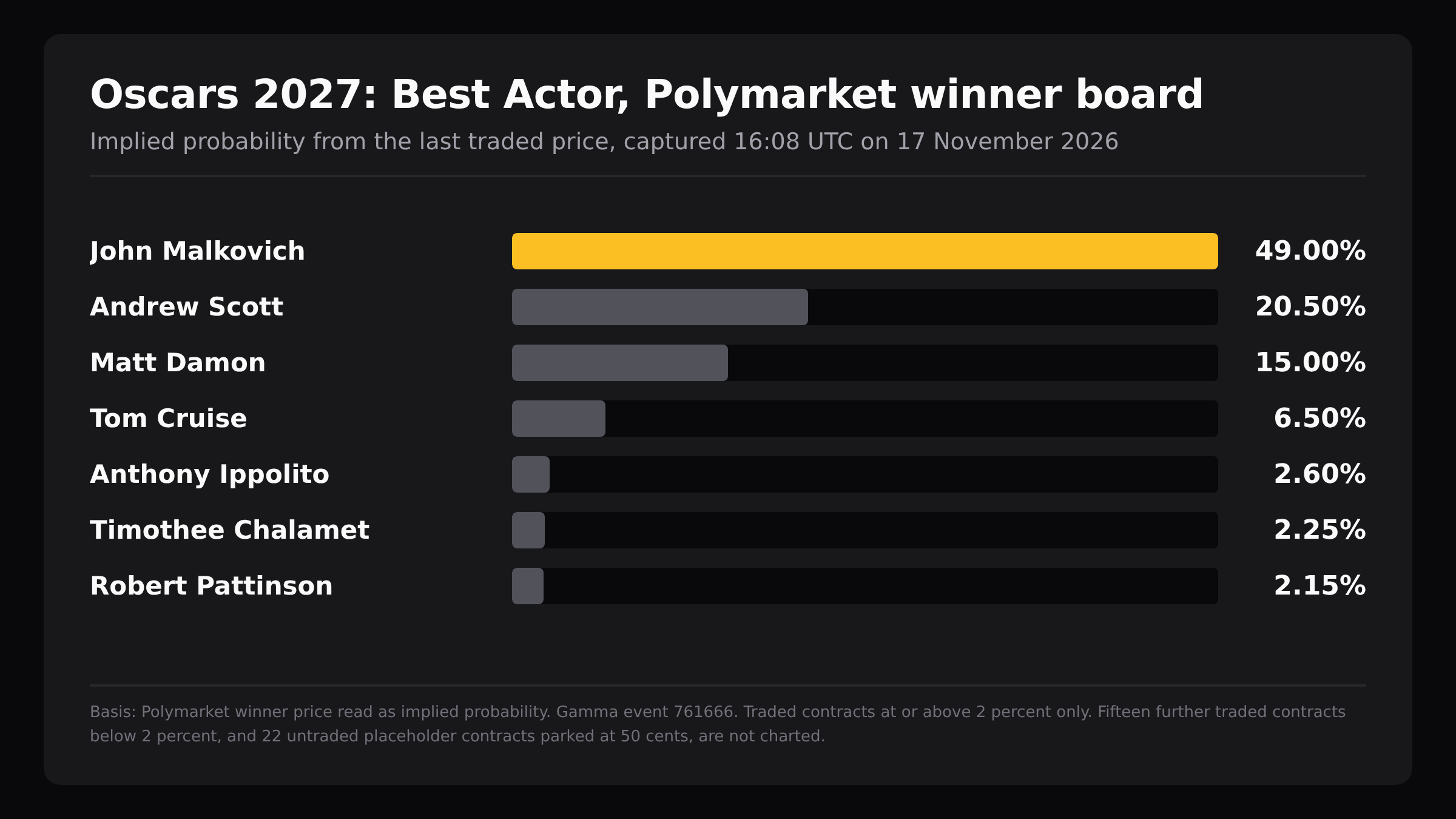
ScreenOdds chart. Prices captured from the Polymarket Gamma public event endpoint at 16:08 UTC on 17 November 2026.
Key takeaways
Polymarket prices John Malkovich at 49.00 percent to win Best Actor at the 99th Academy Awards, on a winner board that has turned over 349,678 dollars. He is the only contract above 21 percent.
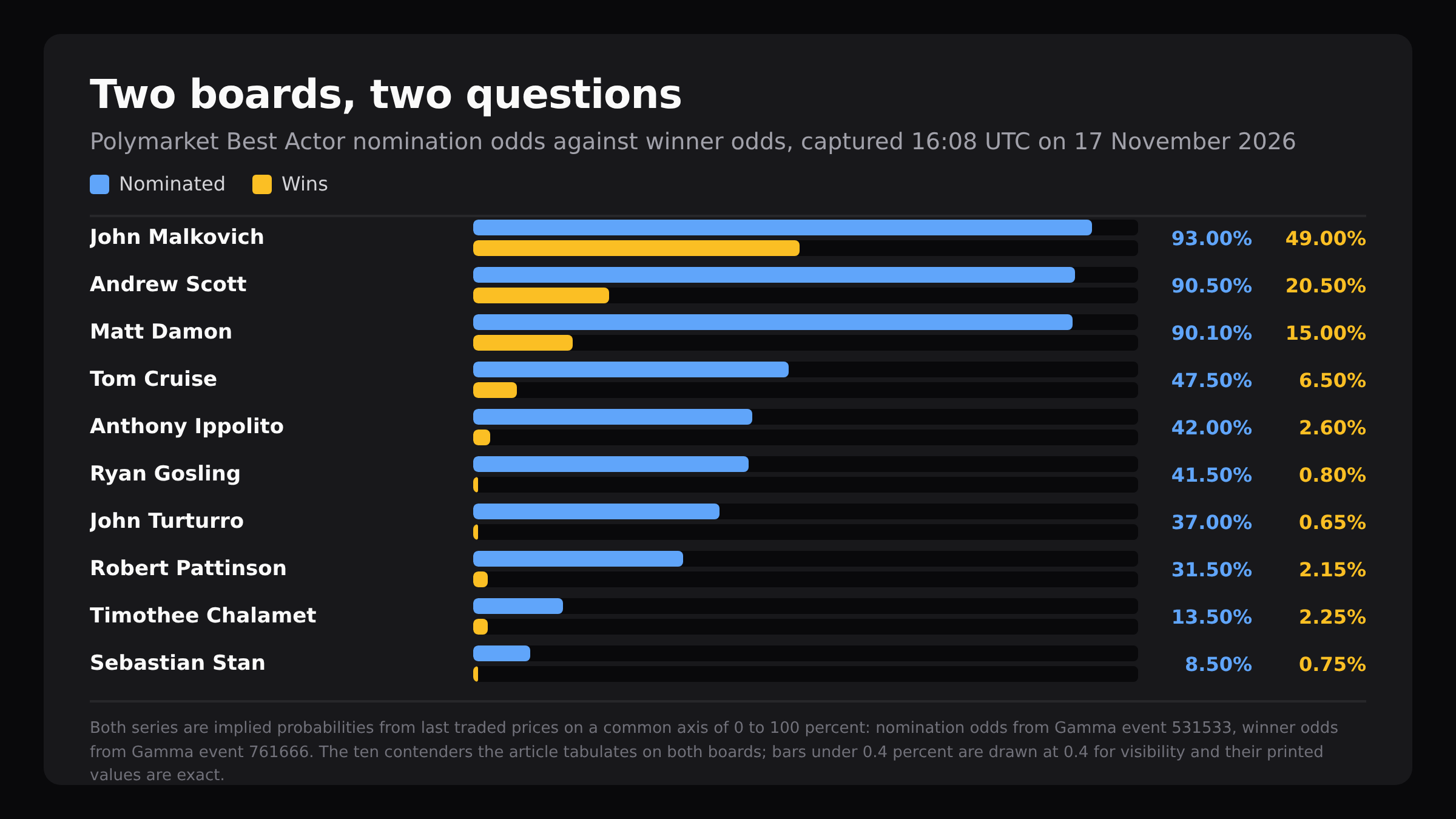
The same event runs a separate nomination market, and it is pricing a different question. Malkovich is 93.00 percent to be nominated there, Andrew Scott 90.50 percent and Matt Damon 90.10 percent, so the board already treats three of the five slots as close to settled.
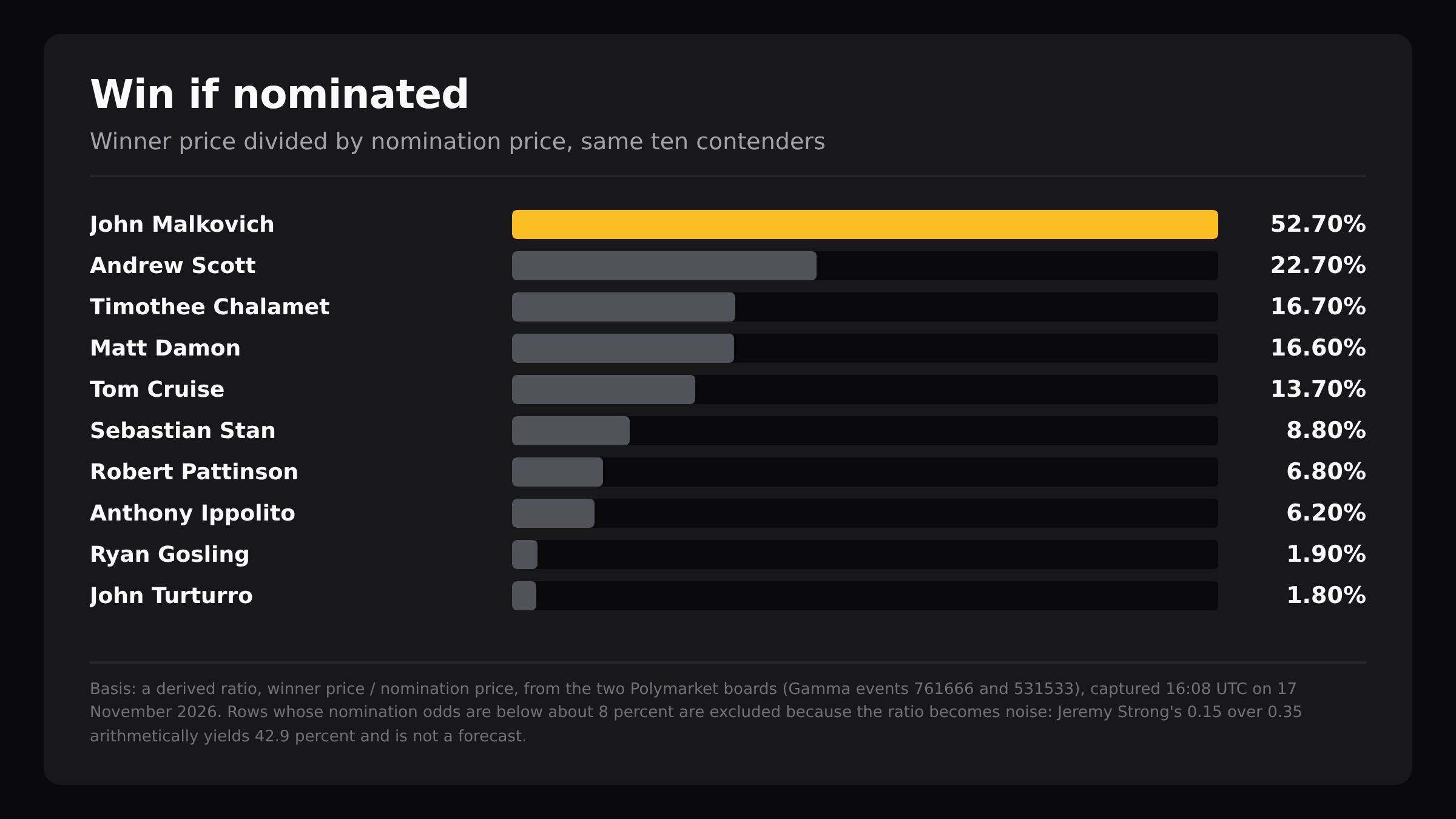
Divide one board by the other and you get a win-if-nominated figure nobody publishes. Malkovich 52.7 percent, Scott 22.7 percent, Damon 16.6 percent, Tom Cruise 13.7 percent, and then a cliff: Ryan Gosling 1.9 percent and John Turturro 1.8 percent despite both being better than one-in-three to be nominated.
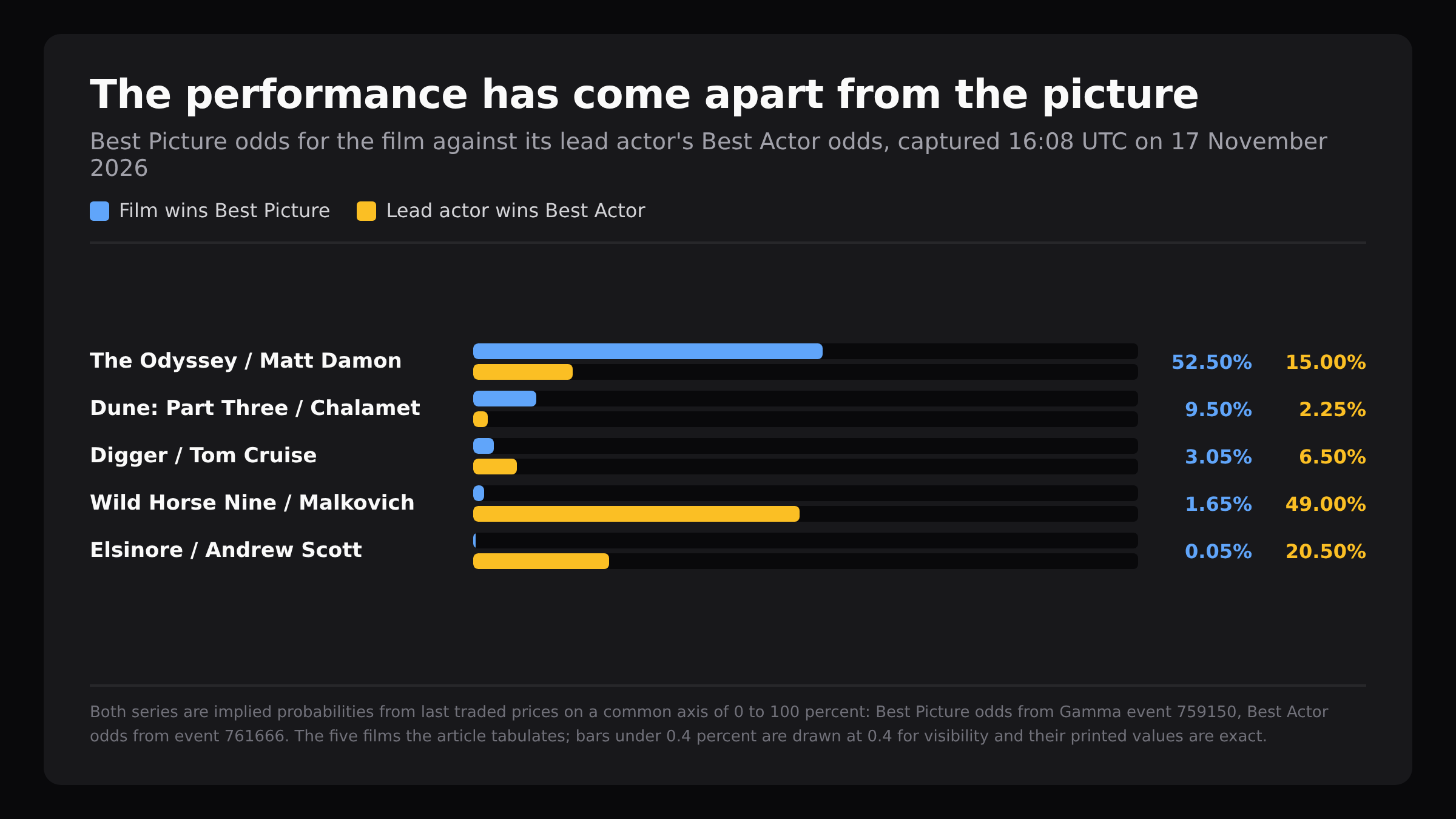
Malkovich leads the acting race while his film does not lead anything. Wild Horse Nine trades at 1.65 percent on the Best Picture board, against 52.50 percent for Matt Damon's The Odyssey. The market has decoupled the performance from the picture.
Kalshi lists 59 Best Actor contracts across two series and has quoted none of them. Every one of the 25 winner contracts and 34 nomination contracts returned no bid, no ask and zero volume when we read the API, so Polymarket is the only priced Best Actor board in this cycle.
Both boards carry an overround. The 22 traded winner contracts sum to 102.90 percent, and the 19 nomination contracts sum to 533.75 percent against the 500 that five slots allow.
On this page
Where the Best Actor winner board stands today, what the separate nomination board is actually pricing, and what happens when you divide one by the other. Why the favourite's film is a 1.65 percent longshot for Best Picture.
Then: why Kalshi has 59 Best Actor contracts and no prices at all, the 22 placeholder contracts that push the raw winner board past 1,200 percent, the new Academy rule that lets one actor take two of the five slots, the calendar between now and 14 March 2027, and seven questions readers keep asking.
Best Actor odds today: one real favourite and a long tail
If you looked up Best Actor odds this week, the figure you were handed was probably a Kalshi price from September. We checked: that board is not quoting at all right now. The only Best Actor market with live prices is on Polymarket, so that is where these numbers come from.
We read the Polymarket Gamma event API directly rather than any summary of it, at 16:08 UTC on 17 November 2026. The winner event has turned over 349,678 dollars with 301,749 dollars of liquidity. Prices below are the last traded price, with the live bid and ask spread beside them.
Contender (film) | Win odds | Volume | Bid-ask spread
John Malkovich (Wild Horse Nine) | 49.00% | $40,252 | 1.4pp
Andrew Scott (Elsinore) | 20.50% | $31,116 | 3.0pp
Matt Damon (The Odyssey) | 15.00% | $49,891 | 2.0pp
Tom Cruise (Digger) | 6.50% | $33,895 | 1.0pp
Anthony Ippolito (I Play Rocky) | 2.60% | $13,024 | 1.6pp
Timothee Chalamet (Dune: Part Three) | 2.25% | $15,417 | 0.1pp
Robert Pattinson (Primetime) | 2.15% | $14,476 | 0.7pp
Ryan Gosling (Project Hail Mary) | 0.80% | $12,696 | 0.8pp
Sebastian Stan (Fjord) | 0.75% | $11,905 | 0.5pp
Yura Borisov (Artificial) | 0.75% | $5,378 | 0.3pp
John Turturro (The Only Living Pickpocket in New York) | 0.65% | $12,074 | 0.5pp
Jaafar Jackson (Michael) | 0.55% | $11,562 | 0.5pp
Brad Pitt (The Adventures of Cliff Booth) | 0.25% | $15,404 | 0.1pp
Eight more names sit at 0.15 percent or below, including Pedro Pascal, Jeremy Strong, Adam Driver, Javier Bardem, Josh O'Connor, Robert Aramayo and Sam Rockwell, each with roughly 11,000 to 13,000 dollars traded.
Two things in that list are worth more attention than the favourite. The most heavily traded contract on the board is not Malkovich at 49 percent but Matt Damon at 15 percent, with 49,891 dollars turned over. And Andrew Scott's 3.0 point spread is the widest of any contender above 5 percent, which is the market telling you it is least sure about second place.
The nomination board is pricing a different question
Polymarket runs a second Best Actor market on the same ceremony, and most write-ups ignore it. It asks who gets nominated rather than who wins, it has 19 contracts against the winner board's 22 traded names, and it has turned over 259,606 dollars of its own.
It is also the less liquid of the two. Liquidity on the nomination event is 58,565 dollars against 301,749 dollars on the winner event, so the prices move on smaller size. Read it as a weaker signal, not a parallel one.
Contender | Nomination odds | Volume | Bid-ask spread
John Malkovich | 93.00% | $13,910 | 2.0pp
Andrew Scott | 90.50% | $18,066 | 1.0pp
Matt Damon | 90.10% | $13,972 | 1.8pp
Tom Cruise | 47.50% | $45,677 | 3.0pp
Anthony Ippolito | 42.00% | $16,793 | 2.0pp
Ryan Gosling | 41.50% | $20,943 | 1.0pp
John Turturro | 37.00% | $11,096 | 2.0pp
Robert Pattinson | 31.50% | $20,490 | 1.0pp
Timothee Chalamet | 13.50% | $23,918 | 1.0pp
Pedro Pascal | 10.85% | $16,225 | 1.7pp
Jaafar Jackson | 10.50% | $19,391 | 3.0pp
Sebastian Stan | 8.50% | $8,729 | 1.0pp
Seven more names trade between 4.15 percent and 0.35 percent: Josh O'Connor, Adam Driver, Brad Pitt, Sam Rockwell, Javier Bardem, Robert Aramayo and Jeremy Strong.
The shape here is the story. Three names are priced as near-locks, then there is a 43 point drop to Tom Cruise at 47.50 percent, and then four contenders bunched between 47.50 and 31.50 percent fighting over what the board treats as two remaining slots. The top five contracts sum to 363.10 percent, which means the market is confident about roughly three and a half of the five nominees and genuinely unsure about the rest.
Divide one board by the other and the race changes shape
Here is the calculation worth doing, and we have not seen anyone else run it on this race. If a contract says an actor is 41.50 percent to be nominated and 0.80 percent to win, then the market thinks that even if he gets in, he almost certainly loses. Dividing the winner price by the nomination price gives a win-if-nominated probability.
Contender | Nomination odds | Win odds | Win if nominated
John Malkovich | 93.00% | 49.00% | 52.7%
Andrew Scott | 90.50% | 20.50% | 22.7%
Matt Damon | 90.10% | 15.00% | 16.6%
Timothee Chalamet | 13.50% | 2.25% | 16.7%
Tom Cruise | 47.50% | 6.50% | 13.7%
Sebastian Stan | 8.50% | 0.75% | 8.8%
Robert Pattinson | 31.50% | 2.15% | 6.8%
Anthony Ippolito | 42.00% | 2.60% | 6.2%
Ryan Gosling | 41.50% | 0.80% | 1.9%
John Turturro | 37.00% | 0.65% | 1.8%
Read the bottom two rows first. Ryan Gosling and John Turturro are both better than one-in-three to be nominated and both under 2 percent to win. The market is pricing them as the category's respect nominees: good enough for a slot, not in the conversation for the statue.
Then look at Chalamet. His win-if-nominated figure of 16.7 percent is fractionally ahead of Matt Damon's 16.6 percent, even though Damon is 90.10 percent to be nominated and Chalamet is 13.50 percent. Traders think Dune: Part Three is a hard film to get nominated for and a reasonable one to win with, which is an unusual shape and the kind of thing only this ratio surfaces.
One caution on method. These ratios are only as good as their denominators, so ignore them below about 8 percent nomination odds. Jeremy Strong's 0.15 percent win against 0.35 percent nomination arithmetically yields 42.9 percent, which is not a forecast, it is two tiny numbers dividing into noise.
Malkovich leads the acting race while his film sits at 1.65 percent
John Malkovich won the Volpi Cup for Best Actor at the 83rd Venice International Film Festival, announced on 12 September 2026, for his performance as a CIA agent in Martin McDonagh's Wild Horse Nine. It was the only prize the film took at the Lido.
That single award is carrying his whole price. He is 49.00 percent to win Best Actor, and he has never won an Academy Award in a career of more than four decades, which is exactly the narrative a category like this rewards.
What makes the position strange is the Best Picture board, which we read from the same Gamma snapshot. Wild Horse Nine trades at 1.65 percent to win Best Picture. The Odyssey, which carries Matt Damon, trades at 52.50 percent.
Film | Best Picture odds | Lead actor | His Best Actor odds
The Odyssey | 52.50% | Matt Damon | 15.00%
Dune: Part Three | 9.50% | Timothee Chalamet | 2.25%
Digger | 3.05% | Tom Cruise | 6.50%
Wild Horse Nine | 1.65% | John Malkovich | 49.00%
Elsinore | 0.05% | Andrew Scott | 20.50%
So the two highest-priced Best Actor contracts belong to films the same traders price at 1.65 percent and 0.05 percent for Best Picture. That is not a contradiction. Best Actor has gone to a performance from outside the Best Picture winner in nine of the last ten ceremonies, the one exception being Cillian Murphy for Oppenheimer in 2024, and as recently as March 2026 Michael B. Jordan won for Sinners while One Battle After Another took Best Picture. A performance prize travels perfectly well on a film nobody expects to win. But it does mean the usual shortcut of reading the Best Picture favourite as the acting favourite would have you backing Damon at 15 percent.
Kalshi lists 59 Best Actor contracts and has quoted none of them
ScreenOdds normally compares the two venues contract by contract, as we do for Best Actress and for the Oscars boards generally. On Best Actor that comparison is not available this cycle, and the reason is worth recording.
Kalshi lists two Best Actor series for 2027. KXOSCARACTO, the winner market, carries 25 contracts. KXOSCARNOMACTO, the nomination market, carries 34. We queried both through the public Kalshi trade API at 16:05 UTC on 17 November 2026 with status set to open.
Series | Contracts | Quoted | Total volume
KXOSCARACTO (winner) | 25 | 0 | 0
KXOSCARNOMACTO (nomination) | 34 | 0 | 0
Every contract in both series returned a null bid, a null ask and zero volume. The markets are listed and open, with a close time of 31 December 2027, and nobody has traded them. Malkovich, Damon, Scott and Cruise are all there as tickers with no price attached.
This matters because the most visible prediction-market article on this race quotes Kalshi prices for Best Actor from late September: Malkovich at 36 cents, Damon at 26 cents, Scott at 17 cents. Those were real prices once. They are not quotes you could trade against today, and a reader comparing them to Polymarket's 49.00 percent would conclude the two venues disagree by 13 points when in fact only one venue is open for business.
If you want the venue comparison itself, our Kalshi versus Polymarket Oscars guide works through fees, settlement and access on the categories where both boards are live.
The 22 placeholder contracts behind a 1,203 percent board
Add up every contract on the Polymarket winner event and you get 1,202.90 percent, which would be a spectacular arbitrage if it were real. It is not. The event carries 44 contracts and 22 of them are placeholders.
They are named Actor F through Actor Z, plus one called Other. Each sits at exactly 50.00 percent with zero volume, a zero bid and a one-dollar ask, which is what an untraded slot looks like when a market maker has never touched it. Twenty-two contracts parked at 50 cents add 1,100 points to the sum on their own.
Strip them out and the 22 traded contracts sum to 102.90 percent. That 2.90 point overround is the real number, and it is modest for a long-dated awards board. The nomination board needs the same treatment in reverse: its 19 contracts sum to 533.75 percent, and because five slots allow 500, the overround there is 33.75 points, or about 6.75 points per slot.
The practical rule is simple. Before you trust any sum you compute off an awards board, check how many of its contracts have ever traded. A placeholder contract is not a price, and on this event it is more than half the board.
One more structural quirk, in the other direction. Three names can win on the winner board but do not exist on the nomination board at all: Yura Borisov, Mahershala Ali and Guy Pearce. The board will pay out on a Borisov win and offers you no way to price his nomination, which is a gap in the product rather than a view about his chances.
One actor, two slots: the rule the nomination board has to absorb
On 1 May 2026 the Academy changed its acting rules for this ceremony. A performer can now receive more than one nomination in the same acting category in the same year, provided each performance finishes in the top five by votes. The old rule allowed one lead and one supporting nod, never two in one category.
That has a direct consequence for the nomination market that nobody is pricing out loud. Andrew Scott is in contention for Elsinore and has been mentioned for Pressure. Robert Pattinson carries Primetime and appears in The Odyssey. Under the new rule either man could take two of the five slots.
If that happens, the five nomination contracts that resolve YES will not belong to five different actors, and the 533.75 percent the board currently sums to is not the same thing as five distinct names. It is worth checking how any nomination contract you hold defines its own resolution before January.
The same rules update barred generative AI from the acting categories: an eligible performance must be credited in the film's billing and demonstrably performed by a human with their consent. That has no bearing on this year's board, where every contract is a working actor, but it closes a question traders had been asking about synthetic performers.
What has to happen before 14 March 2027
The 99th Academy Awards are on Sunday 14 March 2027 at the Dolby Theatre, with Conan O'Brien hosting for a third consecutive year. Between now and then the Best Actor board has four dated events to absorb, and the first is a week away.
Date | Event | Why it matters for this board
24 November 2026 | Golden Globes film nomination ballots go out | First industry-wide vote on this field
4 December 2026 | Globes film nomination voting closes | Field is locked before any result is public
7 December 2026 | Golden Globes nominations announced | First hard evidence of who the industry is watching
10 January 2027 | 84th Golden Globes ceremony | First major televised Best Actor result
11 to 15 January 2027 | Academy nominations voting | The only window that settles the nomination board
21 January 2027 | Oscar nominations announced | Nomination contracts resolve
25 February to 4 March 2027 | Academy final voting | The only window that settles the winner board
14 March 2027 | 99th Academy Awards | Winner contracts resolve
Note what is missing from that list. The Academy's preliminary voting in December and the shortlists announced on 15 December cover categories like documentary and visual effects, not acting, so the mid-December dates that move other boards do nothing here.
The date to watch is 7 December. The Globes are the first body to publish a full set of lead-actor nominees, and on a board where four contenders are bunched between 47.50 and 31.50 percent to be nominated, a Globes list that includes Gosling and excludes Cruise would reprice that cluster immediately. Our precursor awards guide works through which of these bodies actually predicts the Academy and which just gets there first.
Sources
Oscars 2027: Best Actor Winner (Gamma event 761666)
Polymarket | Accessed 2026-11-17
Oscars 2027: Best Actor Nominations (Gamma event 531533)
Polymarket | Accessed 2026-11-17
Oscars 2027: Best Picture Winner (Gamma event 759150)
Polymarket | Accessed 2026-11-17
Kalshi Best Actor winner series KXOSCARACTO
Kalshi | Accessed 2026-11-17
Kalshi Best Actor nomination series KXOSCARNOMACTO
Kalshi | Accessed 2026-11-17
Official Awards of the 83rd Venice International Film Festival
La Biennale di Venezia | Accessed 2026-11-17
The 84th Annual Golden Globes Timetable, Eligibility Rules and Campaign Guidelines Announced
Golden Globes | Accessed 2026-11-17
Oscars Rule Changes: AI Limits, Multiple Acting Nominations Allowed
Variety | Accessed 2026-11-17
99th Academy Awards
Wikipedia | Accessed 2026-11-17
98th Academy Awards
Wikipedia | Accessed 2026-11-17
Oscars 2027 Best Actor Predictions: Nominees, Contenders, and Winner
ScreenRant | Accessed 2026-11-17
FAQ
Who is the favourite for Best Actor at the 2027 Oscars?
John Malkovich, at 49.00 percent on Polymarket as of 17 November 2026, for Wild Horse Nine. He is more than twice the price of the next contender, Andrew Scott at 20.50 percent. Malkovich won the Volpi Cup for Best Actor at Venice in September 2026 and has never won an Academy Award.
Can I bet on Best Actor on Kalshi?
Kalshi lists 25 Best Actor winner contracts and 34 nomination contracts for 2027, but when we read its public API on 17 November 2026 every one returned no bid, no ask and zero volume. The markets exist and nothing is trading on them, so there is no Kalshi price to compare against Polymarket this cycle.
Why is Malkovich 49 percent to win but his film only 1.65 percent for Best Picture?
Because the two awards come apart more often than not. Best Actor has gone to a performance from outside the Best Picture winner in nine of the last ten ceremonies, and in March 2026 it went to Michael B. Jordan for Sinners while One Battle After Another won Best Picture. The market is pricing a single performance in Wild Horse Nine, not the film's overall standing.
What does win-if-nominated mean?
It is the winner price divided by the nomination price for the same actor. It tells you what the market thinks happens once an actor is in the field. Malkovich is 52.7 percent, Andrew Scott 22.7 percent, Ryan Gosling 1.9 percent. Ignore the figure when the nomination price is below about 8 percent, because the ratio becomes noise.
Why do the Best Actor odds add up to more than 100 percent?
Two reasons. The winner event carries 22 untraded placeholder contracts parked at 50 cents each, which inflates the raw sum to 1,202.90 percent. Strip those out and the traded contracts sum to 102.90 percent, a 2.90 point overround. The nomination board sums to 533.75 percent because five slots allow 500.
When are the 2027 Oscar nominations announced?
Nominations for the 99th Academy Awards are announced on 21 January 2027, after a voting window that runs from 11 to 15 January. That is when the Polymarket nomination contracts resolve. The ceremony itself is on 14 March 2027, and final voting runs from 25 February to 4 March.
Can one actor really get two Best Actor nominations?
Yes, since the Academy's rules update of 1 May 2026. A performer can now take more than one slot in the same acting category if each performance places in the top five by votes. Andrew Scott and Robert Pattinson are the two contenders this field most plausibly applies to.