Awards
Kalshi vs Polymarket Oscars Odds 2026: Which Is Right?
We matched the 99th Oscars Best Picture and Best Actor boards on Kalshi and Polymarket on October 27, 2026. Same favorites, 35 points of difference.
Keyword
kalshi vs polymarket oscars
US volume
0
Difficulty
0
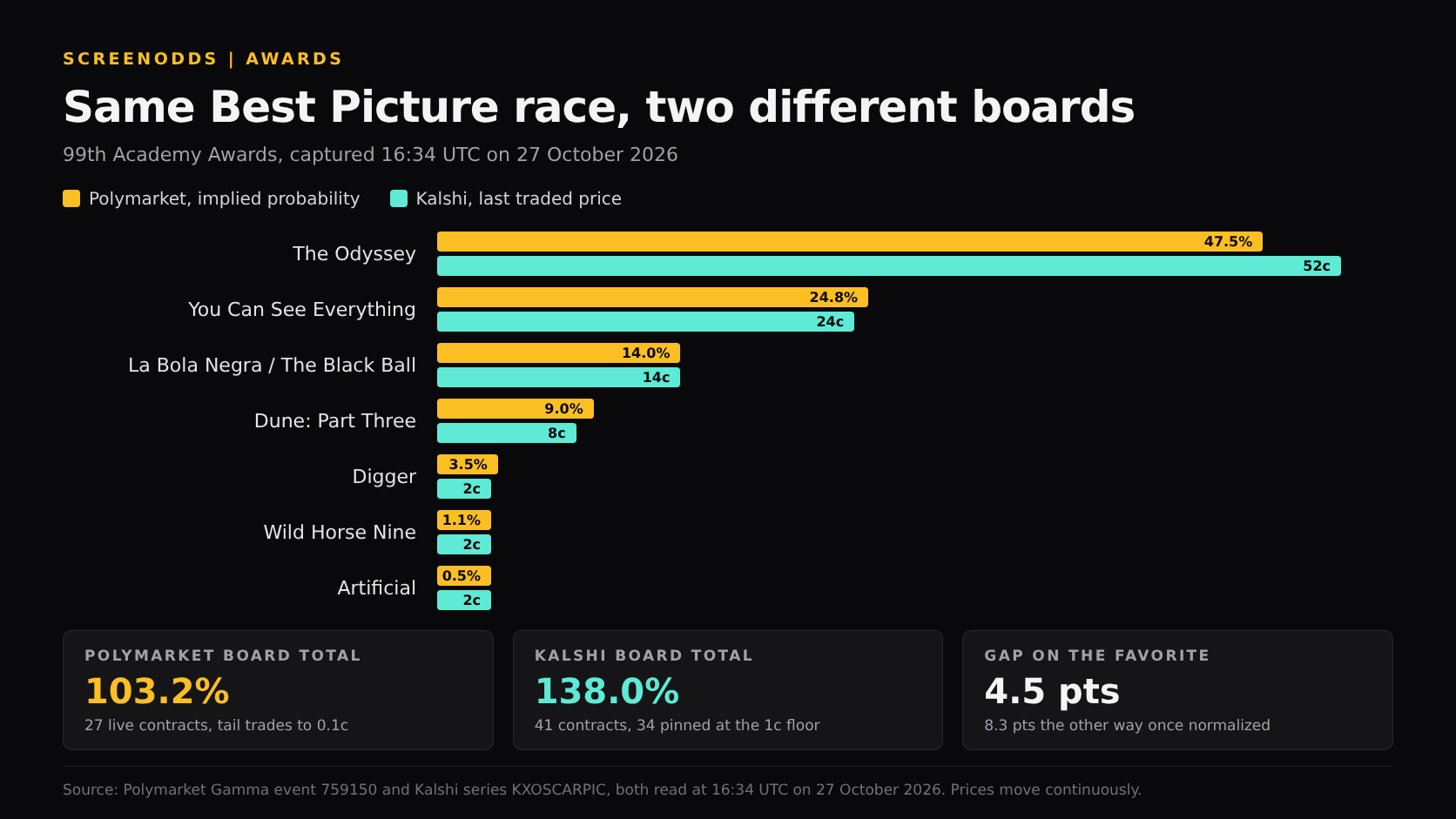
ScreenOdds chart. Prices captured from the Polymarket Gamma and Kalshi public market endpoints at 16:34 UTC on October 27, 2026.
Key takeaways
Both venues make The Odyssey the Best Picture favorite for the 99th Academy Awards, and neither agrees on the price. Polymarket had it at 47.5 percent and Kalshi at 52 cents when we pulled both boards at 16:34 UTC on October 27, 2026. That is a 4.5 point gap on the most heavily traded contract on either board.
Kalshi's Best Picture board sums to 138 percent. Polymarket's sums to 103.2 percent. Almost all of that 35 point difference is one design decision rather than 35 points of trading disagreement.
Kalshi quotes 41 Best Picture contracts and 34 of them sit at exactly 1 cent, which is the floor of its price grid. Polymarket quotes 27 and lets the longshots trade in tenths of a cent, so its tail prices at 0.1 to 0.2 percent instead.
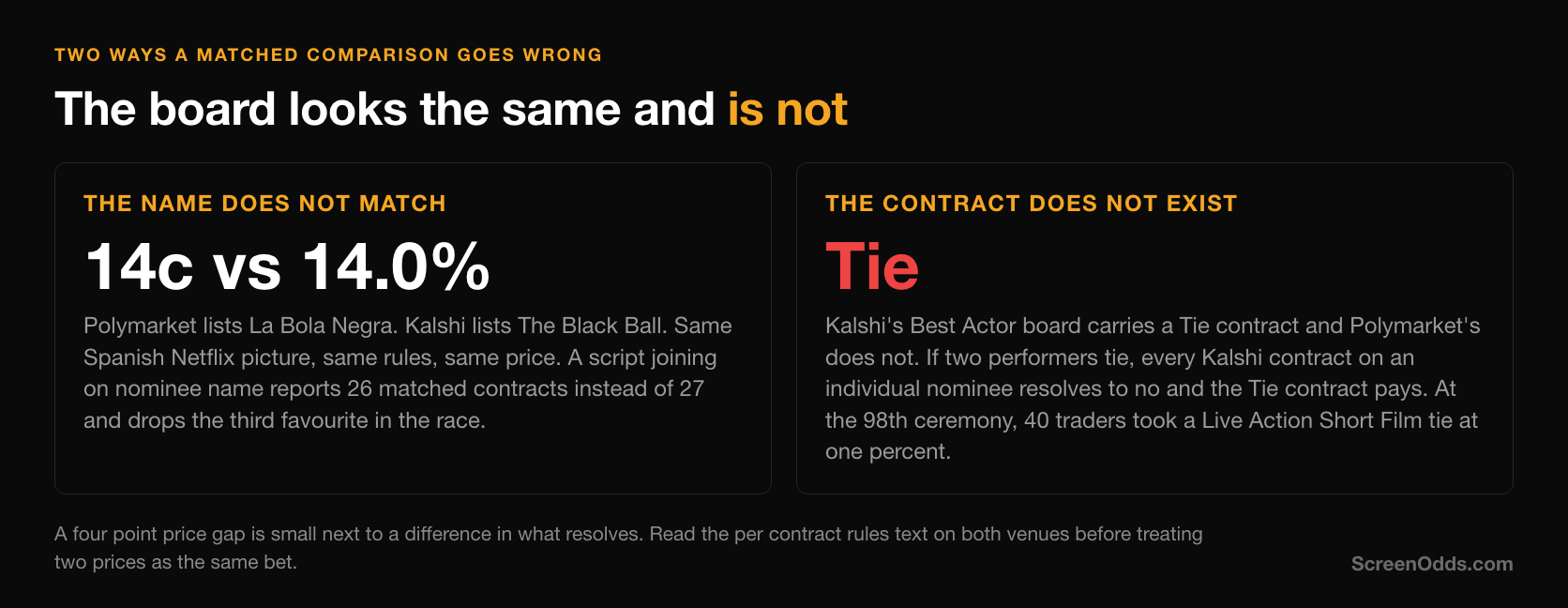
The two venues do not always use the same name for the same film. Polymarket lists La Bola Negra, Kalshi lists The Black Ball. It is the same Spanish Netflix picture, and any price comparison that matches on title will quietly drop it.
Kalshi runs a Tie contract in Best Actor. Polymarket does not. That is a resolution rule rather than a rounding difference, and in a category with a real tie it matters far more than the price gaps above.
On this page: why the two boards disagree, the full Best Picture and Best Actor comparison, what a one cent tick does to a longshot, the nominee name mismatches, what each venue charges you, who is allowed to trade where, and how to read a two venue board without getting burned.
Why the same Oscar race prices differently on two venues
Every Oscars odds page will tell you which film is the favorite. Almost none will tell you that the favorite is 47.5 percent on one venue and 52 cents on another at the same minute, or which half of that gap is information and which half is plumbing. That vagueness has a price: more than 44 million dollars was traded on the Best Picture winner alone across Kalshi and Polymarket at the 98th ceremony, and the 99th board on Polymarket is already carrying 608,493 dollars of volume and 471,047 dollars of resting liquidity with 138 days to go.
This article does one thing. It takes the two live Oscar boards, matches them contract by contract, and explains every difference that turns up. Some of those differences are traders disagreeing. Most of them are not.
We pulled both boards from the venues' own public endpoints at 16:34 UTC on October 27, 2026: the Polymarket Gamma event for Oscars 2027 Best Picture and Best Actor, and the Kalshi markets endpoint for series KXOSCARPIC and KXOSCARACTO. Every number below is from that single capture, so the comparisons are simultaneous rather than stitched together from two different afternoons.
One framing note before the numbers. Kalshi calls this the 99th Academy Awards; Polymarket calls it Oscars 2027. They are the same ceremony, scheduled for Sunday, March 14, 2027 at the Dolby Theatre, with nominations announced on January 21, 2027. Nothing on either board is a nominee yet. Both are pricing a field that the Academy has not drawn up.
Best Picture for the 99th Oscars: the two boards side by side
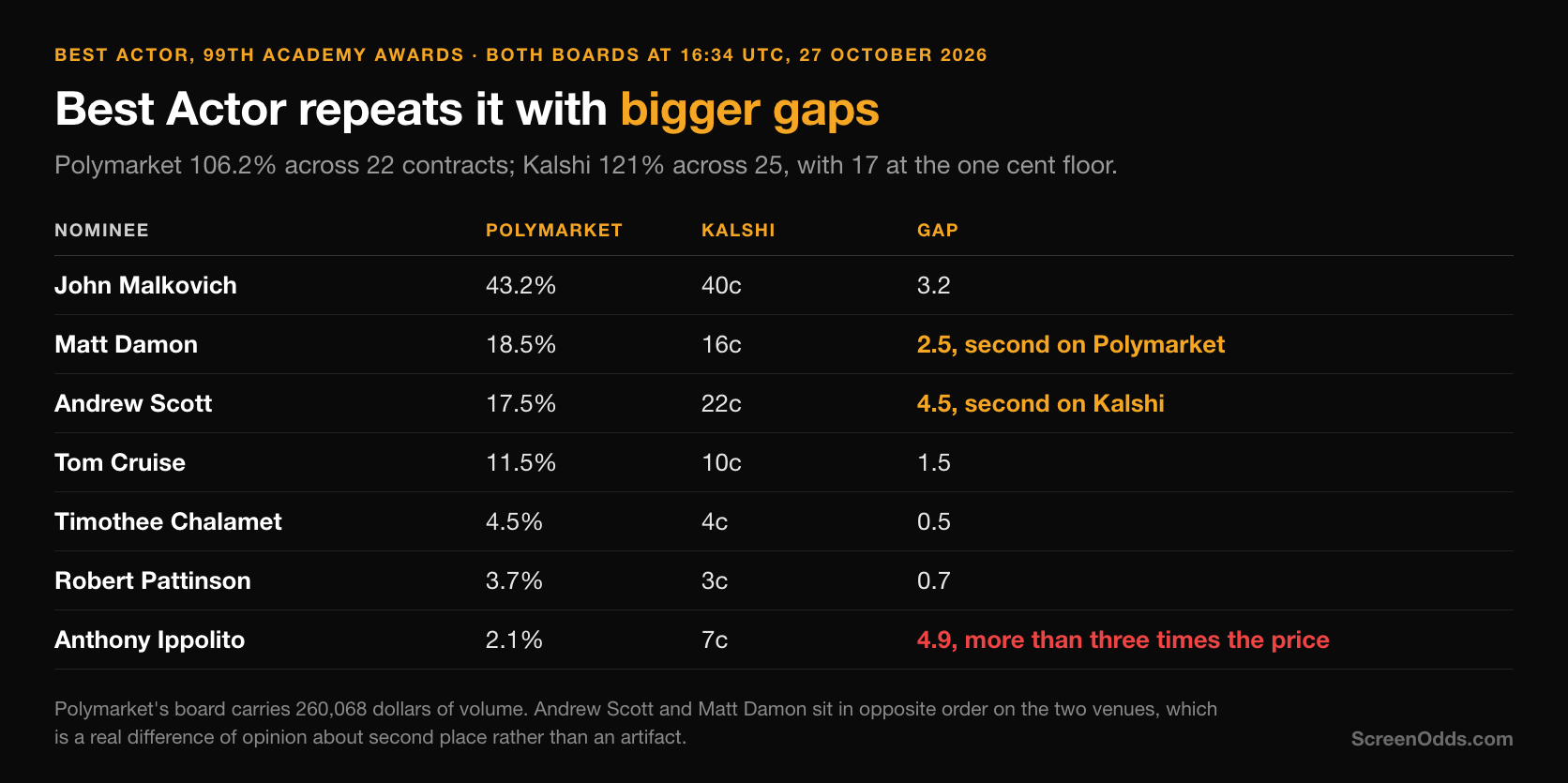
Here is the Best Picture board as both venues had it at 16:34 UTC on October 27, 2026. Polymarket figures are mid prices expressed as implied probability; Kalshi figures are the last traded price in cents, which on a contract that pays one dollar is the same unit.
The Odyssey: Polymarket 47.5 percent, Kalshi 52 cents, gap 4.5 points. You Can See Everything: Polymarket 24.8 percent, Kalshi 24 cents, gap 0.8. La Bola Negra, which Kalshi lists as The Black Ball: Polymarket 14.0 percent, Kalshi 14 cents, gap 0.0. Dune: Part Three: Polymarket 9.0 percent, Kalshi 8 cents, gap 1.0. Digger: Polymarket 3.5 percent, Kalshi 2 cents, gap 1.5. Wild Horse Nine: Polymarket 1.1 percent, Kalshi 2 cents, gap 0.9. Artificial: Polymarket 0.5 percent, Kalshi 2 cents, gap 1.5.
Read the top of that board and the two venues look like one market. Three of the top four contracts agree inside a point, and the second and third favorites are effectively identical. The only meaningful disagreement among the contenders is The Odyssey, where Kalshi is 4.5 points more confident than Polymarket.
For scale, that is wider than the two venues were on the night of the 98th ceremony. On March 15, 2026, One Battle After Another was quoted around 80 percent on Polymarket and 78 percent on Kalshi, two points apart, hours before it won. Boards converge as the information arrives; four and a half points in late October, with the nominations still three months out, is ordinary.
Now read the bottom of the board, and the two venues stop looking like one market at all.
The 138 percent board: what a one cent tick does to a longshot
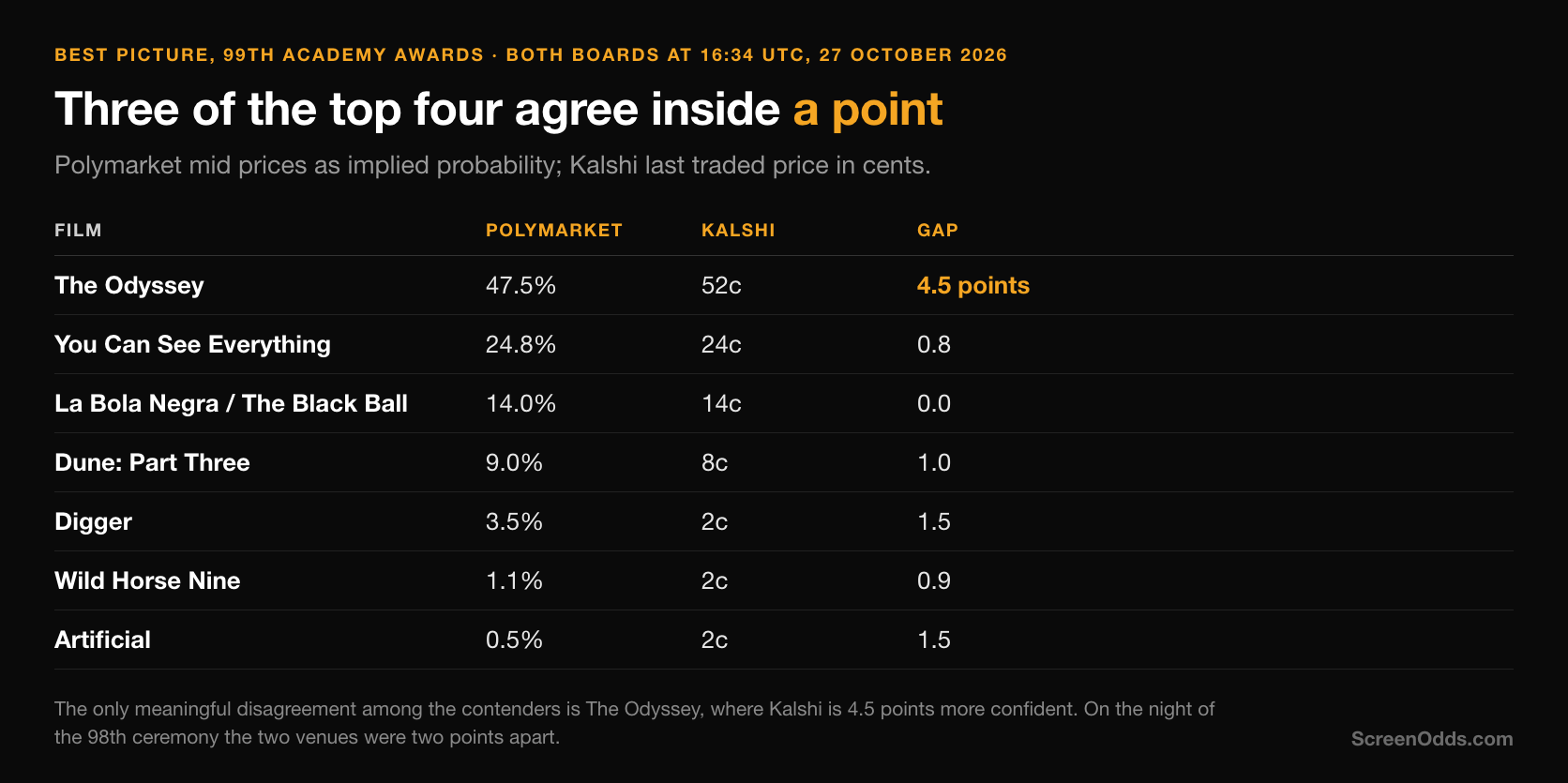
Add up every implied probability on Polymarket's Best Picture board and you get 103.2 percent across 27 live contracts. Do the same on Kalshi and you get 138 percent across 41. On a market where exactly one outcome can happen, the honest total is 100, and the excess is what a bettor would call the overround.
Thirty five points of overround sounds like a venue gouging its traders. It is not. It is a tick size.
Kalshi's own market object describes its price grid as linear_cent with a step of 0.01, so the smallest price a Kalshi contract can trade at is one cent. Polymarket's contracts carry a minimum tick of 0.01 while they are near the money and 0.001 once they are cheap, which is why its tail quotes read 0.1 and 0.2 percent. That single difference does all the work: 34 of Kalshi's 41 Best Picture contracts sit at the one cent floor, and 34 cents of phantom probability is almost exactly the 34.8 point gap between the two boards.
This is not a Kalshi flaw so much as a Kalshi fact, and it has a direct consequence for anyone reading the board. A film quoted at 1 cent on Kalshi is not a one percent chance. It is the cheapest price the exchange can express, which is a different statement, and on a 41 horse field it is closer to a rounding artifact than a forecast.
The practical rule: normalize before you compare. Divide each Kalshi price by the board total and the structure snaps back into line. The Odyssey at 52 of 138 is 37.7 percent, against Polymarket's 47.5 of 103.2, which is 46.0 percent. That is an 8.3 point disagreement on the favorite, and it is the opposite sign to the raw comparison. Which of those two numbers you want depends on whether you are reading the board as a price or as a forecast, and the answer is almost never both.
Best Actor shows the same pattern with bigger disagreements
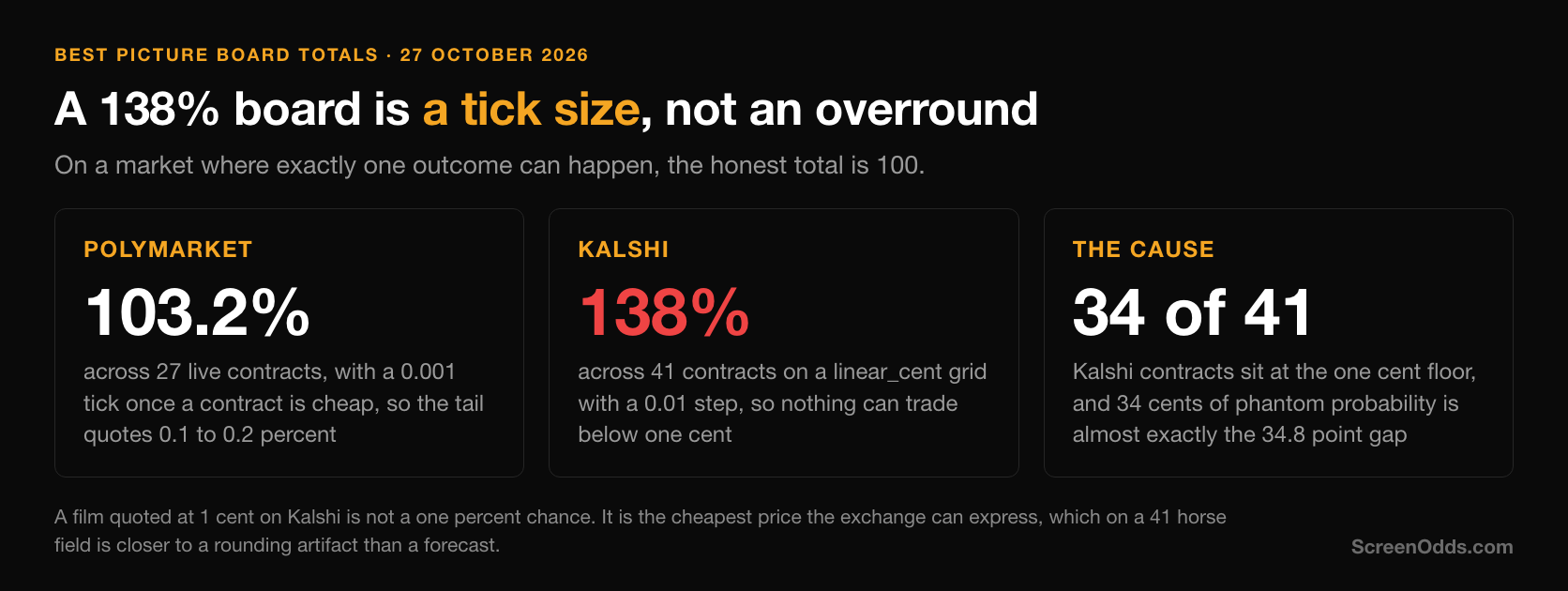
Best Actor is the second most liquid Oscar market on either venue and it repeats the structure exactly. Polymarket's board carries 260,068 dollars of volume across 22 live contracts and sums to 106.2 percent. Kalshi's KXOSCARACTO-27 event carries 25 contracts, sums to 121 percent, and has 17 of them parked at the one cent floor.
Contract by contract at the same 16:34 UTC capture. John Malkovich: Polymarket 43.2 percent, Kalshi 40 cents, gap 3.2. Matt Damon: Polymarket 18.5 percent, Kalshi 16 cents, gap 2.5. Andrew Scott: Polymarket 17.5 percent, Kalshi 22 cents, gap 4.5. Tom Cruise: Polymarket 11.5 percent, Kalshi 10 cents, gap 1.5. Anthony Ippolito: Polymarket 2.1 percent, Kalshi 7 cents, gap 4.9. Timothee Chalamet: Polymarket 4.5 percent, Kalshi 4 cents, gap 0.5. Robert Pattinson: Polymarket 3.7 percent, Kalshi 3 cents, gap 0.7.
Two of those gaps are worth stopping on. Andrew Scott and Matt Damon are in opposite order on the two venues, which is a genuine difference of opinion about second place rather than an artifact. And Anthony Ippolito is 7 cents on Kalshi against 2.1 percent on Polymarket, more than three times the price, on a contract neither venue has traded heavily.
The second one is the kind of gap that looks like free money and usually is not. A 4.9 point spread on a longshot is thin enough that a single resting order moves it, the two venues settle in different currencies on different rails, and the position has to be carried for 138 days. Our own guide to prediction market arbitrage works through why cross venue spreads of this size rarely survive contact with fees and capital lockup.
La Bola Negra is The Black Ball: nominee names do not match
The single most expensive mistake available on a two venue entertainment board is not mispricing. It is matching on the wrong string.
Polymarket lists the Spanish Netflix film as La Bola Negra. Kalshi lists the same picture, under the same rules, as The Black Ball. Both quote it at 14 on the Best Picture board. A comparison script that joins the two boards on nominee name drops it silently, reports 26 matched contracts instead of 27, and leaves the third favorite in the race out of the analysis entirely.
This is not an edge case for this film. La Bola Negra won the People's Choice Award at the 2026 Toronto International Film Festival and is Spain's submission for Best International Feature at the 99th Academy Awards, which makes it one of the most heavily covered titles in the field. Non English titles are exactly where the two venues diverge, because one venue tends to use the original title and the other the distributor's English one.
Title drift is not the only mismatch in the field either. Polymarket carries seven Best Picture contracts Kalshi does not list, among them The Adventures of Cliff Booth, Behemoth! and Saturn Return. Kalshi carries 21 Polymarket does not, among them Tender Loving Care, Primetime and Being Heumann. Before you conclude a venue has mispriced a film, check that the other venue has actually opened a market on it.
Kalshi prices a tie, Polymarket does not
Tucked into Kalshi's Best Actor board is a contract called Tie. Polymarket's board has no such contract.
That is a resolution rule, and resolution rules are where real money is lost. If two performers tie for Best Actor, every Kalshi contract on an individual nominee resolves to no, and the Tie contract pays. On Polymarket the same event has to be handled by the market's written resolution criteria rather than by a contract you can hold, which is a materially different risk even though both boards look the same on screen.
Academy ties are rare and they are not hypothetical. At the 98th ceremony Kalshi ran a market on a tie in Live Action Short Film that 40 traders took at one percent, and Variety wrote it up precisely because the long tail of awards markets is where the odd outcomes live.
The general point holds well beyond ties. Both venues publish per contract rules text, and on Kalshi it is a field on the market object itself: the Best Picture contracts read, in full, that the market resolves to yes if the named film has won Best Picture at the 99th Academy Awards. Read that text on both venues before you treat two prices as the same bet, because a four point price gap is small next to a difference in what resolves.
What it costs to trade an Oscar contract on each venue
Fees are the part of this comparison where the public record is least stable, so here is what can be said with confidence and what cannot.
Both venues use fee formulas of the same shape: a rate multiplied by the number of contracts, the price, and one minus the price. That shape means the fee peaks on a coin flip and collapses to almost nothing on a longshot. A contract at 50 cents is the most expensive thing on the board to trade; a contract at 2 cents costs roughly a twenty fifth as much per contract, because 0.02 times 0.98 is about a twenty fifth of 0.5 times 0.5.
Both venues also charge takers rather than makers. If you cross the spread you pay; if you rest a limit order and wait to be filled you generally do not. On an Oscars board that trades thinly for months and then violently in the fortnight after nominations, that difference is worth more than the headline rate.
The rates themselves have moved repeatedly during 2026 and the secondary sources disagree with each other, including on whether Polymarket's US exchange charges a flat percentage or a formula, so we are not going to print a number we cannot verify against a primary schedule. Kalshi's published schedule is behind a bot wall that refuses automated fetches, and Polymarket's rates have changed at least twice this year. Check the live fee page on whichever venue you intend to use, and do it on the day you trade.
What this does mean for an Oscars position: the fee is close to irrelevant on the tail and material on the favorite, which is the reverse of the intuition most people bring from sportsbooks.
Access, regulation and settlement: who can trade which Oscars odds
The difference that decides which venue you actually use is not price. It is whether you are allowed on it.
Kalshi is a CFTC designated contract market and clears through its own designated clearing organization, which is why it is the venue most US readers can open an Oscars position on. Polymarket's international platform does not accept US traders, and its US exchange, acquired through QCEX, has been rolling out in beta with a narrow product set. So for a large part of this article's audience the practical answer is that the two prices are not two options: one is a market you can trade and the other is a reference price.
That access asymmetry is also why Kalshi's board can be wider and still stand. An arbitrage that requires accounts on both venues is unavailable to the traders who would otherwise close it, and a spread no one can close is a spread that persists.
Settlement differs too. Kalshi resolves against named third party sources under its exchange rules and credits accounts in dollars. Polymarket's international markets resolve through an on chain oracle with a dispute window, and settle in stablecoin. For an Oscars market the underlying fact is the same televised announcement, so the two rarely disagree on the outcome; they disagree on how long your capital is tied up afterwards, and on what happens in the gap between a result being announced and a market being settled.
How to read a two venue entertainment board without getting burned
Five habits cover almost everything in this article, and all five take under a minute.
First, sum the board. If the implied probabilities total well over 100, find out whether that is traders or tick size before you treat any single price as a forecast. On Kalshi's Oscar boards it has been tick size both times we checked.
Second, normalize before you compare across venues. The Odyssey is 4.5 points cheaper on Polymarket raw, and 8.3 points more expensive once both boards are scaled to 100. Those are different claims and only one of them answers the question you were asking.
Third, match on the film, not the string. Check the non English titles by hand, and check whether a contract missing from one venue is mispriced or simply absent.
Fourth, read the resolution text, including whether a tie contract exists. Fifth, treat any longshot gap under about five points as noise until you have seen it survive a week, because at those prices one resting order is the whole market.
If you want to watch these boards move rather than re-derive them, our Oscars hub tracks the live Best Picture and acting markets, and the awards hub carries the same treatment for the Emmys, Globes and Grammys.
Sources
The Academy and ABC Announce Show Dates For 99th and 100th Oscars
ABC / Academy of Motion Picture Arts and Sciences | Accessed 2026-10-27
Oscars 2027: Best Picture Winner market data (Gamma event 759150)
Polymarket | Accessed 2026-10-27
Kalshi Oscar for Best Picture markets (series KXOSCARPIC)
Kalshi | Accessed 2026-10-27
Polymarket API reference: list events
Polymarket Docs | Accessed 2026-10-27
40 People Took 1% Odds on Kalshi on a Rare Oscars Tie for Live Action Short Film
Variety | Accessed 2026-10-27
Who is favored to win an Oscar, according to Kalshi and Polymarket
Business Insider via AOL | Accessed 2026-10-27
La Bola Negra wins TIFF's People's Choice Award, putting it on an Oscar path
Associated Press via NY1 | Accessed 2026-10-27
99th Academy Awards
Wikipedia | Accessed 2026-10-27
FAQ
Is Kalshi or Polymarket better for Oscars odds?
It depends on where you are. Kalshi is a CFTC designated contract market and is the venue most US readers can actually open an Oscars position on, while Polymarket's international platform does not accept US traders. On price, the two boards agreed inside a point on three of the top four Best Picture contracts on October 27, 2026, so the practical difference is access rather than accuracy.
Why do Kalshi's Oscar odds add up to more than 100 percent?
Because Kalshi's price grid has a floor of one cent. On the 99th Oscars Best Picture board, 34 of its 41 contracts sit at that floor, which adds 34 points of implied probability that is really a rounding artifact. The board summed to 138 percent at our capture, against 103.2 percent on Polymarket, whose longshots can trade in tenths of a cent.
Who is the Best Picture favorite for the 99th Academy Awards?
The Odyssey, on both venues. Polymarket had it at 47.5 percent and Kalshi at 52 cents at 16:34 UTC on October 27, 2026. You Can See Everything was second at about 24 on both boards, and La Bola Negra, which Kalshi lists as The Black Ball, was third at 14.
When are the 99th Academy Awards and when do nominations come out?
The ceremony is scheduled for Sunday, March 14, 2027 at the Dolby Theatre, with the Academy and ABC having announced the date in April 2026. Nominations are announced on January 21, 2027, so every contract on both boards today is pricing a field that has not been nominated yet.
Can I arbitrage the price gap between Kalshi and Polymarket on the Oscars?
Rarely, and not on the gaps in this article. Most US traders cannot hold both legs, the fee on a near the money contract is largest exactly where the gaps are widest, and a position has to be carried for months until the ceremony. A gap under about five points on a thinly traded longshot is usually one resting order rather than an opportunity.
Do Kalshi and Polymarket use the same nominee names?
No, and it catches people out. Polymarket lists the Spanish film as La Bola Negra while Kalshi lists it as The Black Ball, and the two boards also carry different numbers of contracts entirely: seven films appear only on Polymarket and 21 only on Kalshi. Match on the film rather than the text string.
How accurate were prediction markets at the last Oscars?
Both venues had the eventual Best Picture winner as a heavy favorite going in. One Battle After Another was quoted around 80 percent on Polymarket and 78 percent on Kalshi on the afternoon of March 15, 2026, and Polymarket had called 26 of 28 categories correctly at that season's Golden Globes.