Awards
Oscar Nomination Odds 2027: Nominated Is Not Won
Oscar nomination odds for the 99th Academy Awards price five slots, not one winner. How the Polymarket and Kalshi boards read, and where they disagree.
Keyword
oscar nomination odds
US volume
90
Difficulty
34
ScreenOdds, from Polymarket Gamma API data captured 6 October 2026
Key takeaways from the 99th Oscars nomination boards
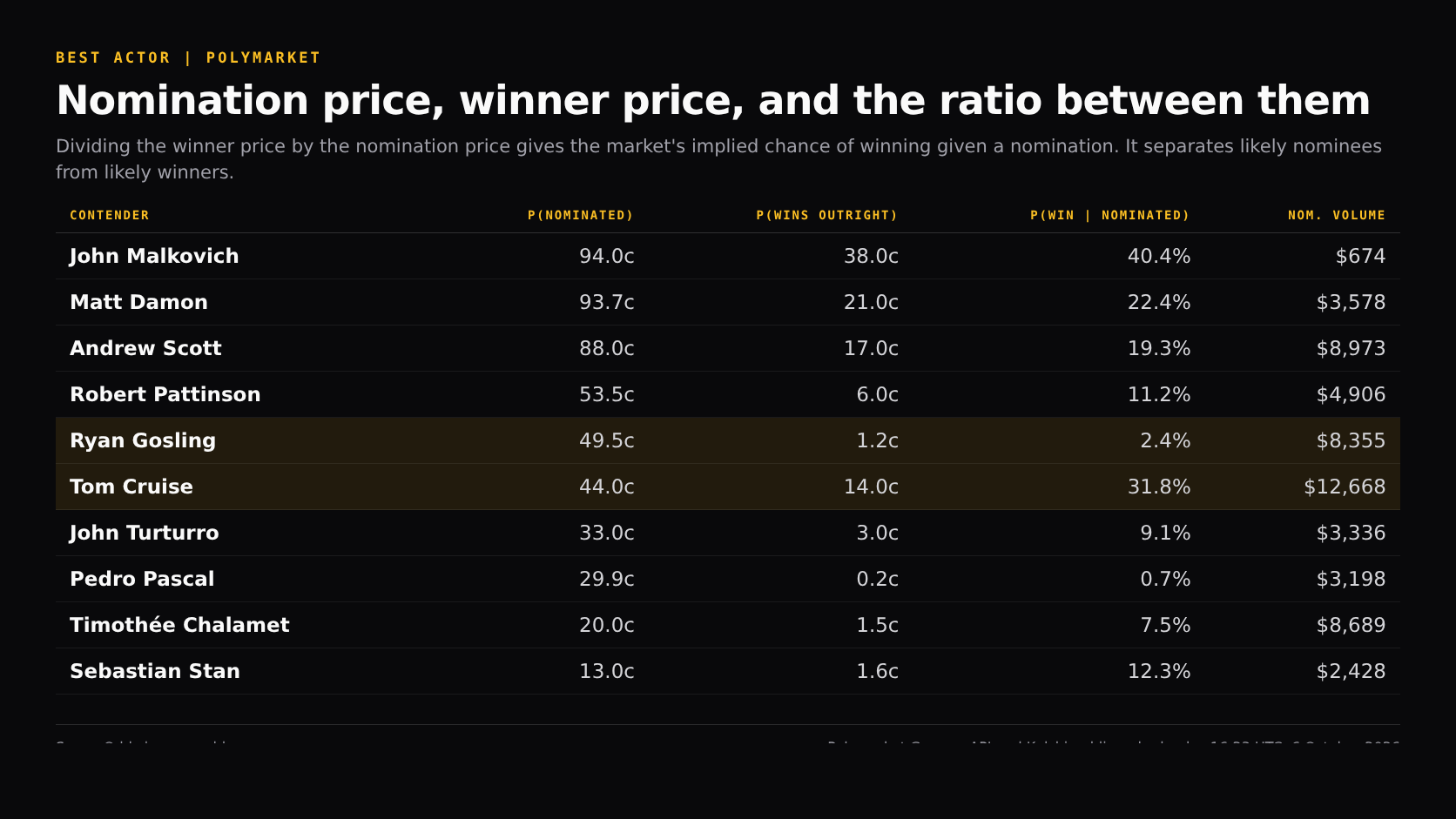
Nomination contracts and winner contracts are different bets on the same name. On Polymarket, Ryan Gosling is 49.5 cents to be nominated for Best Actor and 1.2 cents to win it, which is a 2.4 percent chance of winning given a nomination. Tom Cruise is cheaper to be nominated at 44.0 cents and dearer to win at 14.0 cents, a 31.8 percent conditional. Same category, opposite shapes.
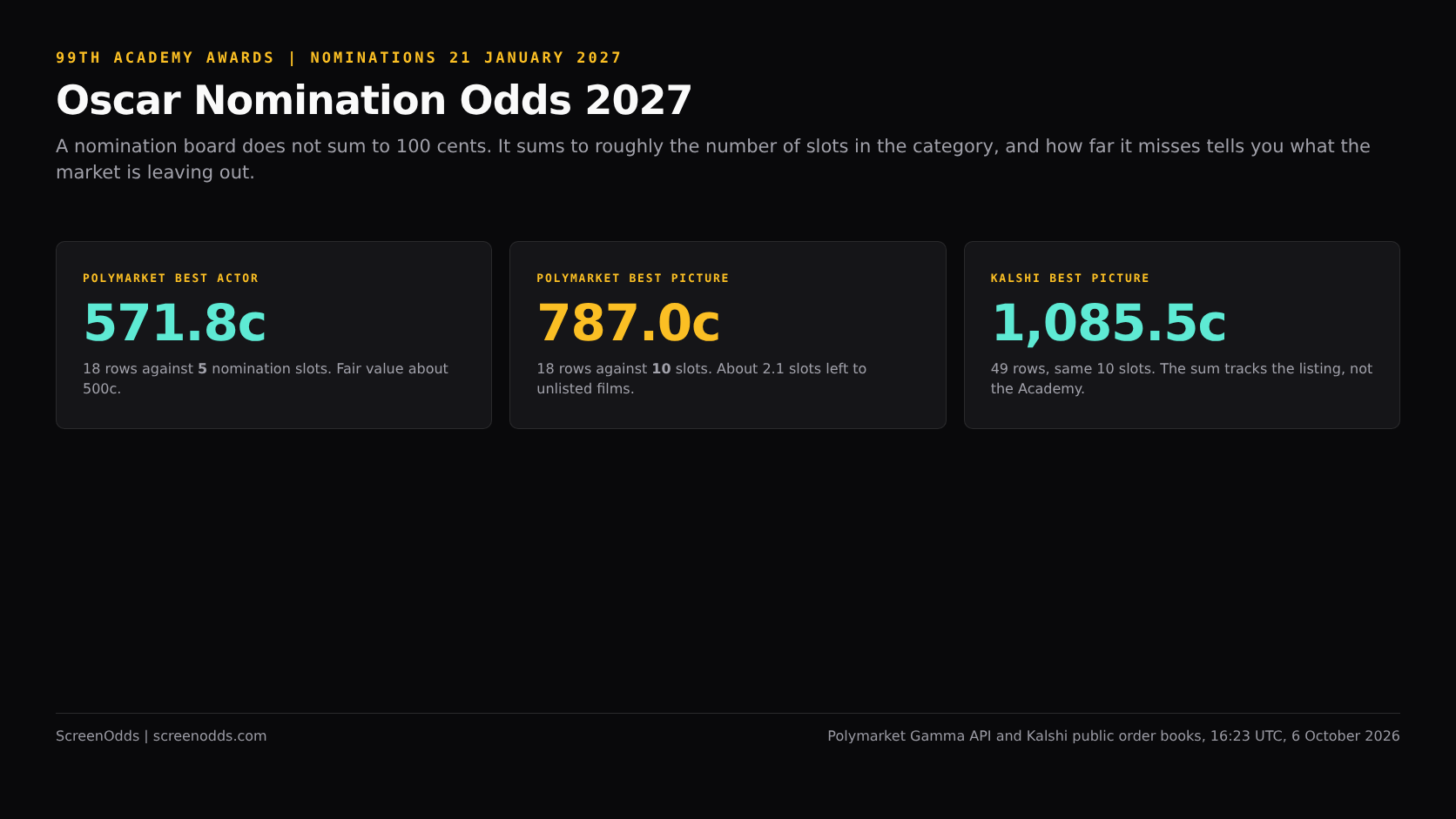
A nomination board does not sum to 100 cents and is not supposed to. Best Actor has five slots, so the eighteen Polymarket rows should sum to roughly 500 cents. They sum to 571.8.
Best Picture has ten slots, and Polymarket's eighteen films sum to 787.0 cents. That is not a bargain, it is a short list: the board is implicitly leaving about two of the ten slots to films it does not list.
Kalshi quotes the same two races far wider, 32 Best Actor rows and 49 Best Picture rows, and its sums land at 683.0 and 1,085.5 cents. The venues barely disagree on individual films. They disagree on how many names to print.
The biggest honest split between the two liquid books is Tom Cruise, 44.0 cents on Polymarket against a 36/38 Kalshi market. Everything bigger than that sits on a row where one side has no trading at all.
All prices in this guide are a single snapshot taken at 16:23 UTC on 6 October 2026, from Polymarket's Gamma API and Kalshi's public order books. Nomination boards resolve on 21 January 2027.
On this page
What separates a nomination contract from a winner contract, and why the two prices multiply into something more useful than either. Then the Academy calendar that sets the resolution date, the Best Actor and Best Picture boards in detail, and what a board's total actually measures.
After that: where Polymarket and Kalshi genuinely disagree as opposed to where one of them simply has not traded, the new Academy rule that changes the slot arithmetic for the acting races, and three specific boards I would not read at face value. The FAQ at the end covers resolution, slot counts and the gap between nomination and winner pricing.
A nomination market is a different instrument from a winner market
The single most common mistake I see on Oscar odds pages is treating nomination prices and winner prices as the same number viewed from different angles. They are not. A winner market is one-of-N and mutually exclusive, so its prices sum to about 100 cents and buying every row guarantees exactly one payout.
A nomination market is a basket of independent yes-or-no questions. Polymarket's Best Actor nomination board is eighteen separate contracts, each asking whether that specific performer appears among the nominees on 21 January 2027. Five of them are expected to resolve YES. Nothing forces the prices to sum to 100, and reading them as if it did produces nonsense.
This matters because the two prices carry different information, and the ratio between them carries a third thing. Dividing a performer's winner price by their nomination price gives you the market's implied probability that they win given that they are nominated. That number is where the consensus about a performance actually lives, and almost nobody publishes it.
Run it across the Best Actor field and the spread is dramatic. John Malkovich converts a nomination into a win 40.4 percent of the time by these prices. Tom Cruise converts at 31.8 percent, Matt Damon at 22.4 percent, Andrew Scott at 19.3 percent. Then it falls off a cliff: Ryan Gosling converts at 2.4 percent and Pedro Pascal at 0.7 percent.
Read plainly, the market is saying Gosling and Pascal are live for a nomination and dead for the statue, while Cruise is a less likely nominee who would be a serious threat if he got there. A page that prints only one of those two boards cannot tell you that.

The 99th Oscars calendar is the resolution clock
Every one of these contracts is governed by one date, and it is worth being exact about it. The Academy and ABC announced the schedule on 7 April 2026: the eligibility window runs from 1 January to 31 December 2026, nominations voting runs 11 to 15 January 2027, and the nominees are announced on Thursday, 21 January 2027. The ceremony is Sunday, 14 March 2027 at the Dolby Theatre.
Polymarket's nomination contracts carry an end date of 15 March 2027, which is a buffer rather than a forecast. The resolution text is unambiguous: a listed name that is not announced among the nominees on 21 January resolves immediately to No. So the real holding period for a nomination bet taken today is about fifteen weeks, not five months.
That gap between the resolution event and the listed end date is why nomination boards are quieter than their volume suggests. Capital sits parked until a single morning in January, which is also why spreads stay wide on everything outside the top few rows.
The eligibility window is the other half of the clock. Films still have until 31 December 2026 to qualify, and the Best Picture board's pricing reflects that directly, as the next sections show. Anything released in the back half of December can still enter a race that the boards have already priced.

Best Actor: the nomination board and the winner board are more useful together
Polymarket's Best Actor nomination board has eighteen names and about 67,800 dollars of lifetime volume. Three contenders are priced as near-locks: John Malkovich at 94.0 cents, Matt Damon at 93.7 and Andrew Scott at 88.0. Those three alone account for 275.7 cents of the board's 571.8, which means the market considers roughly three of the five slots effectively spoken for.
The interesting part is the middle. Robert Pattinson sits at 53.5 cents, Ryan Gosling at 49.5 and Tom Cruise at 44.0, three names competing for what the board treats as about two remaining slots. Below them, John Turturro at 33.0 and Pedro Pascal at 29.9 are priced as genuine outside chances rather than noise.
Now lay the winner board over it. Malkovich is 38.0 cents to win outright, Matt Damon 21.0, Andrew Scott 17.0 and Tom Cruise 14.0. Those four carry 90 of the 105.9 cents that the traded rows of the winner board sum to. Gosling, despite being nearly a coin flip for a nomination, is 1.2 cents to win.
I find the Cruise row the most informative on the whole board. He is the sixth most likely nominee and the fourth most likely winner, which is an unusual shape and the kind of thing that happens when a market thinks a performance would be a story if it landed. Whether that is right is a matter of taste, but it is a clear, falsifiable statement and it is only visible if you read both boards at once.
One caution before anyone sums that winner board. It has 44 rows, and 26 of them are unnamed placeholders labelled Actor B through Actor Z, each parked at 50 cents with no volume. Those placeholders contribute 1,300 cents of the board's 1,405.9 total. Drop them and the eighteen traded rows sum to a perfectly normal 105.9 cents.
Best Picture: ten slots, eighteen films, 787 cents
Best Picture has been a ten-nominee category since 2021, and the 98th Academy Awards earlier this year ran ten again. So the fair sum for a complete Best Picture nomination board is about 1,000 cents. Polymarket's board sums to 787.0 across eighteen films.
That shortfall is the single most useful number on the page, and it is not an inefficiency. Subtract 7.87 from 10 and the board is implicitly reserving about 2.1 of the ten nomination slots for films it does not list. With the eligibility window open until 31 December 2026, that is a reasonable thing for a market to price.
The top of the board is close to settled. The Odyssey is at 99.7 cents, La Bola Negra at 93.5, Wild Horse Nine at 87.5, Project Hail Mary at 86.0, Dune: Part Three at 82.0 and The Debut at 80.0. Six films carrying 528.7 cents between them, which is most of five of the ten slots locked down before a single ballot is cast.
Then it thins fast. The Invite at 69.5 and Fjord at 41.0 are the last rows priced as more likely than not to matter, and below All of a Sudden at 36.0 the board is in longshot territory: Digger at 12.5, The Social Reckoning at 13.0, Michael at 14.0, Avengers: Doomsday at 6.8, Disclosure Day at 2.1.
Note that Digger carries 11,214 dollars of volume at 12.5 cents, more than any other film on the board including The Odyssey. A longshot attracting the heaviest trading on a board is usually a sign that opinion is genuinely split rather than absent, and it is the row I would watch between now and the January announcement.
A board's sum tells you about the listing, not about the Academy
Here is the finding that surprised me most, and it is the reason I would not quote a board total without saying how many rows produced it. Take the same two races on Kalshi and the sums invert.
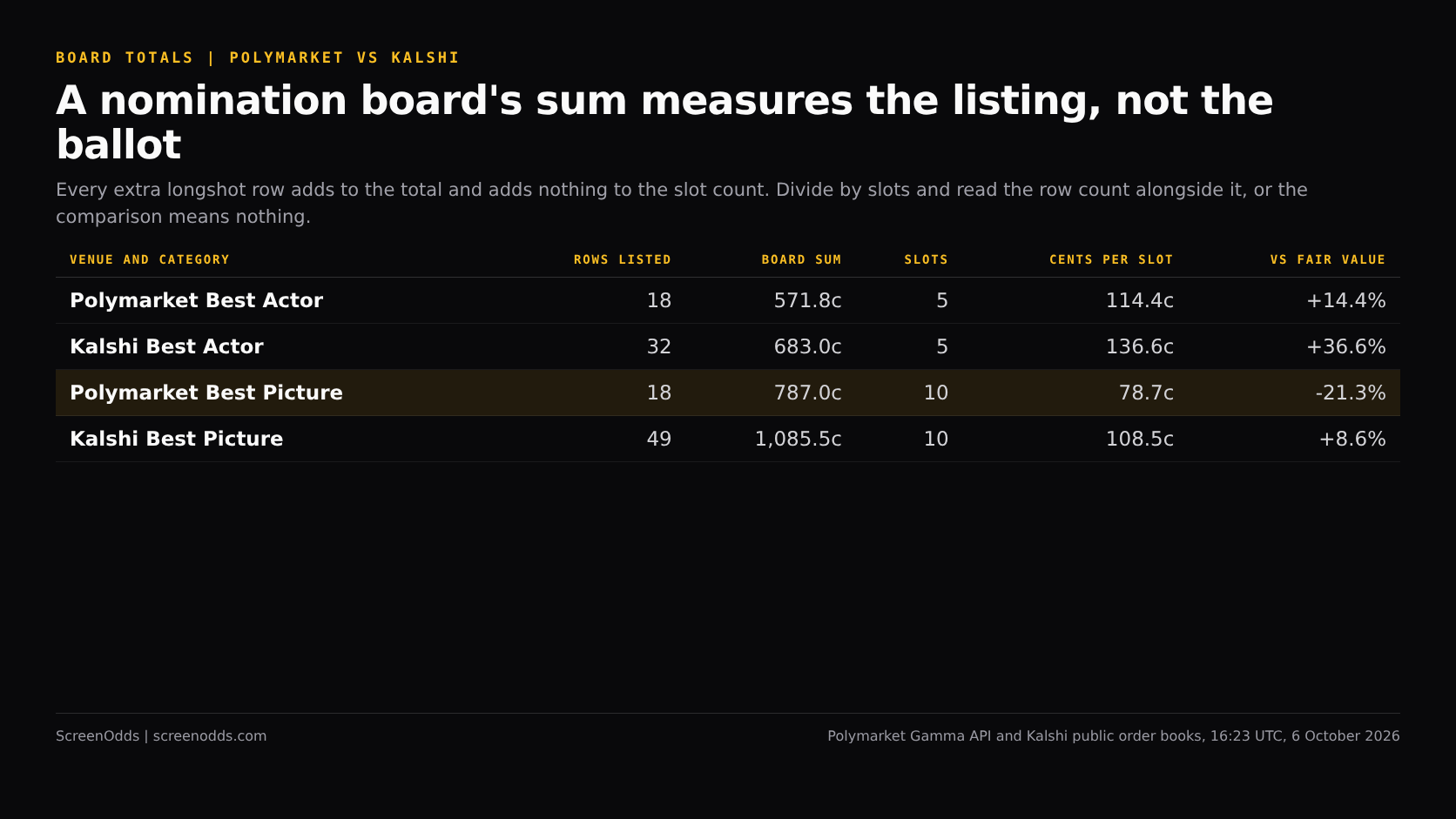
Kalshi quotes 32 Best Actor rows against Polymarket's 18, and its mid prices sum to 683.0 cents against a five-slot race. Kalshi quotes 49 Best Picture rows against Polymarket's 18, and those sum to 1,085.5 cents against a ten-slot race. So on Best Picture, Polymarket's board reads 213 cents light and Kalshi's reads 85 cents heavy, for exactly the same ten slots and very nearly the same prices on the films both venues list.
The mechanism is simple once you see it. Every additional longshot row a venue prints adds its price to the total and adds nothing to the slot count. A board with a long tail of 3-to-8 cent names will always sum high; a board that stops at eighteen names will sum low. The total is a property of the listing policy, not of the Academy's eventual ballot.
This is also why I would be careful with the overround framing that gets applied to these boards. On Polymarket's Best Actor board the 571.8 total sits 14.4 percent above the 500-cent fair value, which looks like a healthy house margin until you notice that Kalshi's wider listing of the same race sits 36.6 percent above it. Neither number is a margin anyone is charging. Both are artefacts of where each venue drew the line.
The usable version of the statistic is the sum divided by the number of slots, read alongside the row count. Polymarket Best Picture: 78.7 cents per slot over 18 rows. Kalshi Best Picture: 108.5 cents per slot over 49 rows. Now the comparison means something, and what it means is that Polymarket is leaving room for films it has not listed while Kalshi has listed nearly everything plausible and then some.
Where Polymarket and Kalshi actually disagree
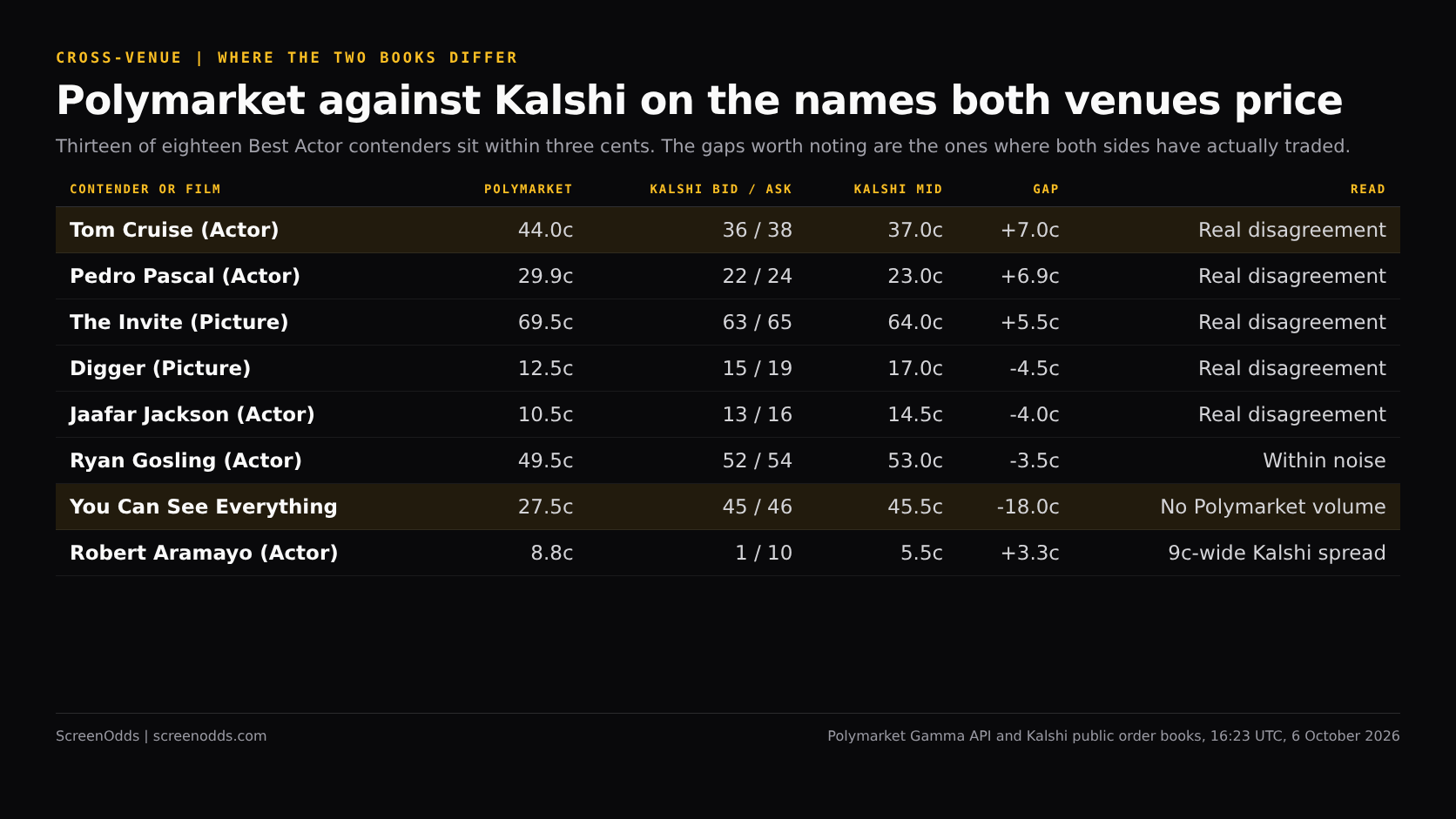
Strip out the listing differences and compare only the names both venues price, and the two books are remarkably close. Of the eighteen Best Actor names on Polymarket, thirteen sit within three cents of the Kalshi mid. On Best Picture, nine of the fourteen shared films are within 2.5 cents.
The one disagreement I would call real is Tom Cruise. Polymarket has him at 44.0 cents with 12,668 dollars traded; Kalshi quotes 36 bid, 38 ask with nearly 78,000 dollars of resting depth. That is a seven-cent gap between two books that are both liquid and both tight, and it is the only such gap on either board.
Pedro Pascal is the second, at 29.9 on Polymarket against a 22/24 Kalshi market, a 6.9-cent spread. After that the list runs out: Jaafar Jackson is four cents apart, Ryan Gosling three and a half, and everything else is inside three.
The largest raw divergence on either board is a trap, and it is worth naming because a naive comparison script would lead with it. You Can See Everything shows 27.5 cents on Polymarket against a Kalshi mid of 45.5, an eighteen-cent gap. That Polymarket row has zero dollars of volume. It is a quoted price nobody has traded against, not a disagreement, and the same caution applies to Robert Aramayo, Josh O'Connor and Sam Rockwell, all of whom sit behind nine-cent-wide Kalshi spreads.
Kalshi also prices names Polymarket does not list at all, which is its own kind of signal. Anthony Ippolito is quoted 40 bid, 46 ask with 54,000 dollars of depth behind it, and does not appear on Polymarket's board. If you only read one venue you would not know that contender existed.
The new multiple-nomination rule quietly changes the arithmetic
The Academy approved a change for the 99th Oscars that most odds pages have not absorbed. Performers can now receive more than one nomination in the same acting category if two of their performances finish in the top five of the vote. Previously the higher vote-getter was declared the nominee and the second performance was removed.
That sounds like trivia and it is not, because it breaks the assumption underneath every nomination board. Polymarket's contracts ask whether a named performer is nominated, and a performer who takes two of the five slots still resolves exactly one row YES. So the five slots are now five performances, and the expected number of YES rows on a per-performer board is five or fewer.
The practical effect is that the fair sum for a complete Best Actor nomination board is now at most 500 cents, and strictly under it in any scenario where someone doubles up. The 571.8-cent total has to clear a bar that moved down rather than up.
I would not overstate this. Double nominations in a single acting category are rare, and the market may well be pricing the possibility at close to zero, which would be defensible. But it is a structural change to how the thing resolves, it took effect for this exact ceremony, and it belongs in any serious reading of these boards.
The same rules package tightened the AI provisions, restricting nominations to roles demonstrably performed by humans with their consent and requiring screenplays to be human-authored, and reworked the international feature race so that films rather than countries are nominated and multiple films from one country can compete.
Three boards to read carefully before trusting the number
First, the Best Actor winner board on Polymarket, for the reason given above. Twenty-six of its 44 rows are unnamed placeholders at 50 cents with no volume, contributing 1,300 of the board's 1,405.9 cents. Any tool that sums the board without filtering for volume will report something meaningless, and the correct figure is the 105.9 cents the traded rows produce.
Second, the market on how many nominations The Odyssey will receive. Its six brackets are mutually exclusive, so they should sum to about 100 cents. They sum to 239.0, on 144 dollars of lifetime volume and 671 dollars of liquidity. That is not a probability distribution, it is a set of untraded quotes with wide spreads, and the ordering it implies should not be read as a forecast of anything.
Third, a naming mismatch worth knowing about. Polymarket's nomination board lists Dune: Part Three, while its separate market on which film leads all nominations lists Dune: Messiah at 12.9 cents. Variety reported in July 2025 that the film's actual title is Dune: Part Three, adapting the Dune Messiah novel, so these appear to be the same December 2026 release carried under two different names on two boards at the same venue.
By contrast, the board on which film leads all nominations is the healthiest of the lot: eight mutually exclusive rows summing to 97.5 cents on 207,879 dollars of volume, with The Odyssey at 83.0 and the Dune entry at 12.9. Tight, properly arbitraged, and the one Oscar market here I would quote without caveats.
The general rule I would take from all of this: before reading any prediction-market board, check the row count against the slot count, check the volume on the specific row you care about, and check whether the total can even be interpreted. Three cheap checks, and they would have caught every distortion on this page.
Sources
The Academy and ABC Announce Show Dates for 99th and 100th Oscars
Academy of Motion Picture Arts and Sciences / ABC | Accessed 2026-10-06
Oscars Rule Changes: AI, Acting Nominations, International Feature
Variety | Accessed 2026-10-06
Oscars 2027: Best Actor Nominations event
Polymarket Gamma API | Accessed 2026-10-06
Oscars 2027: Best Picture Nominations event
Polymarket Gamma API | Accessed 2026-10-06
2027 Best Picture Oscar nominations, The Odyssey contract
Kalshi | Accessed 2026-10-06
Oscars 2027: Best Actor Nominations market page
Polymarket | Accessed 2026-10-06
FAQ
What are Oscar nomination odds?
They are prediction-market prices on whether a specific film or performer will appear among the nominees when the Academy announces them, which for the 99th Academy Awards is 21 January 2027. Each contract is an independent yes-or-no question priced between zero and one dollar, where the price is the market's probability of a nomination. They are distinct from winner odds, which price who takes the statue on 14 March 2027.
Why do Oscar nomination odds add up to more than 100 percent?
Because a nomination board is not a one-winner market. Best Actor has five nominee slots, so a complete board should sum to roughly 500 cents, and Best Picture with ten slots should sum to roughly 1,000. Polymarket's Best Actor board summed to 571.8 cents and its Best Picture board to 787.0 cents in our 6 October 2026 snapshot. The total is also inflated by however many longshot rows the venue chooses to list, so it is not a reliable measure of market margin.
Can you bet on Oscar nominations rather than winners?
Yes. Both Polymarket and Kalshi list separate nomination markets for the 99th Academy Awards, including Best Picture and Best Actor, alongside their winner markets. Polymarket's Best Actor nomination event carried about 67,800 dollars of volume and its Best Picture nomination event about 49,800 dollars when we checked. Availability and eligibility depend on your jurisdiction and the venue's own rules.
What is the difference between nomination odds and winner odds for the same person?
Nomination odds price whether they make the shortlist; winner odds price whether they win. Dividing the winner price by the nomination price gives the implied chance of winning given a nomination, which is often the more revealing number. On our snapshot John Malkovich converted at 40.4 percent and Tom Cruise at 31.8 percent, while Ryan Gosling converted at 2.4 percent despite being close to even money for a nomination.
How many Best Picture nominees are there at the 2027 Oscars?
Ten. Best Picture has had ten nominees since 2021 and the 98th Academy Awards in 2026 ran ten. The four acting categories have five slots each, although a rule change approved for the 99th Oscars now allows one performer to occupy more than one of those five slots if two of their performances finish in the top five of the vote.
Do Polymarket and Kalshi agree on Oscar nomination odds?
Mostly. Across the names both venues list, thirteen of eighteen Best Actor contenders sat within three cents of each other and nine of fourteen shared Best Picture films within 2.5 cents. The one substantive gap was Tom Cruise, 44.0 cents on Polymarket against a 36/38 market on Kalshi. Larger-looking gaps generally sat on rows where one venue had no volume at all.
When do Oscar nomination markets resolve?
On the nominations announcement, Thursday 21 January 2027. Polymarket's contracts carry a later end date of 15 March 2027 as a buffer, but the resolution text states that a name not announced among the nominees resolves immediately to No. Nominations voting runs 11 to 15 January 2027, so the markets are effectively settled by the ballots cast that week.
Is The Odyssey a lock for a Best Picture nomination?
The market treats it as close to one, at 99.7 cents on Polymarket and a 97/99 market on Kalshi, and it is also 83.0 cents to lead all films in total nominations. No contract at those prices offers much room, and a 99.7-cent price still carries real downside relative to what it can return. Prices move, and nothing here is financial advice.