Awards
Grammy Odds 2027: Polymarket vs Kalshi Compared
Grammy odds for the 69th Grammys, checked on both venues: Kalshi has traded $551,776 and Polymarket $211,445. Where the two boards disagree, and why.
Keyword
grammy odds
US volume
320
Difficulty
0
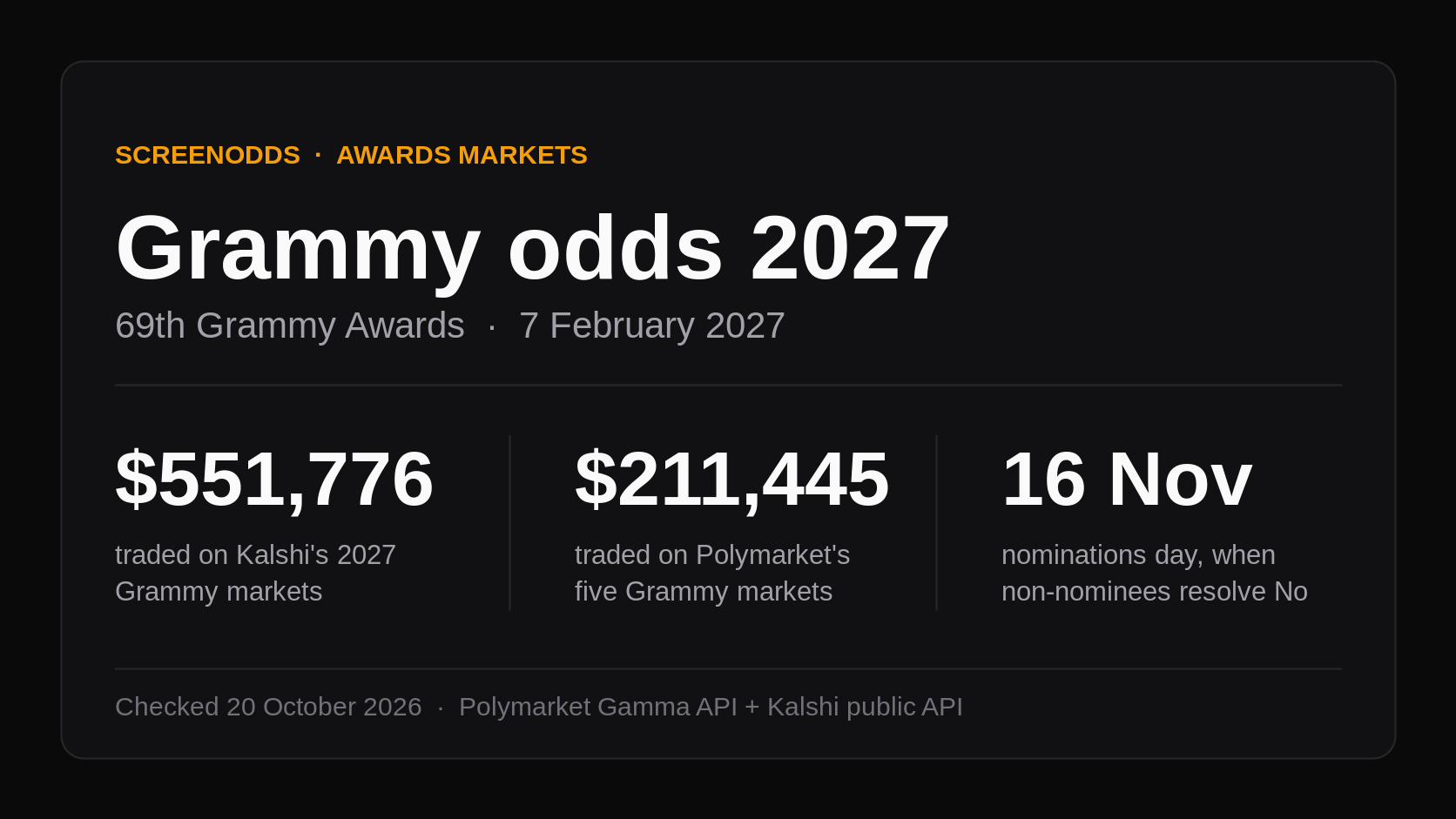
ScreenOdds data card. Figures read from the Polymarket Gamma API and the Kalshi public API on 20 October 2026.
Key takeaways on Grammy odds for the 69th Grammys
Grammy odds for 2027 are live on two venues, and the smaller one gets all the coverage. We read both public APIs on 20 October 2026: Polymarket is running five Grammy markets carrying $211,445 of lifetime volume, and Kalshi is carrying $551,776 across 619 open markets on the same ceremony.
Kalshi is the deeper book by a factor of 2.6, and it is the only venue of the two listing nomination markets. Polymarket lists winners only, so there is nothing there to trade on what happens on 16 November.
The two venues disagree, sometimes by a lot. Rosalia's Lux is 16.0 cents on Polymarket and 25 cents on Kalshi. Olivia Rodrigo's you seem pretty sad for a girl so in love is 42.0 cents on Polymarket and 51 cents on Kalshi.
The resolution rule is the thing most readers miss. Polymarket's Album of the Year contract resolves immediately to No for any album that is not nominated when the list is read out on 16 November 2026, so most of the board goes to zero in a single morning.
Two thirds of what you see is not a market. Of Polymarket's 218 Grammy rows, 141 are unnamed placeholders parked at 50 cents with no volume behind them, and on Kalshi 350 of the 619 open markets have never traded at all.
On this page
This guide covers what is tradable in Grammy odds today, the five Polymarket markets with their prices and sizes, why Kalshi is the larger venue, where the two boards disagree on the same album, what the 16 November nominations date does to open contracts, the official Recording Academy calendar, how bookmaker fractions and pundit percentages differ from market prices, and how to read either board without being caught by a placeholder or a spread.
Every market figure below was read directly from the Polymarket Gamma API and the Kalshi public API on 20 October 2026. Every date comes from the Recording Academy's own announcement. Prices move constantly, so treat the numbers as a dated snapshot rather than a live quote.
Grammy odds in October 2026: what is actually tradable
Search Grammy odds this month and you will mostly get last year's ceremony. The pages ranking for the term are built around the 68th Grammys, a bookmaker board whose own timestamp is ambiguous, or a panel of pundits putting percentages next to names. None of those is a price, and two of them are about the wrong year.
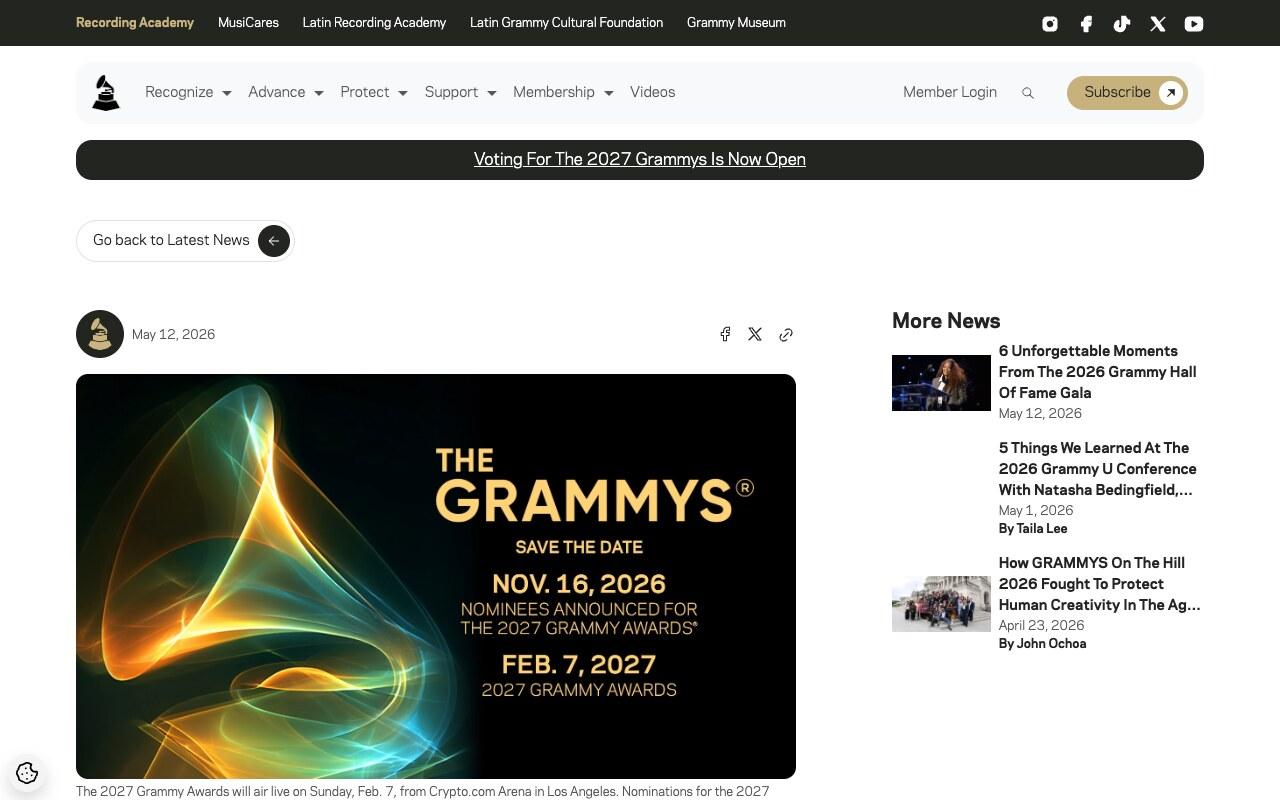
The 69th Grammy Awards are on Sunday 7 February 2027 at Crypto.com Arena in Los Angeles, simulcast on ABC, Disney+ and Hulu. Nominations are announced on Monday 16 November 2026. First round voting, which decides the nominees, runs 12 to 22 October 2026, so Academy members are voting as this page goes up and the window closes in two days.
Here is the promise of this page: by the end of it you will know which Grammy markets are open on each venue, what the money behind them looks like, where the two venues price the same album differently, and the one date that settles most of the board.
We did not take anyone's word for it. We queried Polymarket's Gamma API for every active Grammy event, then enumerated all 147 Grammy series in Kalshi's Entertainment catalogue and pulled every open market under each one, with volume and open interest on each. The numbers below are what those calls returned.
The five Polymarket Grammy markets, priced and sized
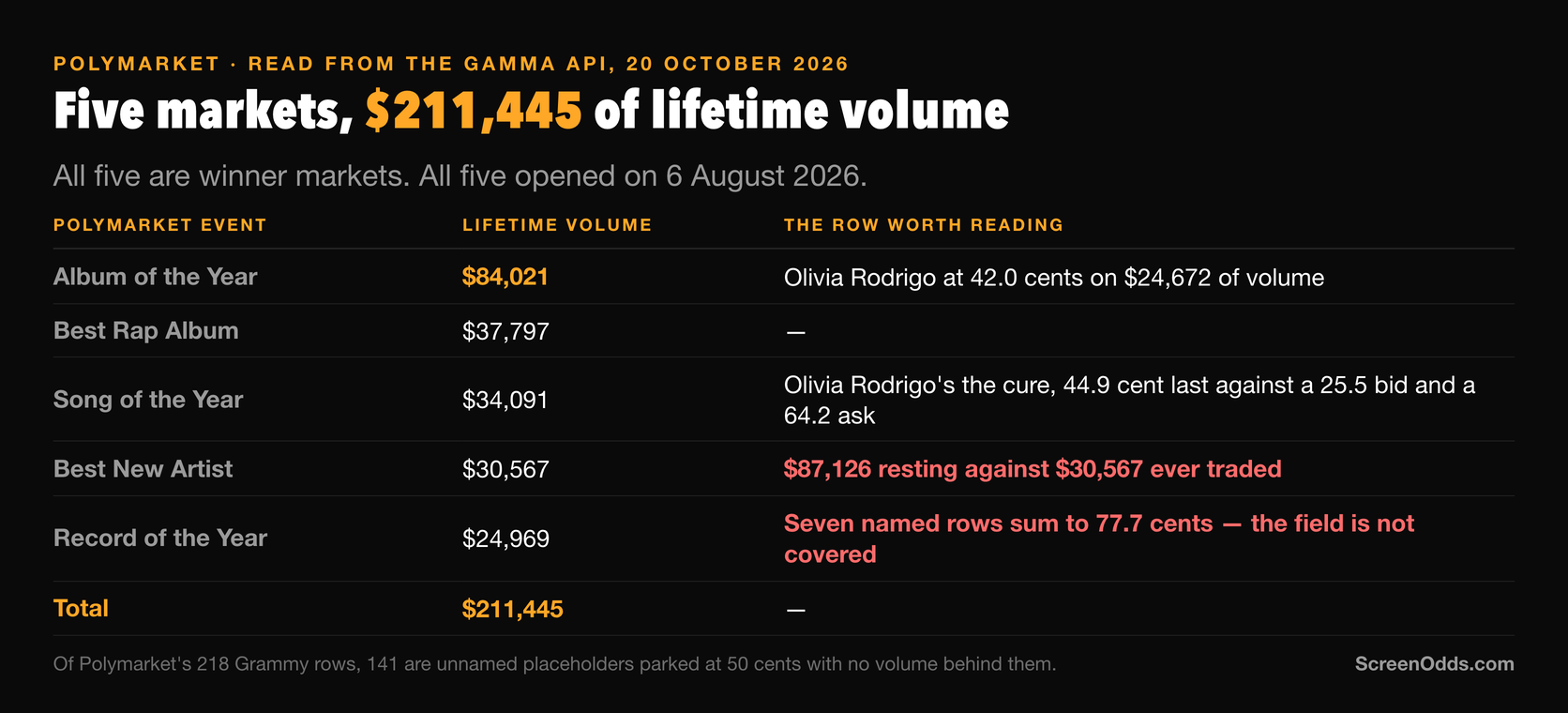
Polymarket is running exactly five Grammy events, all of them winner markets, and all five opened on 6 August 2026. By lifetime volume: Album of the Year at $84,021, Best Rap Album at $37,797, Song of the Year at $34,091, Best New Artist at $30,567 and Record of the Year at $24,969. That is $211,445 across the category.
Album of the Year is the one worth reading. Olivia Rodrigo's you seem pretty sad for a girl so in love leads at 42.0 cents on $24,672 of volume, Olivia Dean's The Art of Loving is at 27.0 cents on $31,760, and Rosalia's Lux is at 16.0 cents on $11,039. Phoebe Bridgers' Lost Weekend is at 5.6 cents and Madonna's Confessions II at 5.1 cents. Taylor Swift's The Life of a Showgirl is a 2.1 cent longshot.
Best New Artist is the strangest book on the venue. Ella Langley is at 60.5 cents and SIENNA SPIRO at 29.0 cents, and the event carries $87,126 of resting liquidity against only $30,567 of lifetime volume. More money is sitting in the order book than has ever traded through it, which is a market makers' board rather than a crowd's.
Record of the Year is the thinnest and the one to be most careful with. Its seven named rows sum to 77.7 cents, which means the listed contenders do not cover the field, and the top row, Olivia Dean's Man I Need, shows a 22.0 cent last price against a 5 cent bid and a 39 cent ask. A 34 cent spread is not a probability you can act on.
Kalshi is the bigger Grammy venue, and nobody says so
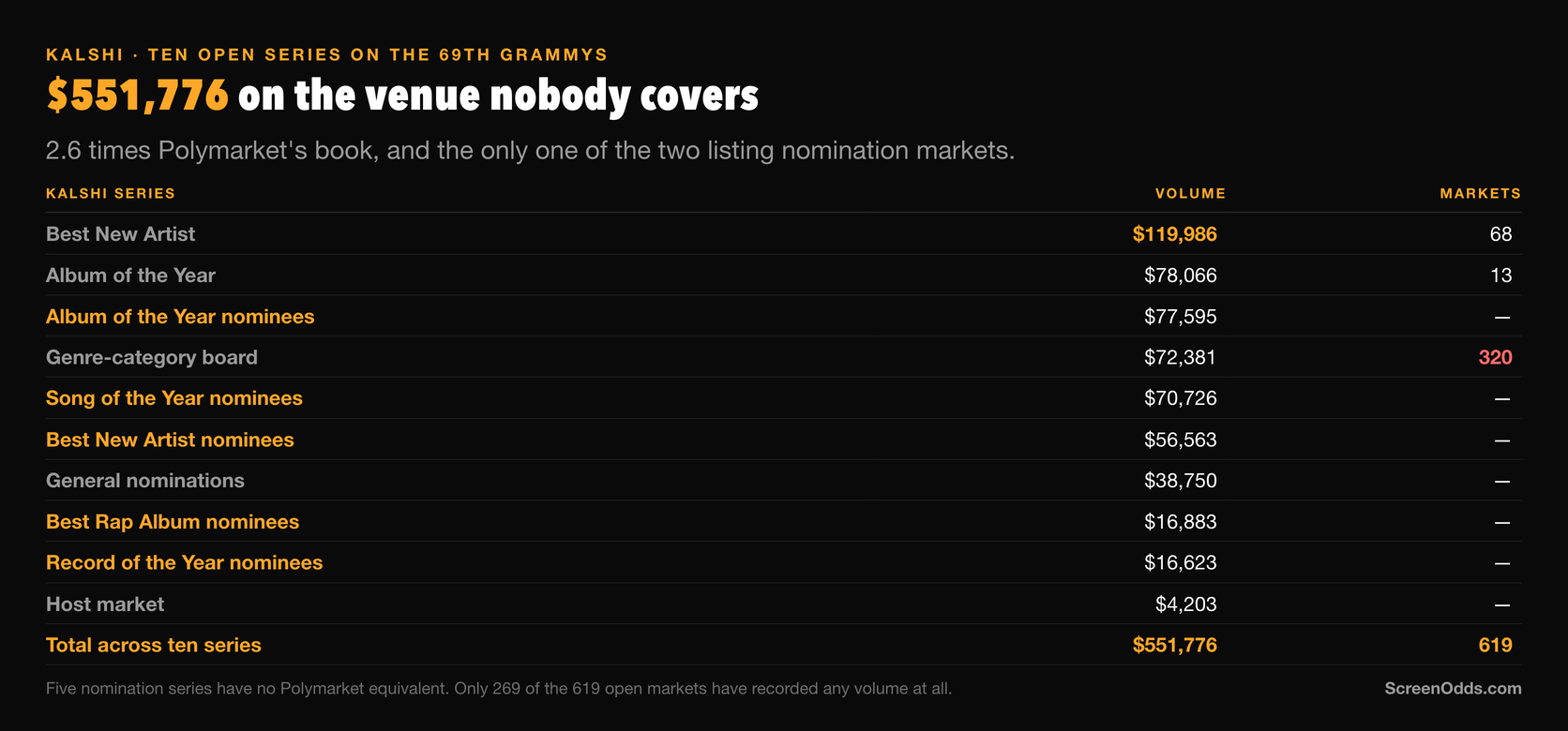
Kalshi's Entertainment catalogue carries 147 Grammy series. Ten of them have open markets on the 69th Grammys, totalling 619 contracts and $551,776 of volume against $371,788 of open interest. An eleventh series covers the 2026 Latin Grammys, a separate ceremony, and we have excluded its $22,407 from that total.
The breakdown, by volume: Best New Artist at $119,986 across 68 markets, Album of the Year at $78,066 across 13, Album of the Year nominees at $77,595, Song of the Year nominees at $70,726, the genre-category board at $72,381 across 320 markets, Best New Artist nominees at $56,563, a general nominations series at $38,750, Record of the Year nominees at $16,623, Best Rap Album nominees at $16,883 and a host market at $4,203.
Four of those ten series have no Polymarket equivalent at all, and they are the interesting ones. Kalshi lists nomination markets for Album of the Year, Song of the Year, Record of the Year and Best Rap Album, which resolve on 16 November rather than in February. If you have a view on the nominations specifically, Kalshi is the only one of the two venues where you can express it.
The caveat is the same one that applies everywhere. Of the 619 open Kalshi markets, only 269 have recorded any volume, and the 320-market genre board has 58 traded rows holding $72,381 between them. A ticker that exists is not a market with a price behind it, and Kalshi lists far more of the former than the latter.
Where the two venues disagree on the same album
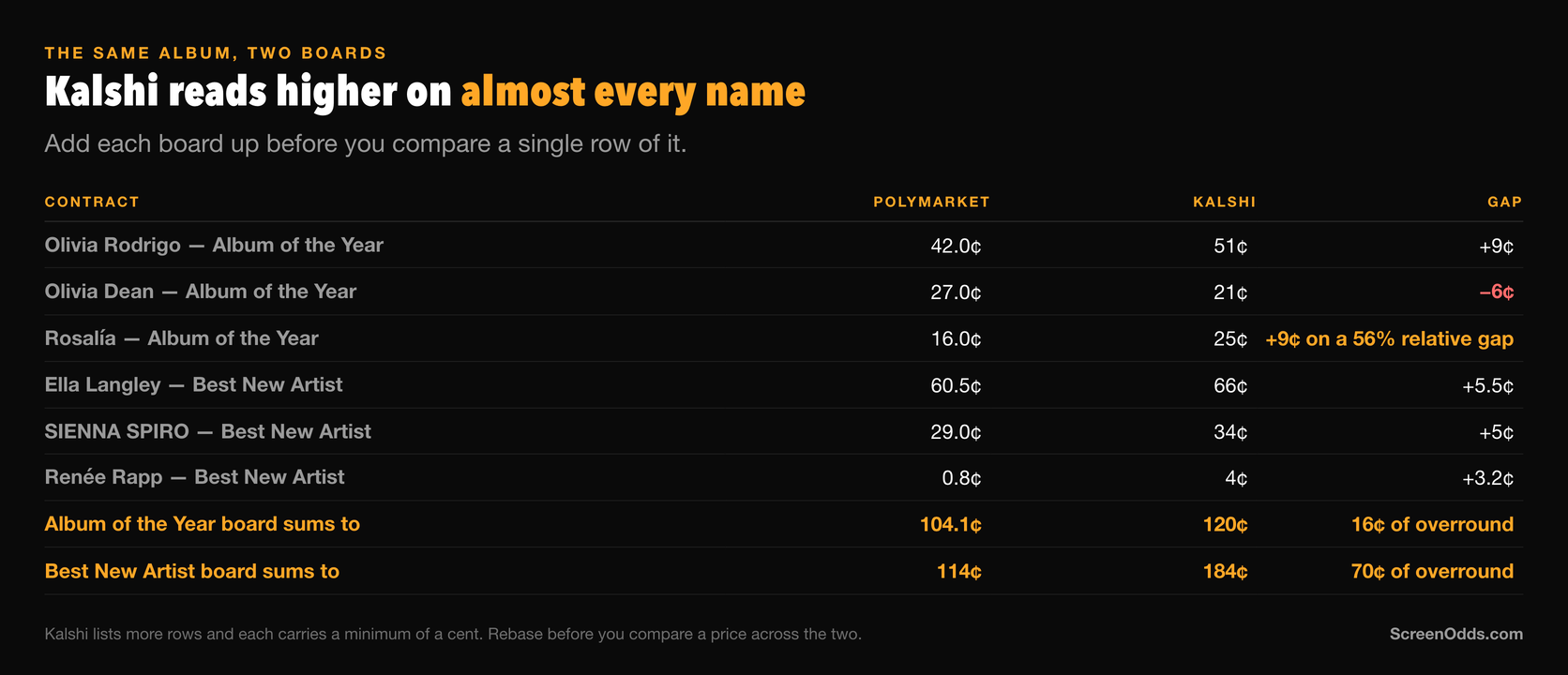
Running the two boards side by side is where this gets useful, because the same album carries a different price depending on where you look. On Album of the Year, Polymarket has Olivia Rodrigo at 42.0 cents and Kalshi has her at 51 cents. Polymarket has Olivia Dean at 27.0 cents, Kalshi at 21 cents. Polymarket has Rosalia at 16.0 cents, Kalshi at 25 cents.
Nine cents on Rosalia is a 56 percent relative gap on the same binary outcome, settled on the same night by the same announcement. In a liquid market that would be an arbitrage; on these two boards it is mostly a measure of how thin both are, and of two different crowds with two different fee structures reaching two different answers.
Best New Artist shows the same pattern in the same direction. Ella Langley is 60.5 cents on Polymarket and 66 cents on Kalshi. SIENNA SPIRO is 29.0 and 34. Slayyyter is 3.1 and 8. Renee Rapp is 0.8 and 4. Kalshi reads higher on almost every name, and the arithmetic explains why.
Add each board up. Polymarket's 15 named Album of the Year rows sum to 104.1 cents, a 4 percent overround. Kalshi's 13 rows sum to 120 cents, a 20 percent overround. On Best New Artist the gap is wider still: Polymarket's named rows total 114 cents, Kalshi's 68 rows total 184 cents. Kalshi prices are systematically higher partly because there are more of them and each one carries a minimum of a cent. Rebase before you compare, every time.
16 November is a resolution date, not just an announcement
The single most important sentence on the Polymarket Album of the Year page is in the resolution rules, not the price chart. It reads: if an album is not officially nominated for Album of the Year when the 69th nominees are announced, the corresponding market will immediately resolve to No.
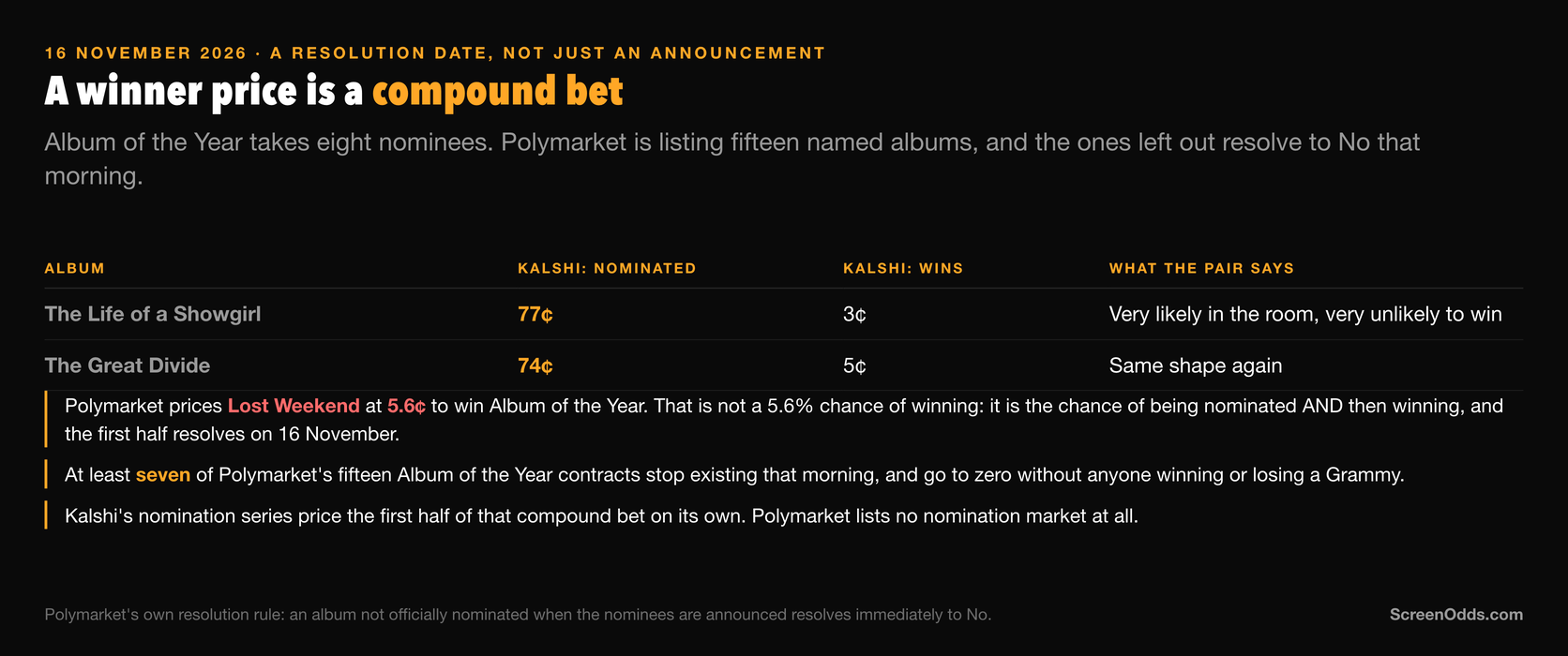
Album of the Year takes eight nominees. Polymarket is listing fifteen named albums. At least seven of those contracts stop existing on the morning of 16 November, and they go to zero without anyone winning or losing a Grammy. A 5.6 cent price on Lost Weekend is not really a 5.6 percent chance of winning Album of the Year; it is the joint chance of being nominated and then winning, and the first half of that resolves in 27 days.
This is why Kalshi's nomination series are worth knowing about even if you never trade them. They price the first half of that compound bet on its own. Kalshi has The Life of a Showgirl at 77 cents to be nominated for Album of the Year while pricing it at just 3 cents to win, and The Great Divide at 74 cents to be nominated against 5 cents to win. The two numbers together tell you something neither does alone.
So if you are reading a Grammy winner price in the next four weeks, read it as a nomination forecast with a win forecast stapled to it. After 16 November the same number means something cleaner, and the board that survives will be a lot shorter.
The official calendar these markets key off
The Recording Academy publishes its own timetable and the markets are built on it. The product eligibility period for the 69th Grammys ran from 31 August 2025 to 28 August 2026. Media company registration ran 25 June to 14 August 2026, and the online entry period 7 July to 21 August 2026.
First round voting, which produces the nominees, runs 12 October to 22 October 2026. Nominations are announced on Monday 16 November 2026. Final round voting, which produces the winners, runs 10 December 2026 to 7 January 2027. The ceremony is Sunday 7 February 2027.
Map the market data onto that and the timing makes sense. Polymarket opened all five of its Grammy events on 6 August 2026, a fortnight before entries closed. Kalshi's Album of the Year series was created on 12 June 2026 and its nomination series back on 9 February 2026, the week after the previous ceremony.
Two dates are worth putting in a calendar. 22 October, when first round voting shuts and the nominee lists are effectively fixed even though nobody outside the Academy knows them. And 16 November, which resolves every nomination contract on Kalshi and deletes most of Polymarket's winner board. Expect the sharpest repricing of the cycle in the hours around that second one.
Bookmaker odds and pundit percentages are different objects
Most of what ranks for Grammy odds is not a prediction market. OLBG's Album of the Year board, the most visible bookmaker page on the keyword, has run Olivia Rodrigo at Evens in one article and at 4/6 in another, and the page's own update stamp is ambiguous enough that we could not date either with confidence. We are quoting it as a bookmaker board, not as a current price.
A fraction from a bookmaker is a price with a margin built in and no public volume attached. Evens implies 50 percent and 4/6 implies 60 percent, but neither tells you how much money agrees, and the overround is spread across the board rather than disclosed on any one line.
Gold Derby's percentages are a third thing again. They are a poll of pundits and site members, which is a genuine signal and worth reading, but nobody is paid for being right or charged for being wrong. They also frequently measure nomination rather than a win, which is the same trap as the Polymarket resolution rule, arriving from the other direction.
A market price carries two things the other two do not: a cost for being wrong, and a volume figure that tells you how seriously to take it. Olivia Rodrigo at 42.0 cents on $24,672 of traded volume is a different object from a 50 percent panel consensus, even when the digits look similar.
How to read a Grammy board without getting caught
Check for a name before you check the price. Of Polymarket's 218 Grammy rows, 141 are placeholders called things like Placeholder z - TBD Artist, sitting at exactly 50 cents with zero volume and zero liquidity. Best New Artist alone carries 42 of them. A 50 cent placeholder is not a forecast that an unnamed artist has a coin-flip chance; it is an empty slot waiting for a name.
Check volume second. On Kalshi's genre board, 262 of the 320 open markets have never traded. On Polymarket's Record of the Year, four of the seven named rows have under $2,000 behind them. A price set by two traders is a rumour with a decimal point.
Check the spread third, and use the bid and ask rather than the last price. Olivia Rodrigo's the cure shows a 44.9 cent last price for Song of the Year against a 25.5 cent bid and a 64.2 cent ask. The last trade is a fact about the past; the spread is what you would actually pay today.
Then add the category up and rebase. If the outcomes sum to 120 or 184 cents, as Kalshi's do, every headline probability in that category is inflated by the same proportion and needs dividing by the total before you compare it to anything on another venue. Do that in order and the two boards stop contradicting each other quite so often.
Sources
The Grammy Awards set to take place Sunday, Feb. 7, 2027: show date, nominations and key dates
Recording Academy | Accessed 2026-10-20
How to submit your music for the 2027 Grammys: deadlines, nominations and voting process
Recording Academy | Accessed 2026-10-20
Polymarket Gamma API: Grammys 2027 Album of the Year Winner event
Polymarket | Accessed 2026-10-20
Kalshi public API: Grammy for Album of the Year open markets
Kalshi | Accessed 2026-10-20
Grammys 2027 Album of the Year odds: Olivia Rodrigo's lead shrinks as the field opens up
OLBG | Accessed 2026-10-20
FAQ
When are the 2027 Grammy nominations announced?
Nominations for the 69th Grammy Awards are announced on Monday 16 November 2026. First round voting, which decides those nominees, runs from 12 to 22 October 2026. The date matters for anyone holding a prediction-market contract, because Polymarket's winner markets resolve to No for any album or artist that is not on the list.
When is the 69th Grammy Awards ceremony?
Sunday 7 February 2027, at Crypto.com Arena in Los Angeles. The show is simulcast on ABC, Disney+ and Hulu, the first time the Grammys have streamed on those platforms. Final round voting, which decides the winners, runs from 10 December 2026 to 7 January 2027.
Can you bet on the Grammys on Polymarket?
Polymarket is running five Grammy markets for the 69th ceremony: Album of the Year, Record of the Year, Song of the Year, Best New Artist and Best Rap Album. All five are winner markets and all opened on 6 August 2026. Combined lifetime volume was $211,445 when we checked on 20 October 2026. Availability depends on your jurisdiction.
Does Kalshi have Grammy markets?
Yes, and more of them than Polymarket. Kalshi's Entertainment catalogue holds 147 Grammy series, ten of which had open markets on the 69th Grammys when we checked: 619 contracts carrying $551,776 of volume. Kalshi also lists nomination markets, which Polymarket does not, and distributes some of its markets through Robinhood.
Who is the favourite for Album of the Year at the 2027 Grammys?
Olivia Rodrigo's you seem pretty sad for a girl so in love leads both prediction markets, at 42.0 cents on Polymarket and 51 cents on Kalshi as of 20 October 2026. Olivia Dean's The Art of Loving and Rosalia's Lux are the next two on both boards, though the venues order them differently. Bookmakers have also had Rodrigo as favourite, at quoted prices between Evens and 4/6.
Why do Polymarket and Kalshi show different Grammy odds?
Three reasons. The books are thin, so a handful of trades moves either venue. The two platforms list different numbers of outcomes, and Kalshi's longer lists carry a bigger overround: its Album of the Year rows sum to 120 cents against Polymarket's 104. And the user bases and fee structures differ. Rebase each board to 100 before comparing any two prices.
What does a 50 cent price on a Grammy market mean?
Often nothing at all. Polymarket pads its Grammy events with unnamed placeholder rows that sit at exactly 50 cents with no volume and no liquidity behind them, waiting for a name to be assigned. 141 of the 218 Grammy rows on the venue were placeholders when we checked. Always confirm a row has a real artist or album attached before reading its price as a probability.