Box Office
Opening Weekend Box Office Odds 2026: Bracket Boards
Opening weekend box office odds on Polymarket are six-bracket boards, not win bets. How they price, how they resolve, and where the 2026 boards misprice.
Keyword
opening weekend box office odds
US volume
0
Difficulty
0
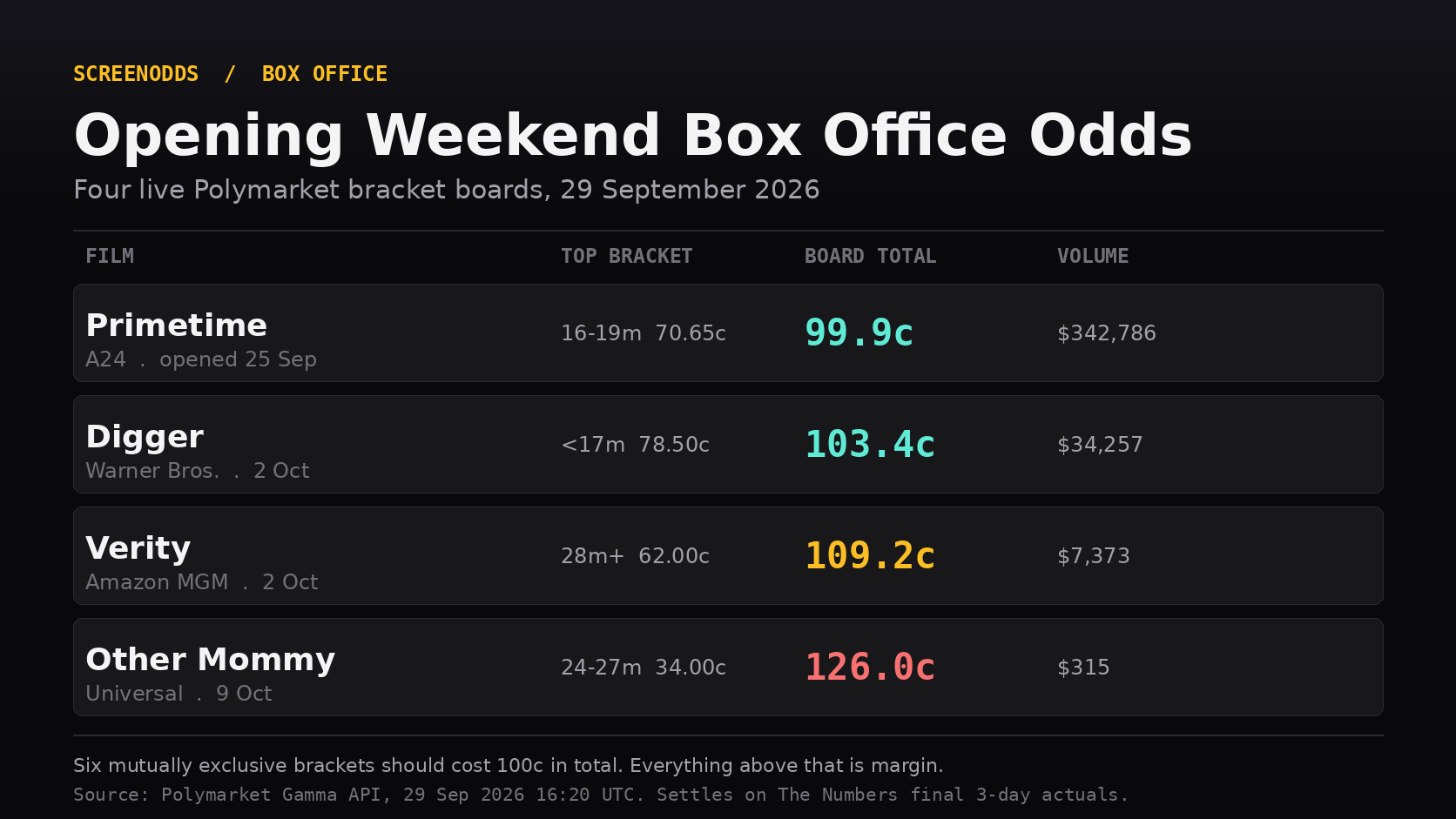
ScreenOdds editorial card rendered from the Polymarket Gamma board prices on 29 September 2026.
Key takeaways from the opening weekend boards on 29 September 2026
An opening weekend box office odds market is not a win bet. Polymarket splits each film's three-day domestic gross into six mutually exclusive dollar brackets, and you are buying one band of a distribution rather than backing a winner.
These markets settle on The Numbers, on final three-day actuals, not on the Sunday studio estimate that every trade headline quotes. That single rule is currently worth about 70 cents on the Primetime board.
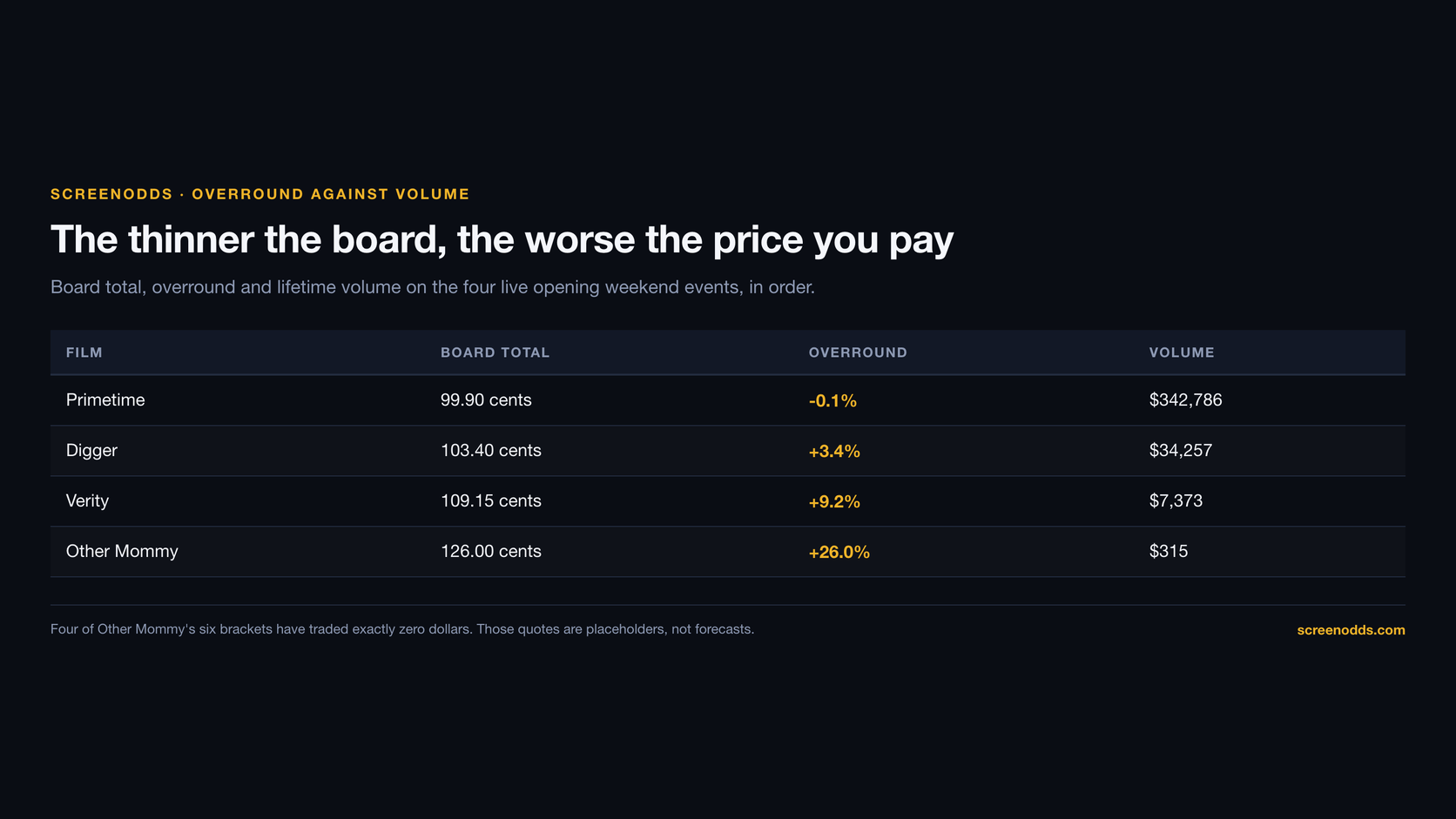
The four live boards on 29 September 2026 price at wildly different quality. Primetime's six brackets sum to 99.9 cents on 342,786 dollars of volume. Other Mommy's sum to 126.0 cents on 315 dollars.
On Digger, the market is a full bracket below the trade consensus: 78.5 cents say under 17 million domestic, while Box Office Theory's public tracking put the film in a 20 to 29 million range on 24 September.
Kalshi does not compete here. A scan of all 2,502 series in Kalshi's Entertainment category on 29 September 2026 returned no opening weekend gross market at all, only two Golden Globes box office award series.
On this page
What an opening weekend box office odds market actually is. The four live boards on 29 September 2026. The resolution rule that decides more bets than the movie does. Digger, where the market sits a bracket below the trade tracking. Verity, where the market is the bullish side. Why you should read the overround before you read the odds. Why Kalshi lists no opening weekend grosses. How I would read one of these boards. The dates that move them.
Every figure below was pulled from the Polymarket Gamma API and The Numbers on 29 September 2026 at roughly 16:20 UTC, and the market prices move continuously. Treat the numbers as a dated snapshot and re-check the live board before acting on anything.
What an opening weekend box office odds market actually is
If you have searched for opening weekend box office odds and landed on a sportsbook page, you have been sent to the wrong product. American sportsbooks do not price domestic grosses. Prediction markets do, and the contract shape is different enough that the usual reading habits mislead you.
Each film gets its own event, and inside that event sit six separate yes-or-no markets, one per dollar bracket. Digger's board runs under 17 million, 17 to 20, 20 to 23, 23 to 26, 26 to 29, and 29 million plus. You buy the bracket, at a price between zero and one dollar, and the price is the market's probability that the final gross lands in that band.
That structure has two consequences worth internalising. First, there is no favourite to back and no underdog to fade: the whole board is one probability distribution chopped into six pieces, and the interesting question is the shape of the distribution, not which piece is biggest. Second, because the brackets are mutually exclusive and collectively exhaustive, their prices should add to exactly one dollar. When they do not, the gap is money, and I come back to that below.
The brackets are not standard across films. Polymarket sets the bands around whatever the pre-release tracking implies, so a modest horror title gets 21 to 24 and 24 to 27 while a tentpole gets bands twenty million wide. Two boards with the same headline percentage are therefore not comparable. You have to read the band widths first.
The four live boards on 29 September 2026
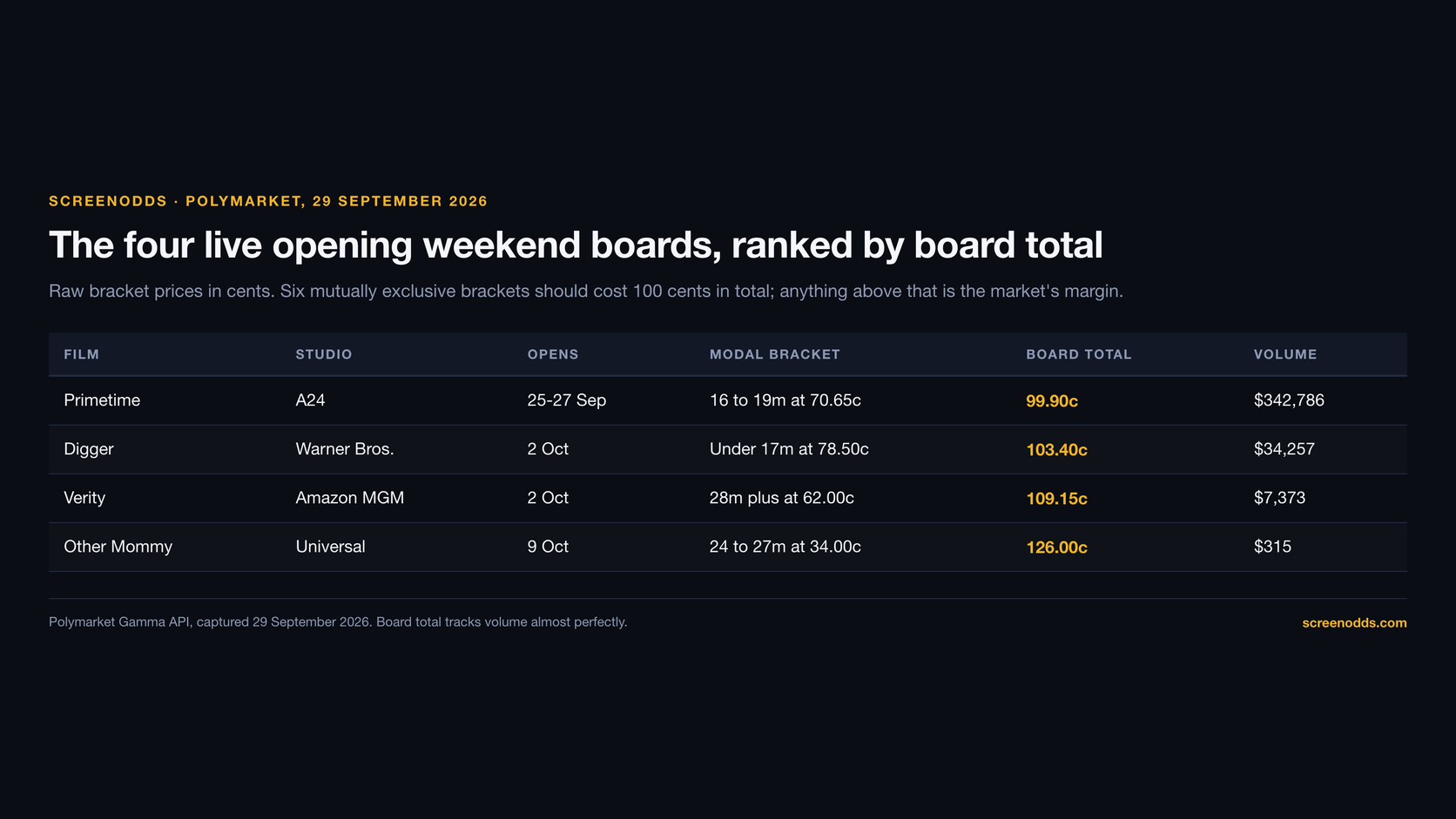
Here is every opening weekend board Polymarket had open when I checked, with the raw bracket prices in cents, the board total, and the event's lifetime volume. The raw prices are what you pay. The board total is what those prices add up to, and anything over 100 is the market's built-in margin.
Primetime, A24, opened 25 to 27 September. Under 10m: 0.05. 10 to 13m: 0.05. 13 to 16m: 0.05. 16 to 19m: 70.65. 19 to 22m: 29.00. 22m plus: 0.10. Board total 99.90 cents. Volume 342,786 dollars, open interest 49,054 dollars.
Digger, Warner Bros., opens 2 October. Under 17m: 78.50. 17 to 20m: 15.50. 20 to 23m: 4.50. 23 to 26m: 2.20. 26 to 29m: 1.40. 29m plus: 1.30. Board total 103.40 cents. Volume 34,257 dollars, open interest 17,909 dollars.
Verity, Amazon MGM, opens 2 October. Under 16m: 3.75. 16 to 19m: 2.40. 19 to 22m: 8.50. 22 to 25m: 13.00. 25 to 28m: 19.50. 28m plus: 62.00. Board total 109.15 cents. Volume 7,373 dollars, open interest 13,629 dollars.
Other Mommy, Universal, opens 9 October. Under 21m: 17.50. 21 to 24m: 17.50. 24 to 27m: 34.00. 27 to 30m: 23.00. 30 to 33m: 16.50. 33m plus: 17.50. Board total 126.00 cents. Volume 315 dollars, open interest 1,474 dollars.
Read down the board-total column and you have the whole quality ranking in one number: 99.90, 103.40, 109.15, 126.00. It tracks volume almost perfectly, and it is the first thing I check on any new film.
The resolution rule decides more bets than the movie does
Every one of these markets carries the same resolution clause, and almost nobody writing about box office odds quotes it. The market resolves on the Daily Box Office Performance figures on the film's page at The Numbers, and only once the three-day opening weekend values are final, which the rules text spells out as not studio estimates. If the gross lands exactly on a boundary, the market resolves to the higher bracket.
Two things follow. The resolution source is The Numbers, not Box Office Mojo. I have seen at least one widely-shared explainer send readers to Mojo's Gross Domestic chart for these markets, and the two services do not always publish identical actuals. Check the event rules text, not a secondary guide.
More importantly, the number you read in a Sunday trade story is not the number that settles the contract. Studios file Sunday projections on Sunday morning based on Friday and Saturday actuals plus a modelled Sunday. The real Sunday is reported on Monday, and for adult-skewing titles it very often comes in under the projection.
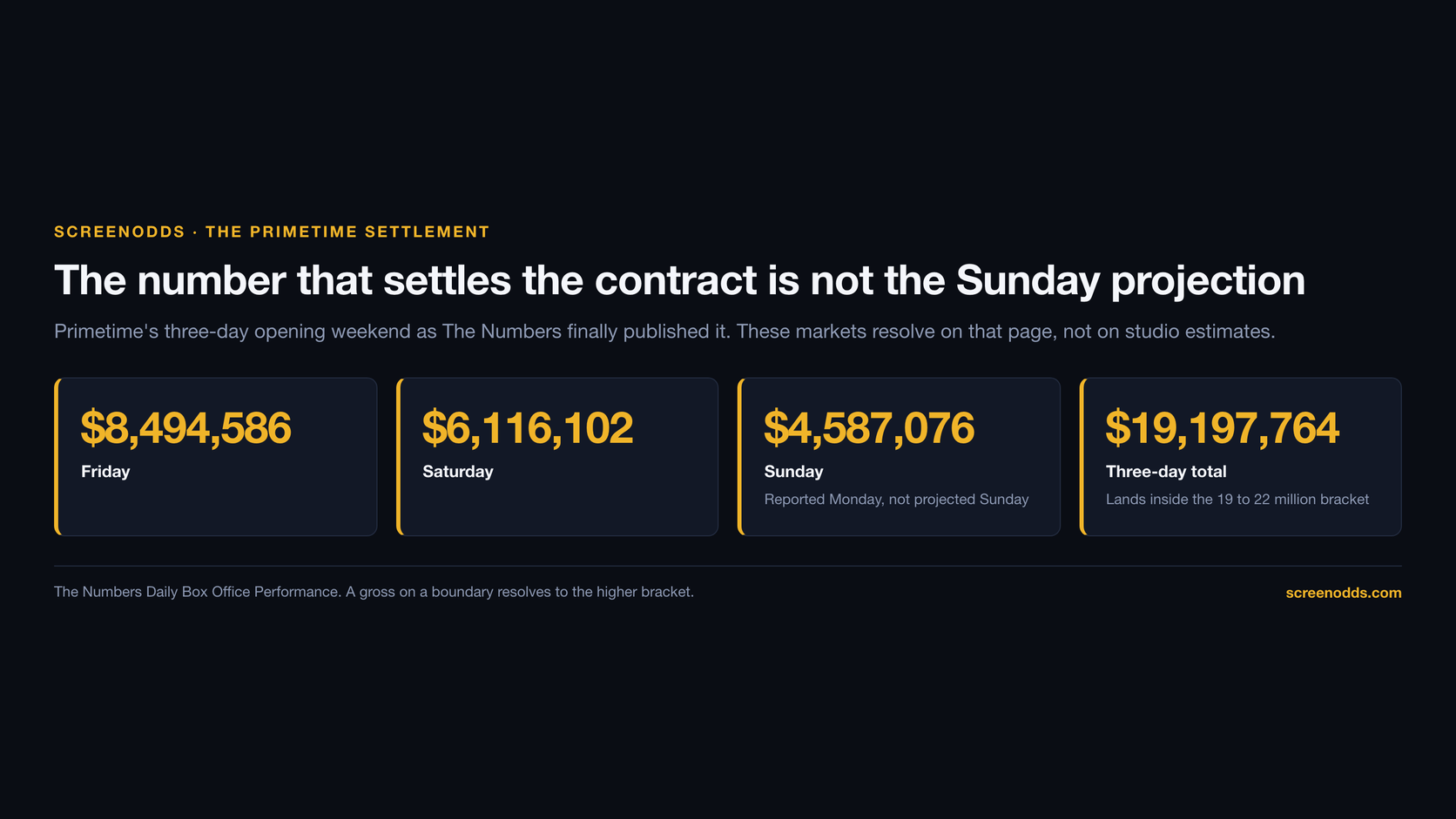
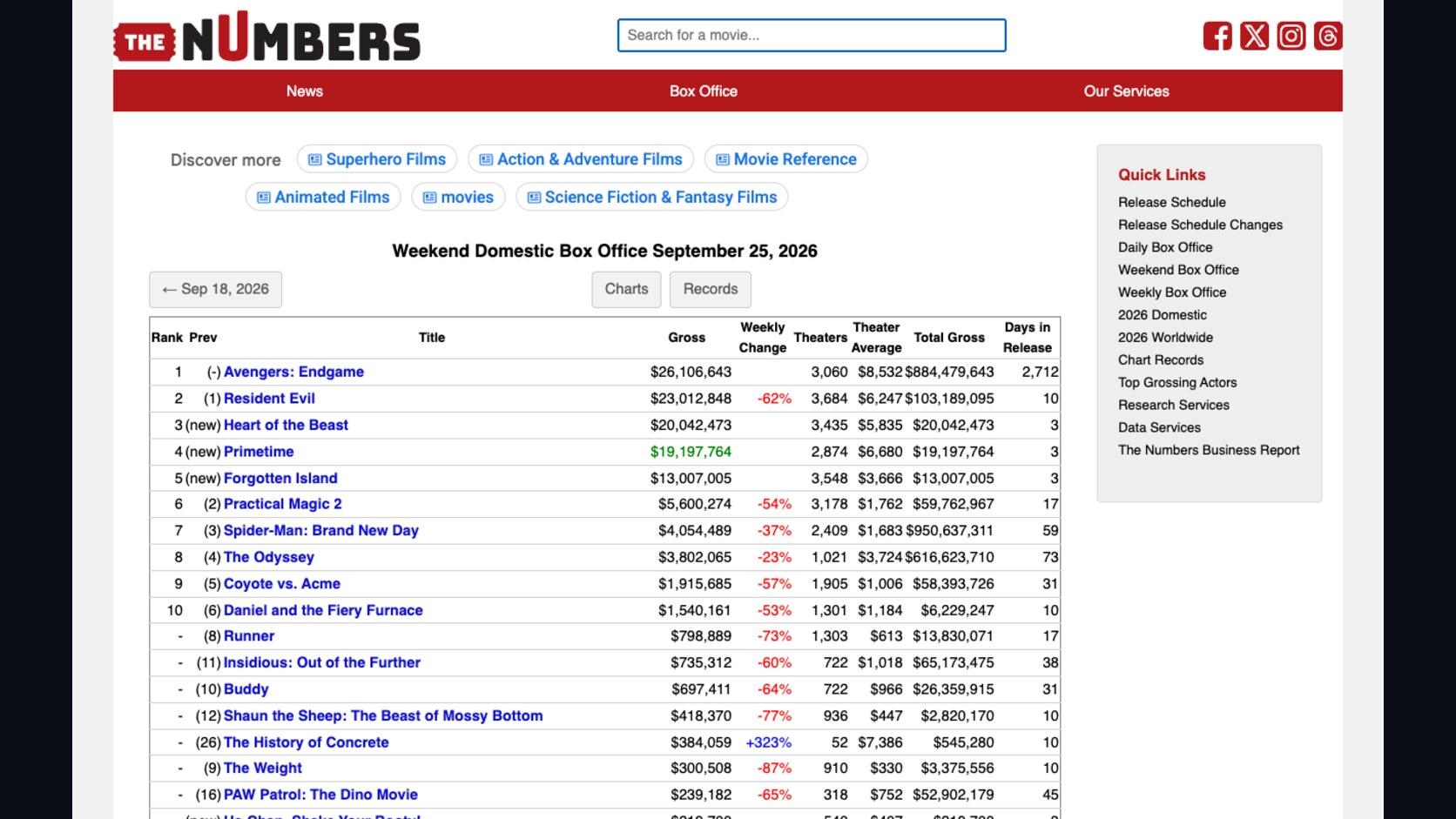
Primetime is a live demonstration. The Numbers currently lists a 19,197,764 dollar opening weekend, built from 8,494,586 on Friday, 6,116,102 on Saturday and 4,587,076 on Sunday. That is 19.2 million, which sits inside the 19 to 22 million bracket, one per cent above the 19 million line. And yet on 29 September the market was still paying 70.65 cents for the 16 to 19 million bracket and only 29 cents for 19 to 22.
The market is not disagreeing with the arithmetic. It is saying the published figure is not yet the final actual, and that a revision of even two per cent takes the film below 19 million and resolves the lower bracket. Whether the traders are right will be settled within days. The point is that a 70-to-29 split hangs entirely on a clause about which version of a number counts.
Digger: the market sits a full bracket below the trade tracking
Digger is Alejandro G. Inarritu's first film with Tom Cruise, a 125 million dollar Warner Bros. release opening wide on 2 October. On paper that is a premium event title. The market does not price it as one.
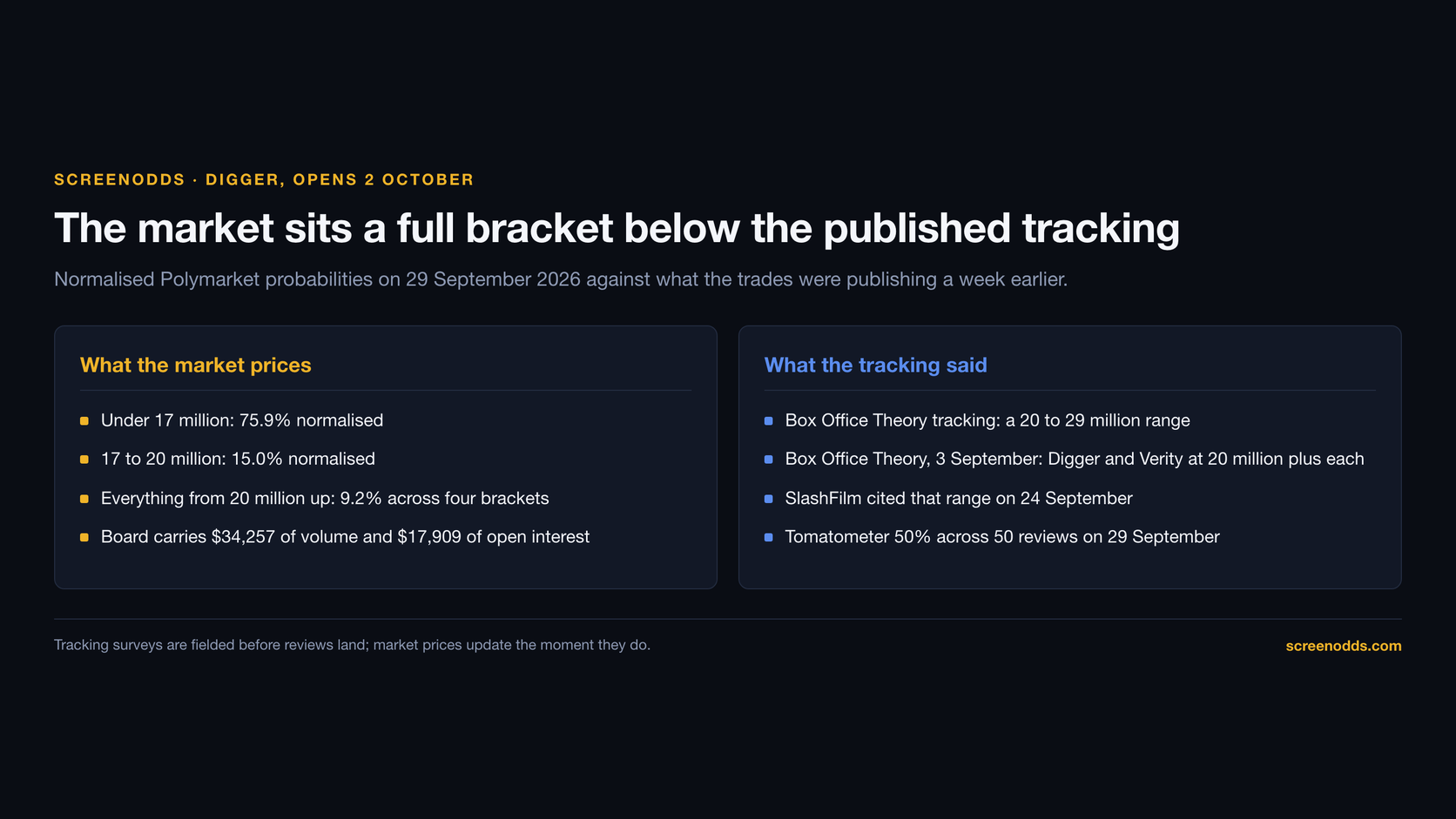
The board puts 78.5 cents on under 17 million, which normalises to about 75.9 per cent once you strip the 3.4 cent margin. The next band up, 17 to 20 million, gets 15.0 per cent normalised. Everything from 20 million upward shares 9.2 per cent between four brackets.
Compare that to what the trades were publishing a week earlier. SlashFilm, writing on 24 September, cited Box Office Theory tracking with Digger in a 20 to 29 million range. Box Office Theory's own 3 September post headlined Digger and Verity at 20 million plus each. The market's central case is at least three million dollars below the bottom of that range, and its modal outcome sits outside it entirely.
That is an unusually wide gap for a film a week from release, and the plausible explanation is reviews. Digger's Tomatometer stood at 50 per cent across 50 reviews on 29 September, and the early critical reaction has been described as mixed and baffled rather than hostile. Tracking surveys are fielded before reviews land; market prices update the moment they do. When you see a market a full bracket under the published tracking, the usual cause is information the tracking was collected too early to contain.
The trade is not automatically to side with the market. It is to notice that the disagreement exists, decide which source is stale, and size accordingly. On a board carrying only 17,909 dollars of open interest, that decision is worth less than it looks, which brings me to the margin.
Verity: the one board where the market is the bullish side
Verity runs the divergence in the opposite direction, which is why it is worth putting next to Digger rather than reading alone. Michael Showalter's adaptation of the Colleen Hoover novel, with Anne Hathaway, Dakota Johnson and Josh Hartnett, opens the same day on a 40 million dollar budget through Amazon MGM.
The board puts 62 cents, or 56.8 per cent normalised, on 28 million plus, and only 13.4 per cent normalised on everything below 22 million. That is a confident bullish distribution.
The independent forecasts do not agree with each other, let alone with the market. Boxoffice Pro's long-range forecast has the film at 30 to 40 million. Quilty, a trend-based forecasting tool that publishes its own scorecard, projects 27.2 million with a 23.1 to 32.1 million range for the 2 October weekend. SlashFilm cited a 20 to 29 million range on 25 September.
Line those up and the market is at the optimistic end of a very wide spread. Quilty's point estimate of 27.2 million falls in the 25 to 28 million bracket, which the market prices at 17.9 per cent normalised. Boxoffice Pro's range mostly agrees with the market. The 20 to 29 million tracking mostly does not.
This is the honest version of what a prediction market gives you that a forecast column cannot: not a better number, but a probability attached to every number, so you can see exactly how much of the distribution each forecaster is arguing about.

Read the overround before you read the odds
Six mutually exclusive brackets should cost one dollar in total. Buy all six and you are guaranteed to win exactly one, so the fair total is 100 cents. Anything above that is the market's margin, and on a thin board it is large enough to eat any edge you think you have found.
Board total, overround and volume, in order: Primetime 99.90 cents, minus 0.1 per cent, 342,786 dollars of volume. Digger 103.40 cents, plus 3.4 per cent, 34,257 dollars. Verity 109.15 cents, plus 9.2 per cent, 7,373 dollars. Other Mommy 126.00 cents, plus 26.0 per cent, 315 dollars.
The relationship is about as clean as market data ever gets. The board with a third of a million dollars traded through it prices to within a tenth of a cent of fair. The board with 315 dollars traded through it carries a 26 per cent margin, which is worse than a bad sportsbook and far worse than a bookmaker's typical two-way price.
Other Mommy is the instructive case because the raw prices look like an opinion and are not one. Four of its six brackets have traded exactly zero dollars. What you are reading is market-maker quotes with wide spreads and no informed flow behind them, and the 34 cents on 24 to 27 million is a placeholder, not a forecast. Universal's James Wan-produced horror title may well be a good bet. You cannot tell from that board.
My working rule is simple. Under about 105 cents the board is tradeable and the quoted percentages are close enough to probabilities to reason with. Between 105 and 115 the numbers are directionally useful but you should normalise before comparing anything. Above 120 the board is a placeholder, and the right move is to wait for volume rather than to take the price at face value.
Kalshi does not list opening weekend grosses at all
One of the more useful things about covering entertainment markets is that the competitive picture is often simpler than the coverage suggests. On awards, Polymarket and Kalshi both list the same races and you can arbitrage the gap. On opening weekend grosses, there is no gap, because there is no second venue.
I pulled Kalshi's full Entertainment series catalogue on 29 September 2026. It runs to 2,502 series, and it is genuinely broad: Spotify stream counts, Rotten Tomatoes scores, Grammy and SAG and Tony categories, Super Bowl halftime headliners, Big Brother Brazil. Filtering that catalogue for box office, opening weekend, gross or domestic returns exactly two series, and both are Golden Globes awards markets: Cinematic and Box Office Achievement Winner, and Best Box Office Achievement.
So Kalshi prices whether a film wins an award named after the box office, and does not price the box office. For anyone comparing venues, opening weekend gross is a Polymarket monopoly as of this date, which is part of why the thin boards stay thin: there is no competing quote to arbitrage them toward fair.
How I would read one of these boards
The order matters more than any single check, because the cheap disqualifying tests come first and most boards fail one of them.
Start with the board total. Add the six bracket prices. Over about 115 cents and you can stop, because whatever you think you know is smaller than the margin you are paying to express it.
Then read the bracket widths, not the percentages. A 34 per cent price on a three-million-wide band is a much stronger claim than a 34 per cent price on a band that runs from 29 million to infinity. The open-ended top bracket in particular is doing different work from the five below it.
Then read the resolution clause on the event page, every time. Which service settles it, whether it takes finals or estimates, and which way a boundary tie rounds. On these boards it is The Numbers, finals only, ties round up, and that combination is currently the single largest driver of the Primetime price.
Then check the tracking date against the review date. Tracking surveys field before reviews. If the market has moved a bracket away from the published tracking, as Digger has, work out which of the two was published later before deciding that either is wrong.
Finally, size to the open interest, not to your conviction. Digger has 17,909 dollars of open interest across six markets. Verity has 13,629. These are not markets where a large position can be opened or exited quietly, and the exit price is the part people forget to model.
The dates that move an opening weekend board
Opening weekend boards have a compressed and predictable calendar, which makes them easier to time than awards markets that grind for months.
Long-range tracking appears three to five weeks out and sets the initial bracket boundaries. The first wave of reviews and festival reactions lands one to two weeks out and is usually the largest single repricing, as Digger shows. National research tracking updates in the final ten days. Thursday preview grosses report on Friday morning and typically move the board more than anything before them. Friday actuals report Saturday, and the Sunday studio estimate lands Sunday morning.
The last step is the one that catches people. The Sunday estimate produces every headline, but these contracts wait for the Monday or Tuesday final. On a film sitting within a couple of per cent of a bracket boundary, the whole position resolves on that revision, and a board can stay split 70-30 for two days after the public already believes it knows the answer.
Sources
"Digger" Opening Weekend Box Office event
Polymarket Gamma API | Accessed 2026-09-29
"Verity" Opening Weekend Box Office event
Polymarket Gamma API | Accessed 2026-09-29
"Primetime" Opening Weekend Box Office event
Polymarket Gamma API | Accessed 2026-09-29
"Other Mommy" Opening Weekend Box Office event
Polymarket Gamma API | Accessed 2026-09-29
Kalshi Entertainment series catalogue
Kalshi | Accessed 2026-09-29
Primetime (2026) box office data
The Numbers | Accessed 2026-09-29
Weekend box office chart, 25 to 27 September 2026
The Numbers | Accessed 2026-09-29
Digger is shaping up to be a box office disaster for Tom Cruise
SlashFilm | Accessed 2026-09-29
Anne Hathaway's Verity will be the sleeper box office hit of the fall movie season
SlashFilm | Accessed 2026-09-29
Weekend box office predictions
Quilty | Accessed 2026-09-29
Digger (2026 film)
Wikipedia | Accessed 2026-09-29
Verity (film)
Wikipedia | Accessed 2026-09-29
Digger (2026) Tomatometer
Rotten Tomatoes | Accessed 2026-09-29
FAQ
What are opening weekend box office odds?
They are prediction-market prices on how much a film will gross domestically over its first three-day weekend. On Polymarket each film gets six mutually exclusive dollar brackets, and the price of each bracket, between zero and one dollar, is the market's probability that the final gross lands in that band. It is a distribution, not a win bet.
Where can you trade opening weekend box office odds?
Polymarket is currently the only venue listing them. A scan of all 2,502 series in Kalshi's Entertainment catalogue on 29 September 2026 returned no opening weekend gross market, only two Golden Globes box office award series. US sportsbooks do not price domestic grosses at all.
How does Polymarket settle an opening weekend box office market?
The rules text on each event points to the Daily Box Office Performance figures on the film's page at The Numbers, and the market resolves once the three-day opening weekend values are final rather than studio estimates. If the gross falls exactly between two brackets, it resolves to the higher bracket.
Do these markets use studio estimates or final box office numbers?
Final numbers only, which is the single most misread rule on these boards. Studio Sunday projections drive every weekend headline but do not settle the contract. On 29 September 2026 the Primetime board still priced the 16 to 19 million bracket at 70.65 cents even though the publicly listed weekend figure was 19.2 million, because traders expected the final actual to revise below the 19 million line.
Why do the six bracket prices add up to more than 100 percent?
That excess is the overround, the market's built-in margin, and it is a direct read on liquidity. On 29 September 2026 the Primetime board summed to 99.90 cents on 342,786 dollars of volume while the Other Mommy board summed to 126.00 cents on 315 dollars. Normalise every board before comparing brackets across films.
Are prediction-market odds better than box office tracking?
They are not automatically better, but they update faster and they attach a probability to every outcome rather than publishing one point estimate. The useful case is the disagreement: on 29 September 2026 the Digger board put 78.5 cents on under 17 million while the published trade tracking sat in a 20 to 29 million range, a gap that mostly reflects reviews landing after the tracking was fielded.
What happens if a film grosses exactly on a bracket boundary?
The event rules say a figure falling exactly between two brackets resolves to the higher range bracket. Because brackets are set at round millions and final grosses are reported to the dollar, an exact tie is rare, but a gross within one or two per cent of a boundary is common and is where most of the resolution risk on these boards actually sits.
How liquid are opening weekend box office markets?
Thin, and very unevenly. On 29 September 2026 open interest was 49,054 dollars on Primetime, 17,909 on Digger, 13,629 on Verity and 1,474 on Other Mommy, spread across six brackets each. Size positions against open interest rather than conviction, because the exit price on a board this thin is the part that is easy to ignore and expensive to discover.